• Fri frakt över 249 kr
  • •
  • Snabba leveranser
  • •
  • Billiga böcker
Kundservice

Du är på sajten för privatpersoner.

Företag, bibliotek eller offentlig verksamhet?

Du handlar på classic.bokus.com, där alla dina funktioner finns intakta.
Till classic.bokus.com
Bokus logotyp. Gå till startsidan.
  • Erbjudanden
  • Nyheter
  • Student
  • Topplistor
  • Barn & ungdom
  • Bokus Play
  • E-böcker
  • Pocketböcker
  • Spel & pussel

10% rabatt på allt med kod NYSTART10 →

Sidfot

Mina sidor

    Hjälp

    • Kundservice
    • Vanliga frågor och svar
    • Frakt och leverans
    • Retur vid ångerrätt
    • Reklamera vara
    • Betalning
    • Köpvillkor
    • Allmänna villkor
    • Information om webbplatsens tillgänglighet

    Om Bokus

    • Om oss
    • Pressrum
    • För studenter
    • För företag
    • För bibliotek och offentlig verksamhet
    • För leverantörer
    • Hållbarhet

    Populärt

    • Aktuella erbjudanden
    • Presentkort
    • Studentlitteratur
    • Nya böcker
    • Topplistor
    • Signerade böcker
    • Engelska böcker

    Inspiration

    • Boktips
    • BookTok
    • Populära bokserier
    • Barnbokskaraktärer
    • Populära författare
    Logotyp för Bokus
    Följ oss på Facebook (extern länk)Följ oss på Instagram (extern länk)Följ oss på YouTube (extern länk)Följ oss på TikTok (extern länk)
    bokus @ CookiesAnpassa cookiesIntegritetspolicyKöpvillkor
    Till Citymail hemsida (extern länk)Till Budbee hemsida (extern länk)Till Postnord hemsida (extern länk)Till Schenker hemsida (extern länk)Till Early Bird hemsida (extern länk)Till Walleys hemsida (extern länk)
    1. Psykologi och pedagogik
    2. Psykologi
    3. Socialpsykologi och gruppsykologi

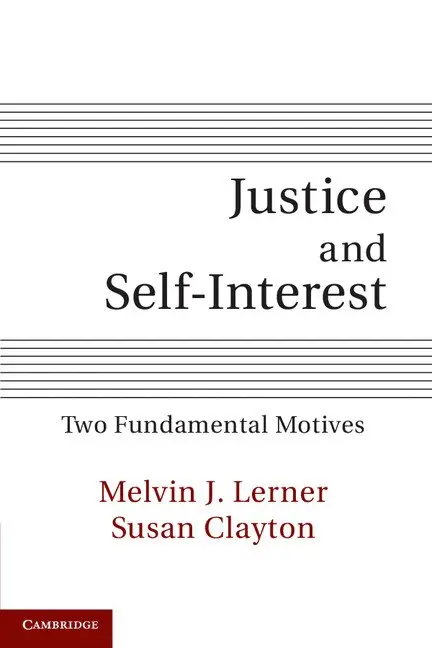
    Justice and Self-Interest

    Two Fundamental Motives

    AvMelvin J. Lerner,Susan Clayton

    Häftad, Engelska, 2012

    567 kr

    Beställningsvara. Skickas inom 10-15 vardagar. Fri frakt över 249 kr.

    Fler format och utgåvor

    Inbunden

    867 kr

    Beskrivning

    This volume argues that the commitment to justice is a fundamental motive and that, although it is typically portrayed as serving self-interest, it sometimes takes priority over self-interest. To make this case, the authors discuss the way justice emerges as a personal contract in children's development; review a wide range of research studying the influences of the justice motive on evaluative, emotional and behavioral responses; and detail common experiences that illustrate the impact of the justice motive. Through an extensive critique of the research on which some alternative models of justice are based, the authors present a model that describes the ways in which motives of justice and self-interest are integrated in people's lives. They close with a discussion of some positive and negative consequences of the commitment to justice.

    Produktinformation

    • Utgivningsdatum:2012-12-10
    • Mått:152 x 228 x 16 mm
    • Vikt:420 g
    • Format:Häftad
    • Språk:Engelska
    • Antal sidor:280
    • Förlag:Cambridge University Press
    • ISBN:9781107640283

    Utforska kategorier

    • Socialpsykologi och gruppsykologi inom Psykologi och pedagogik

    Mer om författaren

    Melvin J. Lerner is Distinguished Professor Emeritus of the Department of Psychology of the University of Waterloo, where he founded the Division of Social Psychology. The majority of his research efforts focus on the theme of justice in people's lives. Much of that research has been summarized in several volumes, beginning with Belief in a Just World: A Fundamental Delusion (1980), which was awarded the Quinquenual Prize from the Society for the Scientific Study of Religion, and continuing in several co-edited volumes: with S. Lerner, The Justice Motive in Social Behavior: Adapting to Times of Scarcity and Change (1981); with Gerold Mikula, Entitlement and the Affectional Bond (1994); with Leo Montada, Responses to Victimizations and Belief in a Just World (1998); and Current Societal Concerns about Justice (1996). In addition, Lerner is the founding editor of the journal Social Justice Research and was the co-recipient of a Max-Planck-Forschungspreis and a Lifetime Achievement Award from the International Society for Justice Research. Susan Clayton is Whitmore-Williams Professor of Psychology and Chair of Environmental Studies at the College of Wooster. She has published extensively on topics related to justice as well as the natural environment. With Faye Crosby, she wrote Justice, Gender, and Affirmative Action (1992), which received an award from the Gustavus Myers Center for the Study of Human Rights in the United States, and with Susan Opotow, she co-edited a volume of the Journal of Social Issues on 'Green Justice' as well as Identity and the Natural Environment (2003). She is also the co-author (with Gene Myers) of Conservation Psychology: Understanding and Promoting Human Care for Nature (2009). Clayton is a Fellow of the American Psychological Association and has served as president of the Society for Population and Environmental Psychology.

    Recensioner i media

    “Given the broad acceptance of capitalist philosophy in most of the developed and developing world, one could expect that self-interest motives would be used to explain all sorts of human interactions with others. Further, it could be expected that such explanations would be readily accepted. Are there no situations where humans act to provide or restore justice to others without benefit to themselves? Lerner and Clayton’s work emphatically says ‘yes, there certainly are many such situations.’ The authors apply careful scientific analyses to studies purporting to support the self-interest explanation and dismantle them with surgical precision. They show that people's actions can stem from justice-seeking motives and not solely from strict self-interest.” – Selwyn Becker, Professor Emeritus of Psychology, Booth School of Business

    Innehållsförteckning

    • 1. Contesting the primacy of self-interest; 2. Why does justice matter? The development of a personal contract; 3. Commitment to justice: the initial primary automatic reaction; 4. Explaining the myth of self-interest; 5. Defining the justice motive: re-integrating procedural and distributive justice; 6. How people assess deserving and justice: the role of social norms; 7. Integrating justice and self-interest: a tentative model; 8. Maintaining the commitment to justice in a complex world; 9. Bringing it closer to home: justice in another 'American tragedy'; 10. Emotional aftereffects: some negative consequences and thoughts on how to avoid them.