• Fri frakt över 249 kr
  • •
  • Snabba leveranser
  • •
  • Billiga böcker
Kundservice

Du är på sajten för privatpersoner.

Företag, bibliotek eller offentlig verksamhet?

Du handlar på classic.bokus.com, där alla dina funktioner finns intakta.
Till classic.bokus.com
Bokus logotyp. Gå till startsidan.
  • Erbjudanden
  • Nyheter
  • Student
  • Topplistor
  • Barn & ungdom
  • Bokus Play
  • E-böcker
  • Pocketböcker
  • Spel & pussel

10% rabatt på allt med kod NYSTART10 →

Sidfot

Mina sidor

    Hjälp

    • Kundservice
    • Vanliga frågor och svar
    • Frakt och leverans
    • Retur vid ångerrätt
    • Reklamera vara
    • Betalning
    • Köpvillkor
    • Allmänna villkor
    • Information om webbplatsens tillgänglighet

    Om Bokus

    • Om oss
    • Pressrum
    • För studenter
    • För företag
    • För bibliotek och offentlig verksamhet
    • För leverantörer
    • Hållbarhet

    Populärt

    • Aktuella erbjudanden
    • Presentkort
    • Studentlitteratur
    • Nya böcker
    • Topplistor
    • Signerade böcker
    • Engelska böcker

    Inspiration

    • Boktips
    • BookTok
    • Populära bokserier
    • Barnbokskaraktärer
    • Populära författare
    Logotyp för Bokus
    Följ oss på Facebook (extern länk)Följ oss på Instagram (extern länk)Följ oss på YouTube (extern länk)Följ oss på TikTok (extern länk)
    bokus @ CookiesAnpassa cookiesIntegritetspolicyKöpvillkor
    Till Citymail hemsida (extern länk)Till Budbee hemsida (extern länk)Till Postnord hemsida (extern länk)Till Schenker hemsida (extern länk)Till Early Bird hemsida (extern länk)Till Walleys hemsida (extern länk)
    1. Naturvetenskap och teknik
    2. Geovetenskap
    3. Geovetenskap
    4. Meteorologi och klimatologi

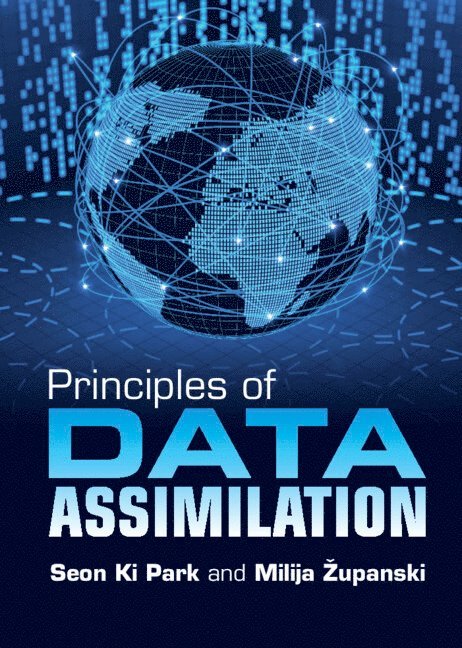
    Principles of Data Assimilation

    AvSeon Ki Park,Milija Zupanski

    Inbunden, Engelska, 2022

    745 kr

    Beställningsvara. Skickas inom 10-15 vardagar. Fri frakt över 249 kr.

    Beskrivning

    Data assimilation is theoretically founded on probability, statistics, control theory, information theory, linear algebra, and functional analysis. At the same time, data assimilation is a very practical subject, given its goal of estimating the posterior probability density function in realistic high-dimensional applications. This puts data assimilation at the intersection between the contrasting requirements of theory and practice. Based on over twenty years of teaching courses in data assimilation, Principles of Data Assimilation introduces a unique perspective that is firmly based on mathematical theories, but also acknowledges practical limitations of the theory. With the inclusion of numerous examples and practical case studies throughout, this new perspective will help students and researchers to competently interpret data assimilation results and to identify critical challenges of developing data assimilation algorithms. The benefit of information theory also introduces new pathways for further development, understanding, and improvement of data assimilation methods.

    Produktinformation

    • Utgivningsdatum:2022-09-29
    • Mått:178 x 251 x 24 mm
    • Vikt:885 g
    • Format:Inbunden
    • Språk:Engelska
    • Antal sidor:414
    • Förlag:Cambridge University Press
    • ISBN:9781108831765

    Utforska kategorier

    • Meteorologi och klimatologi inom Naturvetenskap och teknik

    Mer om författaren

    Seon Ki Park is Professor of Meteorology at Ewha Womans University, Seoul, Korea. His research focuses on storm-scale to meso-scale analysis, parameter estimation, and data assimilation to improve numerical weather and climate prediction. He co-edited a series of four volumes titled Data Assimilation for Atmospheric, Oceanic and Hydrologic Applications (2009, 2013, 2017, 2021). Milija Zupanski is Senior Research Scientist at Colorado State University, Fort Collins. He is a principal developer of two four-dimensional variational data assimilation systems and the Maximum Likelihood Ensemble Filter. His research focuses on data assimilation development and applications, including the atmosphere, land surface, aerosols, and combustion.

    Innehållsförteckning

    • Part I. General Background: 1. Data assimilation: general background; 2. Probability and Bayesian approach; 3. Filters and smoothers; Part I.: Practical Tools: 4. Tangent linear and adjoint model; 5. Automatic differentiation; 6. Numerical minimization process; Part III. Methods and Issues: 7. Variational data assimilation; 8. Ensemble and hybrid data assimilation; 9. Coupled data assimilation; 10. Dynamics and data assimilation; Part IV. Applications: 11. Sensitivity analysis and adaptive observation; 12. Satellite data assimilation; Index.