• Fri frakt över 249 kr
  • •
  • Snabba leveranser
  • •
  • Billiga böcker
Kundservice

Du är på sajten för privatpersoner.

Företag, bibliotek eller offentlig verksamhet?

Du handlar på classic.bokus.com, där alla dina funktioner finns intakta.
Till classic.bokus.com
Bokus logotyp. Gå till startsidan.
  • Erbjudanden
  • Nyheter
  • Student
  • Topplistor
  • Barn & ungdom
  • Bokus Play
  • E-böcker
  • Pocketböcker
  • Spel & pussel

10% rabatt på allt med kod: NYSTART10 →

Sidfot

Mina sidor

    Hjälp

    • Kundservice
    • Vanliga frågor och svar
    • Frakt och leverans
    • Retur vid ångerrätt
    • Reklamera vara
    • Betalning
    • Köpvillkor
    • Allmänna villkor
    • Information om webbplatsens tillgänglighet

    Om Bokus

    • Om oss
    • Pressrum
    • För studenter
    • För företag
    • För bibliotek och offentlig verksamhet
    • För leverantörer
    • Hållbarhet

    Populärt

    • Aktuella erbjudanden
    • Presentkort
    • Studentlitteratur
    • Nya böcker
    • Topplistor
    • Signerade böcker
    • Engelska böcker

    Inspiration

    • Boktips
    • BookTok
    • Populära bokserier
    • Barnbokskaraktärer
    • Populära författare
    Logotyp för Bokus
    Följ oss på Facebook (extern länk)Följ oss på Instagram (extern länk)Följ oss på YouTube (extern länk)Följ oss på TikTok (extern länk)
    bokus @ CookiesAnpassa cookiesIntegritetspolicyKöpvillkor
    Till Citymail hemsida (extern länk)Till Budbee hemsida (extern länk)Till Postnord hemsida (extern länk)Till Schenker hemsida (extern länk)Till Early Bird hemsida (extern länk)Till Walleys hemsida (extern länk)
    1. Naturvetenskap och teknik
    2. Teknik och industri
    3. Elektronik och kommunikationer

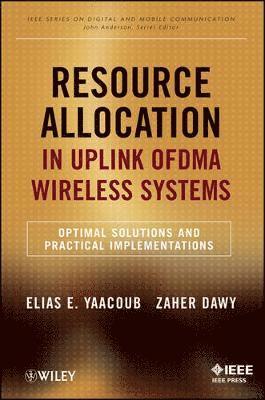
    Resource Allocation in Uplink OFDMA Wireless Systems

    Optimal Solutions and Practical Implementations

    AvElias Yaacoub,Zaher Dawy

    Inbunden, Engelska, 2012

    Del 24 i serien IEEE Series on Digital & Mobile Communication

    1 608 kr

    Beställningsvara. Skickas inom 3-6 vardagar. Fri frakt över 249 kr.

    Beskrivning

    Tackling problems from the least complicated to the most, Resource Allocation in Uplink OFDMA Wireless Systems provides readers with a comprehensive look at resource allocation and scheduling techniques (for both single and multi-cell deployments) in uplink OFDMA wireless networks—relying on convex optimization and game theory to thoroughly analyze performance.Inside, readers will find topics and discussions on: Formulating and solving the uplink ergodic sum-rate maximization problem Proposing suboptimal algorithms that achieve a close performance to the optimal case at a considerably reduced complexity and lead to fairness when the appropriate utility is used Investigating the performance and extensions of the proposed suboptimal algorithms in a distributed base station scenario Studying distributed resource allocation where users take part in the scheduling process, and considering scenarios with and without user collaboration Formulating the sum-rate maximization problem in a multi-cell scenario, and proposing efficient centralized and distributed algorithms for intercell interference mitigation Discussing the applicability of the proposed techniques to state-of-the-art wireless technologies, LTE and WiMAX, and proposing relevant extensions Along with schematics and figures featuring simulation results, Resource Allocation in Uplink OFDMA Wireless Systems is a valuable book for?wireless communications and cellular systems professionals and students.

    Produktinformation

    • Utgivningsdatum:2012-03-27
    • Mått:160 x 236 x 23 mm
    • Vikt:544 g
    • Format:Inbunden
    • Språk:Engelska
    • Serie:IEEE Series on Digital & Mobile Communication
    • Antal sidor:296
    • Förlag:John Wiley & Sons Inc
    • ISBN:9781118074503

    Utforska kategorier

    • Elektronik och kommunikationer inom Naturvetenskap och teknik

    Mer om författaren

    ELIAS E. YAACOUB, PhD, is currently a research scientist at the Qatar University Wireless Innovations Center. His research interests include scheduling and interference mitigation in multi-cell OFDMA and LTE networks. He has authored numerous journal and conference papers on these topics. Dr. Yaacoub is a member of the IEEE and a member of the Lebanese Order of Engineers.ZAHER DAWY, PhD, is an associate professor at the American University of Beirut (AUB). His research interests include cooperative and distributed communications, resource allocation, cellular technologies, and computational biology. He received the IEEE Communications Society Outstanding Young Researcher Award for Europe, Middle East, and Africa Region in 2011 and the AUB 2008 Teaching Excellence Award. Dr. Dawy is a senior member of the IEEE and Chair of the IEEE Communications Society, Lebanon Chapter.

    Innehållsförteckning

    • PREFACE xiii ACKNOWLEDGMENTS xvACRONYMS xviiCHAPTER 1 INTRODUCTION 11.1 Evolution of Wireless Communication Systems 11.2 Orthogonal Frequency Division Multiple Access 21.3 Organization of this Book 5CHAPTER 2 BACKGROUND ON DOWNLINK RESOURCE ALLOCATION IN OFDMA WIRELESS NETWORKS 92.1 Centralized Single Cell Scheduling 92.2 Distributed Scheduling 132.3 Scheduling in Multicell Scenarios 142.3.1 Multicell Scheduling in LTE 162.4 Summary 18CHAPTER 3 ERGODIC SUM-RATE MAXIMIZATION WITH CONTINUOUS RATES 193.1 Background 193.2 Problem Formulation 213.3 Problem Solution 233.4 Achievable Rate Region 283.5 Results and Discussion 353.6 Summary 41CHAPTER 4 ERGODIC SUM-RATE MAXIMIZATION WITH DISCRETE RATES 434.1 Background 434.2 Problem Formulation 444.3 Problem Solution 464.4 Results and Discussion 524.5 Summary 57CHAPTER 5 GENERALIZATION TO UTILITY MAXIMIZATION 595.1 Background 595.2 Ergodic Utility Maximization with Continuous Rates 605.3 Ergodic Utility Maximization with Discrete Rates 645.4 Summary 68CHAPTER 6 SUBOPTIMAL IMPLEMENTATION OF ERGODIC SUM-RATE MAXIMIZATION 696.1 Background 696.2 Suboptimal Approximation of the Continuous Rates Solution 716.3 Suboptimal Approximation of the Discrete Rates Solution 736.4 Complexity Analysis of the Suboptimal Algorithms 766.5 Results and Discussion 786.6 Summary 88CHAPTER 7 SUBOPTIMAL IMPLEMENTATION WITH PROPORTIONAL FAIRNESS 897.1 Background 897.2 Proportional Fair Scheduling 917.3 Low Complexity Utility Maximization Algorithms 947.4 Proportional Fair Utilities 1007.5 Results and Discussion 1017.6 Summary 112CHAPTER 8 SCHEDULING WITH DISTRIBUTED BASE STATIONS 1138.1 Background 1138.2 System Model 1158.3 Scheduling with Distributed Base Stations 1188.4 Results and Discussion 1208.5 Distributed Base Stations Versus Relays 1288.6 Distributed Base Stations Versus Femtocells 1318.7 Summary 133CHAPTER 9 DISTRIBUTED SCHEDULING WITH USER COOPERATION 1359.1 Background 1359.2 Cooperative Distributed Scheduling Scheme 1369.3 Distributed Scheduling Algorithm 1409.4 Results and Discussion 1429.5 Summary 149CHAPTER 10 DISTRIBUTED SCHEDULING WITHOUT USER COOPERATION 15110.1 Background 15110.2 Noncooperative Distributed Scheduling Scheme 15310.3 Comparison to Existing Schemes 15510.4 Analysis of Measurement Inaccuracies 15610.5 Results and Discussion 16010.6 Optimization of Transmission Probabilities 16510.7 Practical Considerations 16910.8 Summary 171CHAPTER 11 CENTRALIZED MULTICELL SCHEDULING WITH INTERFERENCE MITIGATION 17311.1 Background 17311.2 Problem Formulation 17511.3 Iterative Pricing-Based Power Control Solution 17811.4 Pricing Game with Centralized Control 18411.5 Suboptimal Scheduling Scheme Using Pricing-Based Power Control 18611.6 Suboptimal Scheduling Scheme Using Probabilistic Transmission 19011.7 Results and Discussion 19111.8 Summary 201CHAPTER 12 DISTRIBUTED MULTICELL SCHEDULING WITH INTERFERENCE MITIGATION 20312.1 Background 20312.2 System Model 20412.3 Intracell Cooperation: Distributed Scheduling 20512.4 Intercell Interference Mitigation/Avoidance 20612.5 Results and Discussion 20912.6 Practical Aspects 21712.6.3 Application in a CR Network 21912.6.4 Application in a Network with Femtocell Deployment 21912.6.5 Distributed Multicell Scheduling without User Cooperation 22012.7 Summary 221CHAPTER 13 SCHEDULING IN STATE-OF-THE-ART OFDMA-BASED WIRELESS SYSTEMS 22313.1 WiMAX Scheduling Overview 22313.2 LTE Scheduling Overview 22813.3 SCFDMA Versus OFDMA Scheduling 23513.4 Comparison to the LTE Power Control Scheme 24013.5 Summary 245CHAPTER 14 FUTURE RESEARCH DIRECTIONS 24714.1 Resource Allocation with Multiple Service Classes 24714.2 Network MIMO 24714.3 Coalitional Game Theory 24814.4 Resource Allocation with Femtocells 24914.5 Green Networks and Self-Organizing Networks 24914.6 Joint Uplink/Downlink Resource Allocation 25014.7 Joint Resource Allocation in Heterogeneous Networks 25114.8 Resource Allocation in Cognitive Radio Networks 252BIBLIOGRAPHY 255INDEX 269