• Fri frakt över 249 kr
  • •
  • Snabba leveranser
  • •
  • Billiga böcker
Kundservice

Du är på sajten för privatpersoner.

Företag, bibliotek eller offentlig verksamhet?

Du handlar på classic.bokus.com, där alla dina funktioner finns intakta.
Till classic.bokus.com
Bokus logotyp. Gå till startsidan.
  • Erbjudanden
  • Nyheter
  • Student
  • Topplistor
  • Barn & ungdom
  • Bokus Play
  • E-böcker
  • Pocketböcker
  • Spel & pussel

10% rabatt på allt med kod NYSTART10 →

Sidfot

Mina sidor

    Hjälp

    • Kundservice
    • Vanliga frågor och svar
    • Frakt och leverans
    • Retur vid ångerrätt
    • Reklamera vara
    • Betalning
    • Köpvillkor
    • Allmänna villkor
    • Information om webbplatsens tillgänglighet

    Om Bokus

    • Om oss
    • Pressrum
    • För studenter
    • För företag
    • För bibliotek och offentlig verksamhet
    • För leverantörer
    • Hållbarhet

    Populärt

    • Aktuella erbjudanden
    • Presentkort
    • Studentlitteratur
    • Nya böcker
    • Topplistor
    • Signerade böcker
    • Engelska böcker

    Inspiration

    • Boktips
    • BookTok
    • Populära bokserier
    • Barnbokskaraktärer
    • Populära författare
    Logotyp för Bokus
    Följ oss på Facebook (extern länk)Följ oss på Instagram (extern länk)Följ oss på YouTube (extern länk)Följ oss på TikTok (extern länk)
    bokus @ CookiesAnpassa cookiesIntegritetspolicyKöpvillkor
    Till Citymail hemsida (extern länk)Till Budbee hemsida (extern länk)Till Postnord hemsida (extern länk)Till Schenker hemsida (extern länk)Till Early Bird hemsida (extern länk)Till Walleys hemsida (extern länk)
    1. Språk och ordböcker
    2. Språkundervisning och språkinlärning

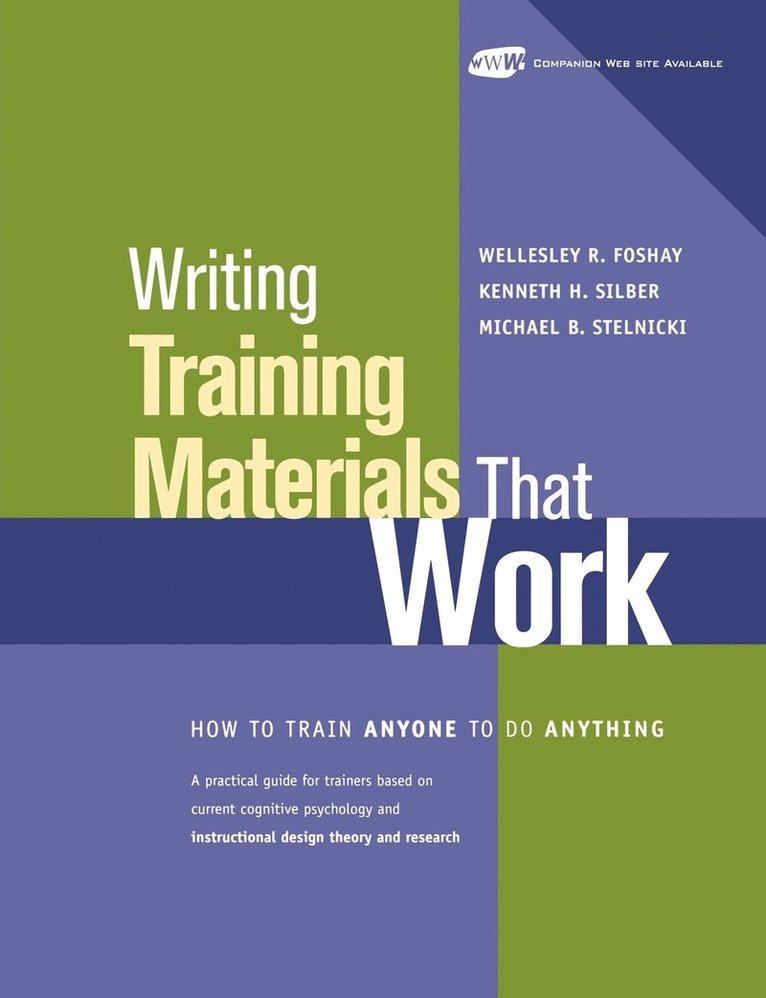
    Writing Training Materials That Work

    How to Train Anyone to Do Anything

    AvWellesley R. Foshay,Kenneth H. Silber

    Häftad, Engelska, 2012

    839 kr

    Beställningsvara. Skickas inom 5-8 vardagar. Fri frakt över 249 kr.

    Beskrivning

    "Writing Training Materials that Work is a solid and practical resource to move our field to a more professional level of practice in which instructional decisions are based on research and valid models of how people learn"--Ruth Clark, president, Clark Training and Consulting, past president, ISPI"I can see how this book will be immediately useful to my students. In fact, I can see how it will be immediately useful to me. Thanks for putting it all together between two covers."--Allison Rossett, professor, San Diego State UniversityThe explosion of e-learning has attracted huge numbers of practitioners to the field of instructional design (ID), many with little or no actual ID training. And most current texts fail to cover the substantial recent developments in the field. Writing Training Materials that Work is different. In it, the authors identify, synthesize, and summarize the most current best practices in ID. They offer new ways of teaching declarative knowledge (facts, concepts, and principles) and well- to ill- structured procedural knowledge (problem solving). Their recommendations are based on those principles in the cognitive learning and instruction literature that are internally consistent, prescriptive, and have been empirically demonstrated to make a cost-effective difference. The authors' approach is easy to implement and consistently gets results because it focuses on teaching deep understanding and problem-solving, allowing learners to generalize and transfer learning to new situations without re-training. Whether you re an experienced instructional design practitioner who wants to expand your skills or a graduate student in an advanced instructional design course, Writing Training Materials T\that Work will prove to be a readable, usable, and indispensable guide!

    Produktinformation

    • Utgivningsdatum:2012-03-09
    • Mått:189 x 246 x 15 mm
    • Vikt:698 g
    • Format:Häftad
    • Språk:Engelska
    • Antal sidor:272
    • Förlag:John Wiley & Sons Inc
    • ISBN:9781118351680

    Utforska kategorier

    • Språkundervisning och språkinlärning inom Språk och ordböcker

    Mer om författaren

    Dr. Wellesley (Rob) Foshay is vice president for instructional design and quality control for PLATO Learning, Inc. He formerly served on the Board of Directors of the International Society for Performance Improvement. Dr. Ken Silber is associate professor of instructional design at Northern Illinois University in DeKalb, Illinois. He is a performance consulting/ID/change management professional with 30 years of experience in consulting in corporate, nonprofit, and academic settings both in the U.S. and internationally.Dr. Michael B. Stelnicki is Professor and Chairman of the graduate Human performance and training program at Governors State University in University Park, Illinois. He is a thirty-five year veteran presenter in the field and has worked as a journalist, psychology instructor, instructional television producer/director and consultant to business and industry.

    Innehållsförteckning

    • List of Figures.Contents of the CD-ROM.Acknowledgments.Preface.Introduction.PART I: INTRODUCTION TO THE COGNITIVE APPROACH.Chapter 1: The Cognitive Approach to Training Development.The Cognitive Approach to Instructional Design.The Cognitive Point of View on How Learning Occurs.Declarative and Procedural Knowledge and Their Subtypes.Summary.Chapter 2: A Cognitive Training Model.A New Cognitive Model.Learner Tasks and Lesson Elements.How to Read the Cognitive Training Model.Differentiating Our Model from Gagne's.How to Use the Model.Summary.PART II: HOW TO DESIGN LESSONS USING THE COGNITIVE APPROACH.Chapter 3: How to Begin Any Lesson: The First Three Lesson Elements.About Using the Lesson Elements Attention, WIIFM, and YCDI to Begin a Lesson.Using the Lesson Elements Attention, WIIFM, and YCDI to Begin a Lesson.Summary.Chapter 4: How to Organize and Present Information: Message Design Principles.About Using the Lesson Elements to Help Learners Organize the Information.Summary.Chapter 5: Teaching Facts.About Facts.General Strategies for Teaching Facts.Using the Lesson Elements to Teach Facts.Summary.Chapter 6: Teaching Concepts.About Concepts.General Strategies for Teaching Concepts.Using the Lesson Elements to Teach Concepts.Summary.Chapter 7: Teaching Principles and Mental Models.About Principles and Mental Models.General Strategies for Teaching Principles and Mental Models.Using the Lesson Elements to Teach Principles and Mental Models.Summary.Chapter 8: Teaching Well-Structured Problem-Solving.About Well-Structured Problem-Solving.General Strategies for Teaching Well-Structured Problem-Solving.Using the Lesson Elements to Teach Well-Structured Problem-Solving.Summary.Chapter 9: Teaching Ill-Structured Problem-Solving.About Ill-Structured Problem-Solving.Problems Learning Ill-Structured Problem-Solving.General Strategies for Teaching Ill-Structured Problem-Solving.Using the Lesson Elements to Teach Ill-Structured Problem-Solving.Summary.Chapter 10: Teaching Troubleshooting.About Troubleshooting.General Strategies for Teaching Troubleshooting.Using the Lesson Elements to Teach Troubleshooting.Summary.Chapter 11: Teaching Complete Lessons.Combining Declarative and Procedural Teaching: Two Approaches.Two Key ID Issues.Template.An Example of the Recommended Approach to Combined Lessons.Summary.PART III: USING THE COGNITIVE APPROACH: THE RESEARCH ISSUES.Chapter 12: Issues Underlying the Cognitive Approach to Instructional Design.Purpose and Approach.How the Behavioral and Cognitive Approaches Differ.Summary.Chapter 13: Issues Underlying Teaching Declarative Knowledge.How Declarative and Procedural Knowledge Differ.Facts.Concepts.Principles and Mental Models.Common Errors in Teaching Declarative Knowledge.Summary.Chapter 14: Issues Underlying Teaching Procedural Knowledge.About Procedural Knowledge.Terminology.How Learners Solve Problems.Problem-Solving Strategies.Teaching Procedural Knowledge to Solve Problems.Issues in Teaching Ill-Structured Problem Solving.Issues in Teaching Troubleshooting.Summary.Further Reading.About the Authors.Index.How to Use the CD-ROM.