• Fri frakt över 249 kr
  • •
  • Snabba leveranser
  • •
  • Billiga böcker
Kundservice

Du är på sajten för privatpersoner.

Företag, bibliotek eller offentlig verksamhet?

Du handlar på classic.bokus.com, där alla dina funktioner finns intakta.
Till classic.bokus.com
Bokus logotyp. Gå till startsidan.
  • Erbjudanden
  • Nyheter
  • Student
  • Topplistor
  • Barn & ungdom
  • Bokus Play
  • E-böcker
  • Pocketböcker
  • Spel & pussel

Må bättre, för mindre! Upp till 50% rabatt på hälsoböcker

Sidfot

Mina sidor

    Hjälp

    • Kundservice
    • Vanliga frågor och svar
    • Frakt och leverans
    • Retur vid ångerrätt
    • Reklamera vara
    • Betalning
    • Köpvillkor
    • Allmänna villkor
    • Information om webbplatsens tillgänglighet

    Om Bokus

    • Om oss
    • Pressrum
    • För studenter
    • För företag
    • För bibliotek och offentlig verksamhet
    • För leverantörer
    • Hållbarhet

    Populärt

    • Aktuella erbjudanden
    • Presentkort
    • Studentlitteratur
    • Nya böcker
    • Topplistor
    • Signerade böcker
    • Engelska böcker

    Inspiration

    • Boktips
    • BookTok
    • Populära bokserier
    • Barnbokskaraktärer
    • Populära författare
    Logotyp för Bokus
    Följ oss på Facebook (extern länk)Följ oss på Instagram (extern länk)Följ oss på YouTube (extern länk)Följ oss på TikTok (extern länk)
    bokus @ CookiesAnpassa cookiesIntegritetspolicyKöpvillkor
    Till Citymail hemsida (extern länk)Till Budbee hemsida (extern länk)Till Postnord hemsida (extern länk)Till Schenker hemsida (extern länk)Till Early Bird hemsida (extern länk)Till Walleys hemsida (extern länk)
    1. Naturvetenskap och teknik
    2. Teknik och industri
    3. Elektronik och kommunikationer

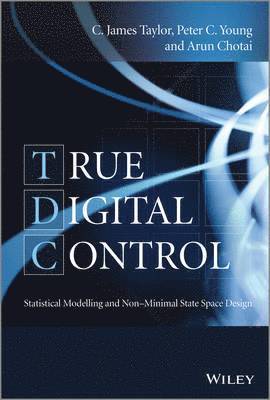
    True Digital Control

    Statistical Modelling and Non-Minimal State Space Design

    AvC. James Taylor,Peter C. Young

    Inbunden, Engelska, 2013

    1 304 kr

    Beställningsvara. Skickas inom 11-20 vardagar. Fri frakt över 249 kr.

    Beskrivning

    True Digital Control: Statistical Modelling and Non–Minimal State Space Designdevelops a true digital control design philosophy that encompasses data–based model identification, through to control algorithm design, robustness evaluation and implementation. With a heritage from both classical and modern control system synthesis, this book is supported by detailed practical examples based on the authors’ research into environmental, mechatronic and robotic systems. Treatment of both statistical modelling and control design under one cover is unusual and highlights the important connections between these disciplines.Starting from the ubiquitous proportional–integral controller, and with essential concepts such as pole assignment introduced using straightforward algebra and block diagrams, this book addresses the needs of those students, researchers and engineers, who would like to advance their knowledge of control theory and practice into the state space domain; and academics who are interested to learn more about non–minimal state variable feedback control systems. Such non–minimal state feedback is utilised as a unifying framework for generalised digital control system design. This approach provides a gentle learning curve, from which potentially difficult topics, such as optimal, stochastic and multivariable control, can be introduced and assimilated in an interesting and straightforward manner.Key features: Covers both system identification and control system design in a unified mannerIncludes practical design case studies and simulation examplesConsiders recent research into time–variable and state–dependent parameter modelling and control, essential elements of adaptive and nonlinear control system design, and the delta–operator (the discrete–time equivalent of the differential operator) systemsAccompanied by a website hosting MATLAB examplesTrue Digital Control: Statistical Modelling and Non–Minimal State Space Design is a comprehensive and practical guide for students and professionals who wish to further their knowledge in the areas of modern control and system identification.

    Produktinformation

    • Utgivningsdatum:2013-08-09
    • Mått:175 x 252 x 22 mm
    • Vikt:699 g
    • Format:Inbunden
    • Språk:Engelska
    • Antal sidor:368
    • Förlag:John Wiley & Sons Inc
    • ISBN:9781118521212

    Utforska kategorier

    • Elektronik och kommunikationer inom Naturvetenskap och teknik

    Mer om författaren

    James Taylor received his B.Sc. (Hons.) and Ph.D degrees from Lancaster University, UK, before joining the academic staff of the Engineering Department in 2000. His research focuses on control system design and system identification, with applied work spanning robotics, transport, energy, agriculture and the environment. This has led to over 100 publications in the open literature and widespread impact across a variety of academic and industry–based users. He has pioneered new advances in non–minimal state space design, and coordinates development of the well–known Captain Toolbox for Time Series Analysis and Forecasting. He is a Fellow of the Institution of Engineering and Technology, and supervises students across a spectrum of mechanical, electronic, nuclear and chemical engineering disciplines. Peter Young is Emeritus Professor at Lancaster University, UK, and Adjunct Professor at the Australian National University, Canberra. After an apprenticeship in the Aerospace Industry and B.Tech., MSc. degrees from Loughborough University, he obtained his Ph.D degree from Cambridge University in 1970 and became University Lecturer in Engineering and a Fellow of Clare Hall at Cambridge University. After seven years as Professorial Fellow at the Australian National University, he then moved to Lancaster University in 1981 as Professor and Head of the Environmental Science Department. He is well known for his work on optimal identification, data–based mechanistic modelling and adaptive forecasting, with applications in areas ranging from the environment, through ecology, biology and engineering to business and macro–economics.Until his recent retirement, Arun Chotai was Senior Lecturer in the Lancaster Environment Centre at Lancaster University, UK. He holds a Ph.D in Systems and Control and a B.Sc. (Hons.) in Mathematics, both from the University of Bath, UK. Following his appointment to an academic position at Lancaster in 1984, he taught and developed modules in environmental systems, courses that were then unique to the UK in providing an advanced, quantitative approach to the subject. For many years, he was also joint head (with present co–author Peter Young) of the Systems and Control Group, which he helped to build into a successful research unit that became known internationally for its research in the areas of system identification, time–series analysis and control system design.

    Innehållsförteckning

    • Preface xiiiList of Acronyms xvList of Examples, Theorems and Estimation Algorithms xix1 Introduction 11.1 Control Engineering and Control Theory 21.2 Classical and Modern Control 51.3 The Evolution of the NMSS Model Form 81.4 True Digital Control 111.5 Book Outline 121.6 Concluding Remarks 13References 142 Discrete-Time Transfer Functions 172.1 Discrete-Time TF Models 182.1.1 The Backward Shift Operator 182.1.2 General Discrete-Time TF Model 222.1.3 Steady-State Gain 232.2 Stability and the Unit Circle 242.3 Block Diagram Analysis 262.4 Discrete-Time Control 282.5 Continuous to Discrete-Time TF Model Conversion 362.6 Concluding Remarks 38References 383 Minimal State Variable Feedback 413.1 Controllable Canonical Form 443.1.1 State Variable Feedback for the General TF Model 493.2 Observable Canonical Form 503.3 General State Space Form 533.3.1 Transfer Function Form of a State Space Model 533.3.2 The Characteristic Equation, Eigenvalues and Eigenvectors 553.3.3 The Diagonal Form of a State Space Model 573.4 Controllability and Observability 583.4.1 Definition of Controllability (or Reachability) 583.4.2 Rank Test for Controllability 593.4.3 Definition of Observability 593.4.4 Rank Test for Observability 593.5 Concluding Remarks 61References 624 Non-Minimal State Variable Feedback 634.1 The NMSS Form 644.1.1 The NMSS (Regulator) Representation 644.1.2 The Characteristic Polynomial of the NMSS Model 674.2 Controllability of the NMSS Model 684.3 The Unity Gain NMSS Regulator 694.3.1 The General Unity Gain NMSS Regulator 744.4 Constrained NMSS Control and Transformations 774.4.1 Non-Minimal State Space Design Constrained to yield a Minimal SVF Controller 794.5 Worked Example with Model Mismatch 814.6 Concluding Remarks 85References 865 True Digital Control for Univariate Systems 895.1 The NMSS Servomechanism Representation 935.1.1 Characteristic Polynomial of the NMSS Servomechanism Model 955.2 Proportional-Integral-Plus Control 985.2.1 The Closed-Loop Transfer Function 995.3 Pole Assignment for PIP Control 1015.3.1 State Space Derivation 1015.4 Optimal Design for PIP Control 1105.4.1 Linear Quadratic Weighting Matrices 1115.4.2 The LQ Closed-loop System and Solution of the Riccati Equation 1125.4.3 Recursive Solution of the Discrete-Time Matrix Riccati Equation 1145.5 Case Studies 1165.6 Concluding Remarks 119References 1206 Control Structures and Interpretations 1236.1 Feedback and Forward Path PIP Control Structures 1236.1.1 Proportional-Integral-Plus Control in Forward Path Form 1256.1.2 Closed-loop TF for Forward Path PIP Control 1266.1.3 Closed-loop Behaviour and Robustness 1276.2 Incremental Forms for Practical Implementation 1316.2.1 Incremental Form for Feedback PIP Control 1316.2.2 Incremental Form for Forward Path PIP Control 1346.3 The Smith Predictor and its Relationship with PIP Design 1376.3.1 Relationship between PIP and SP-PIP Control Gains 1396.3.2 Complete Equivalence of the SP-PIP and Forward Path PIP Controllers 1406.4 Stochastic Optimal PIP Design 1426.4.1 Stochastic NMSS Equations and the Kalman Filter 1426.4.2 Polynomial Implementation of the Kalman Filter 1446.4.3 Stochastic Closed-loop System 1496.4.4 Other Stochastic Control Structures 1506.4.5 Modified Kalman Filter for Non-Stationary Disturbances 1516.4.6 Stochastic PIP Control using a Risk Sensitive Criterion 1526.5 Generalised NMSS Design 1536.5.1 Feed-forward PIP Control based on an Extended Servomechanism NMSS Model 1536.5.2 Command Anticipation based on an Extended Servomechanism NMSS Model 1546.6 Model Predictive Control 1576.6.1 Model Predictive Control based on NMSS Models 1586.6.2 Generalised Predictive Control 1586.6.3 Equivalence Between GPC and PIP Control 1596.6.4 Observer Filters 1626.7 Concluding Remarks 163References 1647 True Digital Control for Multivariable Systems 1677.1 The Multivariable NMSS (Servomechanism) Representation 1687.1.1 The General Multivariable System Description 1707.1.2 Multivariable NMSS Form 1717.1.3 The Characteristic Polynomial of the Multivariable NMSS Model 1737.2 Multivariable PIP Control 1757.3 Optimal Design for Multivariable PIP Control 1777.4 Multi-Objective Optimization for PIP Control 1867.4.1 Goal Attainment 1877.5 Proportional-Integral-Plus Decoupling Control by Algebraic Pole Assignment 1927.5.1 Decoupling Algorithm I 1937.5.2 Implementation Form 1947.5.3 Decoupling Algorithm II 1957.6 Concluding Remarks 195References 1968 Data-Based Identification and Estimation of Transfer Function Models 1998.1 Linear Least Squares, ARX and Finite Impulse Response Models 2008.1.1 En bloc LLS Estimation 2028.1.2 Recursive LLS Estimation 2038.1.3 Statistical Properties of the RLS Algorithm 2058.1.4 The FIR Model 2108.2 General TF Models 2118.2.1 The Box–Jenkins and ARMAX Models 2128.2.2 A Brief Review of TF Estimation Algorithms 2138.2.3 Standard IV Estimation 2158.3 Optimal RIV Estimation 2188.3.1 Initial Motivation for RIV Estimation 2188.3.2 The RIV Algorithm in the Context of ml 2208.3.3 Simple AR Noise Model Estimation 2228.3.4 RIVAR Estimation: RIV with Simple AR Noise Model Estimation 2238.3.5 Additional RIV Algorithms 2268.3.6 RIVAR and IV4 Estimation Algorithms 2278.4 Model Structure Identification and Statistical Diagnosis 2318.4.1 Identification Criteria 2328.4.2 Model Structure Identification Procedure 2348.5 Multivariable Models 2438.5.1 The Common Denominator Polynomial MISO Model 2438.5.2 The MISO Model with Different Denominator Polynomials 2468.6 Continuous-Time Models 2488.6.1 The SRIV and RIVBJ Algorithms for Continuous-Time Models 2498.6.2 Estimation of δ-Operator Models 2538.7 Identification and Estimation in the Closed-Loop 2538.7.1 The Generalised Box−Jenkins Model in a Closed-Loop Context 2548.7.2 Two-Stage Closed-Loop Estimation 2558.7.3 Three-Stage Closed-Loop Estimation 2568.7.4 Unstable Systems 2608.8 Concluding Remarks 260References 2619 Additional Topics 2659.1 The δ-Operator Model and PIP Control 2669.1.1 The δ-operator NMSS Representation 2679.1.2 Characteristic Polynomial and Controllability 2689.1.3 The δ-Operator PIP Control Law 2699.1.4 Implementation Structures for δ-Operator PIP Control 2709.1.5 Pole Assignment δ-Operator PIP Design 2719.1.6 Linear Quadratic Optimal δ-Operator PIP Design 2729.2 Time Variable Parameter Estimation 2799.2.1 Simple Limited Memory Algorithms 2819.2.2 Modelling the Parameter Variations 2829.2.3 State Space Model for DTF Estimation 2849.2.4 Optimisation of the Hyper-parameters 2879.3 State-Dependent Parameter Modelling and PIP Control 2909.3.1 The SDP-TF Model 2909.3.2 State-Dependent Parameter Model Identification and Estimation 2929.3.3 Proportional-Integral-Plus Control of SDP Modelled Systems 2939.4 Concluding Remarks 298References 298Appendix A Matrices and Matrix Algebra 301A. 1 Matrices 301A. 2 Vectors 302A. 3 Matrix Addition (or Subtraction) 302A. 4 Matrix or Vector Transpose 302A. 5 Matrix Multiplication 303A. 6 Determinant of a Matrix 304A. 7 Partitioned Matrices 305A. 8 Inverse of a Matrix 306A. 9 Quadratic Forms 307A. 10 Positive Definite or Semi-Definite Matrices 308A. 11 The Rank of a Matrix 308A. 12 Differentiation of Vectors and Matrices 308References 310Appendix B The Time Constant 311Reference 311Appendix C Proof of Theorem 4.1 313References 314Appendix D Derivative Action Form of the Controller 315Appendix E Block Diagram Derivation of PIP Pole Placement Algorithm 317Appendix F Proof of Theorem 6.1 321Reference 322Appendix G The CAPTAIN Toolbox 323G. 1 Transfer Functions and Control System Design 323G. 2 Other Routines 324G. 3 Download 325References 325Appendix H The Theorem of D.A. Pierce (1972) 327References 328Index 329