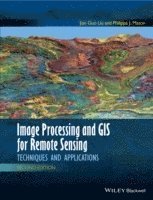
Image Processing and GIS for Remote Sensing
Techniques and Applications
AvJian Guo Liu,Philippa J. Mason
1 038 kr
Beställningsvara. Skickas inom 5-8 vardagar. Fri frakt över 249 kr.
Beskrivning
Produktinformation
- Utgivningsdatum:2016-03-18
- Mått:193 x 249 x 28 mm
- Vikt:1 179 g
- Format:Inbunden
- Språk:Engelska
- Antal sidor:480
- Upplaga:2
- Förlag:John Wiley and Sons Ltd
- ISBN:9781118724200
Utforska kategorier
Mer om författaren
Jian Guo Liu received a Ph.D. in 1991 in remote sensing and image processing from Imperial College London, UK and an M.Sc. in 1982 in remote sensing and geology from China University of Geosciences, Beijing, China. He is a Reader in remote sensing in the Department of Earth Science and Engineering, Imperial College London. His current research activities include: sub-pixel technology for image registration, DEM generation and change detection; image processing techniques for data fusion, filtering and InSAR; and GIS multi-data modelling for geohazard studies.Philippa J Mason completed a BSc in Geology at Southampton University in 1987, an MSc in Remote Sensing at University College London in 1993 and a PhD in 1998 at Imperial College London. She is a lecturer in remote sensing & GIS at Imperial College London and a consultant in geological remote sensing and image interpretation. Her research interests include the application of geospatial sciences to geohazards, tectonic geomorphology, spectral geology and mineral exploration.
Innehållsförteckning
- Overview of the Book xiPart I Image processing1 Digital image and display 31.1 What is a digital image? 31.2 Digital image display 41.3 Some key points 81.4 Questions 82 Point operations (contrast enhancement) 92.1 Histogram modification and lookup table 92.2 Linear contrast enhancement (LCE) 112.3 Logarithmic and exponential contrast enhancement 132.4 Histogram equalisation (HE) 142.5 Histogram matching (HM) and Gaussian stretch 152.6 Balance contrast enhancement technique (BCET) 162.7 Clipping in contrast enhancement 182.8 Tips for interactive contrast enhancement 182.9 Questions 193 Algebraic operations (multi‐image point operations) 213.1 Image addition 213.2 Image subtraction (differencing) 223.3 Image multiplication 223.4 Image division (ratio) 223.5 Index derivation and supervised enhancement 263.6 Standardization and logarithmic residual 293.7 Simulated reflectance 293.8 Summary 333.9 Questions 344 Filtering and neighbourhood processing 354.1 FT: Understanding filtering in image frequency 354.2 Concepts of convolution for image filtering 374.3 Low pass filters (smoothing) 384.4 High pass filters (edge enhancement) 424.5 Local contrast enhancement 454.6 FFT selective and adaptive filtering 464.7 Summary 524.8 Questions 525 RGB‐IHS transformation 555.1 Colour co‐ordinate transformation 555.2 IHS de‐correlation stretch 575.3 Direct de‐correlation stretch technique 585.4 Hue RGB colour composites 605.5 Derivation of RGB‐IHS and IHS‐RGB transformation based on 3D geometry of the RGB colour cube 635.6 Mathematical proof of DDS and its properties 655.7 Summary 675.8 Questions 676 Image fusion techniques 696.1 RGB‐IHS transformation as a tool for data fusion 696.2 Brovey transform (intensity modulation) 716.3 Smoothing filter‐based intensity modulation 716.4 Summary 756.5 Questions 757 Principal component analysis 777.1 Principle of the PCA 777.2 PC images and PC colour composition 797.3 Selective PCA for PC colour composition 827.4 De‐correlation stretch 847.5 Physical property orientated coordinate transformation and tasselled cap transformation 857.6 Statistical methods for band selection 877.7 Remarks 887.8 Questions 898 Image classification 918.1 Approaches of statistical classification 918.2 Unsupervised classification (iterative clustering) 928.3 Supervised classification 968.4 Decision rules: Dissimilarity functions 978.5 Post‐classification processing: Smoothing and accuracy assessment 988.6 Summary 1018.7 Questions 1019 Image geometric operations 1039.1 Image geometric deformation 1039.2 Polynomial deformation model and image warping co‐registration 1069.3 GCP selection and automation of image co‐registration 1099.4 Summary 1109.5 Questions 11010 Introduction to interferometric synthetic aperture radar technique 11310.1 The principle of a radar interferometer 11310.2 Radar interferogram and DEM 11510.3 Differential InSAR and deformation measurement 11710.4 Multi‐temporal coherence image and random change detection 11910.5 Spatial de‐correlation and ratio coherence technique 12110.6 Fringe smoothing filter 12310.7 Summary 12410.8 Questions 12511 Sub‐pixel technology and its applications 12711.1 Phase correlation algorithm 12711.2 PC scanning for pixel‐wise disparity estimation 13211.3 Pixel‐wise image co‐registration 13411.4 Very narrow‐baseline stereo matching and 3D data generation 13911.5 Ground motion/deformation detection and estimation 14311.6 Summary 146Part II Geographical information systems12 Geographical information systems 15112.1 Introduction 15112.2 Software tools 15212.3 GIS cartography and thematic mapping 15212.4 Standards, inter‐operability and metadata 15312.5 GIS and the internet 15413 Data models and structures 15513.1 Introducing spatial data in representing geographic features 15513.2 How are spatial data different from other digital data? 15513.3 Attributes and measurement scales 15613.4 Fundamental data structures 15613.5 Raster data 15713.6 Vector data 16113.7 Data conversion between models and structures 17113.8 Summary 17413.9 Questions 17514 Defining a coordinate space 17714.1 Introduction 17714.2 Datums and projections 17714.3 How coordinate information is stored and accessed 18814.4 Selecting appropriate coordinate systems 18914.5 Questions 18915 Operations 19115.1 Introducing operations on spatial data 19115.2 Map algebra concepts 19215.3 Local operations 19415.4 Neighbourhood operations 19915.5 Vector equivalents to raster map algebra 20615.6 Automating GIS functions 20915.7 Summary 20915.8 Questions 21016 Extracting information from point data: Geostatistics 21116.1 Introduction 21116.2 Understanding the data 21116.3 Interpolation 21416.4 Summary 22416.5 Questions 22517 Representing and exploiting surfaces 22717.1 Introduction 22717.2 Sources and uses of surface data 22717.3 Visualising surfaces 23017.4 Extracting surface parameters 23617.5 Summary 24517.6 Questions 24618 Decision support and uncertainty 24718.1 Introduction 24718.2 Decision support 24718.3 Uncertainty 24818.4 Risk and hazard 25018.5 Dealing with uncertainty in GIS‐based spatial analysis 25018.6 Summary 25418.7 Questions 25519 Complex problems and multi‐criterion evaluation 25719.1 Introduction 25719.2 Different approaches and models 25819.3 Evaluation criteria 25919.4 Deriving weighting coefficients 26019.5 Multi‐criterion combination methods 26319.6 Summary 27219.7 Questions 272Part III Remote sensing applications20 Image processing and GIS operation strategy 27520.1 General image processing strategy 27620.2 Remote sensing‐based GIS projects: From images to thematic mapping 28420.3 An example of thematic mapping based on optimal visualisation and interpretation of multi‐spectral satellite imagery 28420.4 Summary 29221 Thematic teaching case studies in SE Spain 29321.1 Thematic information extraction (1): Gypsum natural outcrop mapping and quarry change assessment 29321.2 Thematic information extraction (2): Spectral enhancement and mineral mapping of epithermal gold alteration and iron‐ore deposits in ferroan dolomite 29921.3 Remote sensing and GIS: Evaluating vegetation and landuse change in the Nijar Basin, SE Spain 30821.4 Applied remote sensing and GIS: A combined interpretive tool for regional tectonics, drainage and water resources in the Andarax basin 31822 Research case studies 33522.1 Vegetation change in the Three Parallel Rivers region, Yunnan Province, China 33522.2 GIS modelling of earthquake damage zones using satellite imagery and digital elevation model (DEM) data 34522.3 Predicting landslides using fuzzy geohazard mapping: An example from Piemonte, north‐west Italy 36922.4 Land surface change detection in a desert area in Algeria using multi‐temporal ERS SAR coherence images 38023 Industrial case studies 38923.1 Multi‐criteria assessment of mineral prospectivity in SE Greenland 38923.2 Water resource exploration in Somalia 405Part IV Summary24 Concluding remarks 41924.1 Image processing 41924.2 Geographic Information Systems 42224.3 Final remarks 425Appendix A Imaging sensor systems and remote sensing satellites 427A.1 Multi‐spectral sensing 427A.2 Broadband multi‐spectral sensors 431A.3 Thermal sensing and TIR sensors 434A.4 Hyperspectral sensors (imaging spectrometers) 434A.5 Passive microwave sensors 436A.6 Active sensing: SAR imaging systems 437Appendix B Online resources for information software and data 441B.1 Software – proprietary, low cost and free (shareware) 441B.2 Information and technical information on standards, best practice, formats, techniques and various publications 441B.3 Data sources including online satellite imagery from major suppliers, DEM data plus GIS maps and data of all kinds 442References 443Index 451
Mer från samma författare
Dynamics In Models Of Coarsening, Coagulation, Condensation And Quantization
Weizhu Bao, Jian-guo Liu
2 071 kr
Multi-scale Phenomena In Complex Fluids: Modeling, Analysis And Numerical Simulations
HOU THOMAS Y, Chun Liu, Thomas Yizhao Hou, Jian-guo Liu
1 633 kr
Du kanske också är intresserad av
Multi-scale Phenomena In Complex Fluids: Modeling, Analysis And Numerical Simulations
HOU THOMAS Y, Chun Liu, Thomas Yizhao Hou, Jian-guo Liu
1 633 kr
Dynamics In Models Of Coarsening, Coagulation, Condensation And Quantization
Weizhu Bao, Jian-guo Liu
2 071 kr
- -30%
- Signerad!
- 4 för 3
- 4 för 3
- Nyhet
- -21%
Hjärnans akilleshälar : hur din hjärna lurar dig, och vad du kan göra åt det
Anders Hansen
229 kr289 kr
- -30%