• Fri frakt över 249 kr
  • •
  • Snabba leveranser
  • •
  • Billiga böcker
Kundservice

Du är på sajten för privatpersoner.

Företag, bibliotek eller offentlig verksamhet?

Du handlar på classic.bokus.com, där alla dina funktioner finns intakta.
Till classic.bokus.com
Bokus logotyp. Gå till startsidan.
  • Erbjudanden
  • Nyheter
  • Student
  • Topplistor
  • Barn & ungdom
  • Bokus Play
  • E-böcker
  • Pocketböcker
  • Spel & pussel

10% rabatt på allt med kod NYSTART10 →

Sidfot

Mina sidor

    Hjälp

    • Kundservice
    • Vanliga frågor och svar
    • Frakt och leverans
    • Retur vid ångerrätt
    • Reklamera vara
    • Betalning
    • Köpvillkor
    • Allmänna villkor
    • Information om webbplatsens tillgänglighet

    Om Bokus

    • Om oss
    • Pressrum
    • För studenter
    • För företag
    • För bibliotek och offentlig verksamhet
    • För leverantörer
    • Hållbarhet

    Populärt

    • Aktuella erbjudanden
    • Presentkort
    • Studentlitteratur
    • Nya böcker
    • Topplistor
    • Signerade böcker
    • Engelska böcker

    Inspiration

    • Boktips
    • BookTok
    • Populära bokserier
    • Barnbokskaraktärer
    • Populära författare
    Logotyp för Bokus
    Följ oss på Facebook (extern länk)Följ oss på Instagram (extern länk)Följ oss på YouTube (extern länk)Följ oss på TikTok (extern länk)
    bokus @ CookiesAnpassa cookiesIntegritetspolicyKöpvillkor
    Till Citymail hemsida (extern länk)Till Budbee hemsida (extern länk)Till Postnord hemsida (extern länk)Till Schenker hemsida (extern länk)Till Early Bird hemsida (extern länk)Till Walleys hemsida (extern länk)
    1. Naturvetenskap och teknik
    2. Teknik och industri
    3. Elektronik och kommunikationer

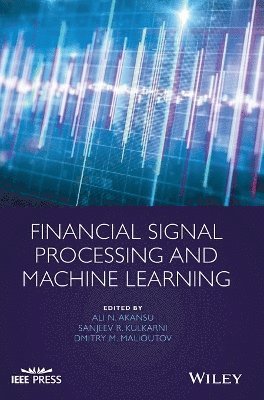
    Financial Signal Processing and Machine Learning

    AvAli N. Akansu,Ali N. Akansu

    Inbunden, Engelska, 2016

    Del i serien IEEE Press

    1 229 kr

    Beställningsvara. Skickas inom 5-8 vardagar. Fri frakt över 249 kr.

    Beskrivning

    The modern financial industry has been required to deal with large and diverse portfolios in a variety of asset classes often with limited market data available. Financial Signal Processing and Machine Learning unifies a number of recent advances made in signal processing and machine learning for the design and management of investment portfolios and financial engineering. This book bridges the gap between these disciplines, offering the latest information on key topics including characterizing statistical dependence and correlation in high dimensions, constructing effective and robust risk measures, and their use in portfolio optimization and rebalancing. The book focuses on signal processing approaches to model return, momentum, and mean reversion, addressing theoretical and implementation aspects. It highlights the connections between portfolio theory, sparse learning and compressed sensing, sparse eigen-portfolios, robust optimization, non-Gaussian data-driven risk measures, graphical models, causal analysis through temporal-causal modeling, and large-scale copula-based approaches. Key features: Highlights signal processing and machine learning as key approaches to quantitative finance.Offers advanced mathematical tools for high-dimensional portfolio construction, monitoring, and post-trade analysis problems.Presents portfolio theory, sparse learning and compressed sensing, sparsity methods for investment portfolios. including eigen-portfolios, model return, momentum, mean reversion and non-Gaussian data-driven risk measures with real-world applications of these techniques.Includes contributions from leading researchers and practitioners in both the signal and information processing communities, and the quantitative finance community.

    Produktinformation

    • Utgivningsdatum:2016-05-27
    • Mått:173 x 246 x 23 mm
    • Vikt:658 g
    • Format:Inbunden
    • Språk:Engelska
    • Serie:IEEE Press
    • Antal sidor:320
    • Förlag:John Wiley & Sons Inc
    • ISBN:9781118745670

    Utforska kategorier

    • Elektronik och kommunikationer inom Naturvetenskap och teknik
    • Systemvetenskap och AI inom Data och IT

    Mer om författaren

    Ali N. Akansu, Electrical and Computer Engineering Department, New Jersey Institute of Technology (NJIT), USA Dr. Akansu is a Professor of Electrical and Computer Engineering at NJIT, USA. Prof. Akansu was VP R&D at IDT Corporation and the founding President and CEO of PixWave, Inc. He has sat on the board of an investment fund and has been an academic visitor at David Sarnoff Research Center, IBM T.J. Watson Research Center, and GEC-Marconi Electronic Systems.Prof. Akansu was a Visiting Professor at Courant Institute of Mathematical Sciences of New York University performing research on Quantitative Finance. He is a Fellow of the IEEE and was the Lead Guest Editor of the recent special issue of IEEE Journal of Selected Topics in Signal Processing on Signal Processing Methods in Finance and Electronic Trading. Sanjeev R. Kulkarni, Department of Electrical Engineering, Princeton University, USA Dr. Kulkarni is currently Professor of Electrical Engineering at Princeton University, and Director of Princeton’s Keller Center. He is an affiliated faculty member of the Department of Operations Research and Financial Engineering and the Department of Philosophy, and has taught a broad range of courses across a number of departments (Electrical Engineering, Computer Science, Philosophy, and Operations Research & Financial Engineering). He has received 7 E-Council Excellence in Teaching Awards. He spent 1998 with Susquehanna International Group and was a regular consultant there from 1997 to 2001, working on statistical arbitrage and analysis of firm-wide stock trading. Prof. Kulkarni is a Fellow of the IEEE. Dmitry Malioutev, IBM Research, USA Dr. Dmitry Malioutov is a research staff member in the machine learning group of the Cognitive Algorithms department at IBM Research. Dmitry received the Ph.D. and the S.M. degrees in Electrical Engineering and Computer Science from MIT where he was part of the Laboratory for Information and Decision Systems. Prior to joining IBM, Dmitry had spent several years as an applied researcher in high-frequency trading in DRW Trading, Chicago, and as a postdoctoral researcher in Microsoft Research, Cambridge, UK. His research interests include interpretable machine learning; sparse signal representation; inference and learning in graphical models, message passing algorithms; Statistical risk modeling, robust covariance estimation; portfolio optimization. Dr. Malioutov received the 2010 IEEE Signal Processing Society best 5-year paper award, and a 2006 IEEE ICASSP student paper award, and the MIT Presidential fellowship. Dr. Malioutov serves on the IEEE-SPS machine learning for signal processing technical committee, and is an associate editor of the IEEE Transactions on Signal Processing, and a guest editor of the IEEE Journal on Selected Topics in Signal Processing.

    Innehållsförteckning

    • List of Contributors xiiiPreface xv1 Overview 1Ali N. Akansu, Sanjeev R. Kulkarni, and Dmitry Malioutov1.1 Introduction 11.2 A Bird’s-Eye View of Finance 21.2.1 Trading and Exchanges 41.2.2 Technical Themes in the Book 51.3 Overview of the Chapters 61.3.1 Chapter 2: “Sparse Markowitz Portfolios” by Christine De Mol 61.3.2 Chapter 3: “Mean-Reverting Portfolios: Tradeoffs between Sparsity and Volatility” by Marco Cuturi and Alexandre d’Aspremont 71.3.3 Chapter 4: “Temporal Causal Modeling” by Prabhanjan Kambadur, Aurélie C. Lozano, and Ronny Luss 71.3.4 Chapter 5: “Explicit Kernel and Sparsity of Eigen Subspace for the AR(1) Process” by Mustafa U. Torun, Onur Yilmaz and Ali N. Akansu 71.3.5 Chapter 6: “Approaches to High-Dimensional Covariance and Precision Matrix Estimation” by Jianqing Fan, Yuan Liao, and Han Liu 71.3.6 Chapter 7: “Stochastic Volatility: Modeling and Asymptotic Approaches to Option Pricing and Portfolio Selection” by Matthew Lorig and Ronnie Sircar 71.3.7 Chapter 8: “Statistical Measures of Dependence for Financial Data” by David S. Matteson, Nicholas A. James, and William B. Nicholson 81.3.8 Chapter 9: “Correlated Poisson Processes and Their Applications in Financial Modeling” by Alexander Kreinin 81.3.9 Chapter 10: “CVaR Minimizations in Support Vector Machines” by Junya Gotoh and Akiko Takeda 81.3.10 Chapter 11: “Regression Models in Risk Management” by Stan Uryasev 81.4 Other Topics in Financial Signal Processing and Machine Learning 9References 92 Sparse Markowitz Portfolios 11ChristineDeMol2.1 Markowitz Portfolios 112.2 Portfolio Optimization as an Inverse Problem: The Need for Regularization 132.3 Sparse Portfolios 152.4 Empirical Validation 172.5 Variations on the Theme 182.5.1 Portfolio Rebalancing 182.5.2 Portfolio Replication or Index Tracking 192.5.3 Other Penalties and Portfolio Norms 192.6 Optimal Forecast Combination 20Acknowlegments 21References 213 Mean-Reverting Portfolios 23Marco Cuturi and Alexandre d’Aspremont3.1 Introduction 233.1.1 Synthetic Mean-Reverting Baskets 243.1.2 Mean-Reverting Baskets with Sufficient Volatility and Sparsity 243.2 Proxies for Mean Reversion 253.2.1 Related Work and Problem Setting 253.2.2 Predictability 263.2.3 Portmanteau Criterion 273.2.4 Crossing Statistics 283.3 Optimal Baskets 283.3.1 Minimizing Predictability 293.3.2 Minimizing the Portmanteau Statistic 293.3.3 Minimizing the Crossing Statistic 293.4 Semidefinite Relaxations and Sparse Components 303.4.1 A Semidefinite Programming Approach to Basket Estimation 303.4.2 Predictability 303.4.3 Portmanteau 313.4.4 Crossing Stats 313.5 Numerical Experiments 323.5.1 Historical Data 323.5.2 Mean-reverting Basket Estimators 333.5.3 Jurek and Yang (2007) Trading Strategy 333.5.4 Transaction Costs 333.5.5 Experimental Setup 363.5.6 Results 363.6 Conclusion 39References 394 Temporal Causal Modeling 41Prabhanjan Kambadur, Aurélie C. Lozano, and Ronny Luss4.1 Introduction 414.2 TCM 464.2.1 Granger Causality and Temporal Causal Modeling 464.2.2 Grouped Temporal Causal Modeling Method 474.2.3 Synthetic Experiments 494.3 Causal Strength Modeling 514.4 Quantile TCM (Q-TCM) 524.4.1 Modifying Group OMP for Quantile Loss 524.4.2 Experiments 534.5 TCM with Regime Change Identification 554.5.1 Model 564.5.2 Algorithm 584.5.3 Synthetic Experiments 604.5.4 Application: Analyzing Stock Returns 624.6 Conclusions 63References 645 Explicit Kernel and Sparsity of Eigen Subspace for the AR(1) Process 67Mustafa U. Torun, Onur Yilmaz, and Ali N. Akansu5.1 Introduction 675.2 Mathematical Definitions 685.2.1 Discrete AR(1) Stochastic Signal Model 685.2.2 Orthogonal Subspace 695.3 Derivation of Explicit KLT Kernel for a Discrete AR(1) Process 725.3.1 A Simple Method for Explicit Solution of a Transcendental Equation 735.3.2 Continuous Process with Exponential Autocorrelation 745.3.3 Eigenanalysis of a Discrete AR(1) Process 765.3.4 Fast Derivation of KLT Kernel for an AR(1) Process 795.4 Sparsity of Eigen Subspace 825.4.1 Overview of Sparsity Methods 835.4.2 pdf-Optimized Midtread Quantizer 845.4.3 Quantization of Eigen Subspace 865.4.4 pdf of Eigenvector 875.4.5 Sparse KLT Method 895.4.6 Sparsity Performance 915.5 Conclusions 97References 976 Approaches to High-Dimensional Covariance and Precision Matrix Estimations 100Jianqing Fan, Yuan Liao, and Han Liu6.1 Introduction 1006.2 Covariance Estimation via Factor Analysis 1016.2.1 Known Factors 1036.2.2 Unknown Factors 1046.2.3 Choosing the Threshold 1056.2.4 Asymptotic Results 1056.2.5 A Numerical Illustration 1076.3 Precision Matrix Estimation and Graphical Models 1096.3.1 Column-wise Precision Matrix Estimation 1106.3.2 The Need for Tuning-insensitive Procedures 1116.3.3 TIGER: A Tuning-insensitive Approach for Optimal Precision Matrix Estimation 1126.3.4 Computation 1146.3.5 Theoretical Properties of TIGER 1146.3.6 Applications to Modeling Stock Returns 1156.3.7 Applications to Genomic Network 1186.4 Financial Applications 1196.4.1 Estimating Risks of Large Portfolios 1196.4.2 Large Panel Test of Factor Pricing Models 1216.5 Statistical Inference in Panel Data Models 1266.5.1 Efficient Estimation in Pure Factor Models 1266.5.2 Panel Data Model with Interactive Effects 1276.5.3 Numerical Illustrations 1306.6 Conclusions 131References 1317 Stochastic Volatility 135Matthew Lorig and Ronnie Sircar7.1 Introduction 1357.1.1 Options and Implied Volatility 1367.1.2 Volatility Modeling 1377.2 Asymptotic Regimes and Approximations 1417.2.1 Contract Asymptotics 1427.2.2 Model Asymptotics 1427.2.3 Implied Volatility Asymptotics 1437.2.4 Tractable Models 1457.2.5 Model Coefficient Polynomial Expansions 1467.2.6 Small “Vol of Vol” Expansion 1527.2.7 Separation of Timescales Approach 1527.2.8 Comparison of the Expansion Schemes 1547.3 Merton Problem with Stochastic Volatility: Model Coefficient Polynomial Expansions 1557.3.1 Models and Dynamic Programming Equation 1557.3.2 Asymptotic Approximation 1577.3.3 Power Utility 1597.4 Conclusions 160Acknowledgements 160References 1608 Statistical Measures of Dependence for Financial Data 162David S. Matteson, Nicholas A. James, and William B. Nicholson8.1 Introduction 1628.2 Robust Measures of Correlation and Autocorrelation 1648.2.1 Transformations and Rank-Based Methods 1668.2.2 Inference 1698.2.3 Misspecification Testing 1718.3 Multivariate Extensions 1748.3.1 Multivariate Volatility 1758.3.2 Multivariate Misspecification Testing 1768.3.3 Granger Causality 1768.3.4 Nonlinear Granger Causality 1778.4 Copulas 1798.4.1 Fitting Copula Models 1808.4.2 Parametric Copulas 1818.4.3 Extending beyond Two Random Variables 1838.4.4 Software 1858.5 Types of Dependence 1858.5.1 Positive and Negative Dependence 1858.5.2 Tail Dependence 187References 1889 Correlated Poisson Processes and Their Applications in Financial Modeling 191Alexander Kreinin9.1 Introduction 1919.2 Poisson Processes and Financial Scenarios 1939.2.1 Integrated Market–Credit Risk Modeling 1939.2.2 Market Risk and Derivatives Pricing 1949.2.3 Operational Risk Modeling 1949.2.4 Correlation of Operational Events 1959.3 Common Shock Model and Randomization of Intensities 1969.3.1 Common Shock Model 1969.3.2 Randomization of Intensities 1969.4 Simulation of Poisson Processes 1979.4.1 Forward Simulation 1979.4.2 Backward Simulation 2009.5 Extreme Joint Distribution 2079.5.1 Reduction to Optimization Problem 2079.5.2 Monotone Distributions 2089.5.3 Computation of the Joint Distribution 2149.5.4 On the Frechet–Hoeffding Theorem 2159.5.5 Approximation of the Extreme Distributions 2179.6 Numerical Results 2199.6.1 Examples of the Support 2199.6.2 Correlation Boundaries 2219.7 Backward Simulation of the Poisson-Wiener Process 2229.8 Concluding Remarks 227Acknowledgments 228Appendix A 229A. 1 Proof of Lemmas 9.2 and 9.3 229A.1.1 Proof of Lemma 9.2 229A.1.2 Proof of Lemma 9.3 230References 23110 CVaR Minimizations in Support Vector Machines 233Jun-ya Gotoh and Akiko Takeda10.1 What Is CVaR? 23410.1.1 Definition and Interpretations 23410.1.2 Basic Properties of CVaR 23810.1.3 Minimization of CVaR 24010.2 Support Vector Machines 24210.2.1 Classification 24210.2.2 Regression 24610.3 ν-SVMs as CVaR Minimizations 24710.3.1 ν-SVMs as CVaR Minimizations with Homogeneous Loss 24710.3.2 ν-SVMs as CVaR Minimizations with Nonhomogeneous Loss 25110.3.3 Refining the ν-Property 25310.4 Duality 25610.4.1 Binary Classification 25610.4.2 Geometric Interpretation of ν-SVM 25710.4.3 Geometric Interpretation of the Range of ν for ν-SVC 25810.4.4 Regression 25910.4.5 One-class Classification and SVDD 25910.5 Extensions to Robust Optimization Modelings 25910.5.1 Distributionally Robust Formulation 25910.5.2 Measurement-wise Robust Formulation 26110.6 Literature Review 26210.6.1 CVaR as a Risk Measure 26310.6.2 From CVaR Minimization to SVM 26310.6.3 From SVM to CVaR Minimization 26310.6.4 Beyond CVaR 263References 26411 Regression Models in Risk Management 266Stan Uryasev11.1 Introduction 26711.2 Error and Deviation Measures 26811.3 Risk Envelopes and Risk Identifiers 27111.3.1 Examples of Deviation Measures D, Corresponding Risk Envelopes Q, and Sets of Risk Identifiers QD(X) 27211.4 Error Decomposition in Regression 27311.5 Least-Squares Linear Regression 27511.6 Median Regression 27711.7 Quantile Regression and Mixed Quantile Regression 28111.8 Special Types of Linear Regression 28311.9 Robust Regression 284References, Further Reading, and Bibliography 287Index 289