• Fri frakt över 249 kr
  • •
  • Snabba leveranser
  • •
  • Billiga böcker
Kundservice

Du är på sajten för privatpersoner.

Företag, bibliotek eller offentlig verksamhet?

Du handlar på classic.bokus.com, där alla dina funktioner finns intakta.
Till classic.bokus.com
Bokus logotyp. Gå till startsidan.
  • Erbjudanden
  • Nyheter
  • Student
  • Topplistor
  • Barn & ungdom
  • Bokus Play
  • E-böcker
  • Pocketböcker
  • Spel & pussel

10% rabatt på allt med kod NYSTART10 →

Sidfot

Mina sidor

    Hjälp

    • Kundservice
    • Vanliga frågor och svar
    • Frakt och leverans
    • Retur vid ångerrätt
    • Reklamera vara
    • Betalning
    • Köpvillkor
    • Allmänna villkor
    • Information om webbplatsens tillgänglighet

    Om Bokus

    • Om oss
    • Pressrum
    • För studenter
    • För företag
    • För bibliotek och offentlig verksamhet
    • För leverantörer
    • Hållbarhet

    Populärt

    • Aktuella erbjudanden
    • Presentkort
    • Studentlitteratur
    • Nya böcker
    • Topplistor
    • Signerade böcker
    • Engelska böcker

    Inspiration

    • Boktips
    • BookTok
    • Populära bokserier
    • Barnbokskaraktärer
    • Populära författare
    Logotyp för Bokus
    Följ oss på Facebook (extern länk)Följ oss på Instagram (extern länk)Följ oss på YouTube (extern länk)Följ oss på TikTok (extern länk)
    bokus @ CookiesAnpassa cookiesIntegritetspolicyKöpvillkor
    Till Citymail hemsida (extern länk)Till Budbee hemsida (extern länk)Till Postnord hemsida (extern länk)Till Schenker hemsida (extern länk)Till Early Bird hemsida (extern länk)Till Walleys hemsida (extern länk)
    1. Naturvetenskap och teknik
    2. Teknik och industri
    3. Elektronik och kommunikationer

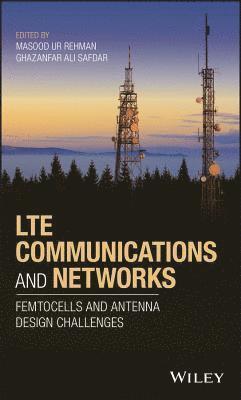
    LTE Communications and Networks

    Femtocells and Antenna Design Challenges

    AvMasood Ur Rehman,Ghazanfar Ali Safdar

    Inbunden, Engelska, 2018

    1 609 kr

    Beställningsvara. Skickas inom 5-8 vardagar. Fri frakt över 249 kr.

    Beskrivning

    A comprehensive resource to the latest developments of system enhancement techniques of Femtocells, power management, interference mitigation and antenna designLTE Communications and Networks fills a gap in the literature to offer a comprehensive review of the most current developments of LTE Femtocells and antennas and explores their future growth. With contributions from a group of experts that represent the fields of wireless communications and mobile communications, signal processing and antenna design, this text identifies technical challenges and presents recent results related to the development, integration and enhancement of LTE systems in portable devices.The authors examine topics such as application of cognitive radio with efficient sensing mechanisms, interference mitigation and power management schemes for the LTE systems. They also provide a comprehensive account of design challenges and approaches, performance enhancement techniques and effects of user’s presence on the LTE antennas. LTE Communications and Networks also highlights the promising technologies of multiband, multimode and reconfigurable antennas for efficient design of portable LTE devices. Designed to be a practical resource, this text: Explores the interference mitigation, power control and spectrum management in LTE Femtocells and related issuesContains information on the design challenges, different approaches, performance enhancement and application case scenarios for the LTE antennas Covers the most recent developments of system enhancement techniques in terms of Femtocells, power management, interference mitigation and antenna designIncludes contributions from leading experts in the field Written for industry professionals and researchers, LTE Communications and Networks is a groundbreaking book that presents a comprehensive treatment to the LTE systems in the context of Femtocells and antenna design and covers the wide range of issues related to the topic.

    Produktinformation

    • Utgivningsdatum:2018-05-04
    • Mått:145 x 218 x 23 mm
    • Vikt:544 g
    • Format:Inbunden
    • Språk:Engelska
    • Antal sidor:360
    • Förlag:John Wiley & Sons Inc
    • ISBN:9781119385226

    Utforska kategorier

    • Elektronik och kommunikationer inom Naturvetenskap och teknik

    Mer om författaren

    DR. MASOOD UR REHMAN is a Lecturer in Electronic Engineering at the University of Bedfordshire, UK. He has authored four books, eight book chapters, more than eighty technical papers in leading journals and peer-reviewed conferences, and one patent in the area of antennas and RF systems. DR. GHAZANFAR ALI SAFDAR is a Senior Lecturer in Computer Networking at the University of Bedfordshire, UK. He has authored two books, nine book chapters and approximately sixty research papers in renowned journals and peer-reviewed conferences in the area of wireless communications and networking.

    Innehållsförteckning

    • List of Contributors xvPreface xvi1 Introduction 1Ghazanfar Ali Safdar and Masood Ur Rehman1.1 Evolution of Wireless and Cellular Communication 21.1.1 1 G 31.1.2 2 G 31.1.3 2.5 G 31.1.4 2.75 G 41.1.5 3 G 41.1.6 3.5 G 41.1.7 4 G/LTE 51.2 LTE Architecture 51.2.1 Communications Perspective Challenges in LTE Networks 81.2.1.1 Signalling System 81.2.1.2 Backward Compatibility 91.2.1.3 BS Efficiency 91.2.2 LTE Radio Frame 101.3 LTE Antennas 111.4 LTE Applications 111.4.1 Communications 111.4.2 Public Safety 121.4.3 Device]to]Device Communications 121.4.4 Video Streaming 121.4.5 Voice over LTE (VoLTE) 121.4.6 Internet of Things 131.4.7 Wearable Systems 131.4.8 Cloud Computing 131.5 Book Organization 14References 16Part I LTE Femtocells 192 LTE Femtocells 21Ghazanfar Ali Safdar2.1 Introduction 212.1.1 Cross]Tier Interference 222.1.2 Co]Tier Interference 242.1.3 Downlink Interference Modelling 242.1.4 Uplink Interference Modelling 252.2 Platform for Femtocell Deployment 262.3 LTE Architecture Overview 262.3.1 LTE Downlink Transmission 272.3.2 LTE Uplink Transmission 272.4 LTE Femtocell Interference Analysis 282.4.1 Scenario 1: Cross]Tier Interference Analysis 282.4.2 Scenario 2: Effects of Femtocell Access Mode Deployment 282.4.3 Scenario 3: Co]Tier Interference Analysis 292.4.4 Scenario 4: Effects of Varying FAP Transmit Power Levels on MUEs 292.5 Interference Mitigation: Current State of the Art 312.5.1 Spectrum Access/Frequency Assignment 312.5.2 Power Control 322.5.3 Antenna Schemes 332.6 Cognitive Femtocells: A Smart Solution to a Complex Problem 332.7 Summary 35References 363 Interference Mitigation in Cognitive Radio]Based LTE Femtocells 38Ghazanfar Ali Safdar3.1 Introduction 393.2 Femtocells 413.2.1 Femtocells – Interference versus Deployment 433.2.2 Femtocells – Typical Interference Mitigation Techniques 463.2.2.1 Spectrum Access/Frequency Assignment Schemes 463.2.2.2 Power Control (PC) Schemes 463.2.2.3 Antenna Schemes 483.3 Interference Mitigation in Femtocells using Cognitive Radio 493.3.1 Cognitive Interference Mitigation 513.3.1.1 Cognitive Interference Mitigation – PC 523.3.1.2 Cognitive Interference Mitigation – Spectrum Access 543.3.1.3 Cognitive Interference Mitigation – Antenna Schemes 643.3.1.4 Cognitive Interference Mitigation – Joint Schemes 663.3.2 Cognitive Interference Mitigation versus Conventional Interference Mitigation 703.4 Summary 74References 754 Coverage Area]Based Power Control for Interference Management in LTE Femtocells 84Ghazanfar Ali Safdar4.1 Introduction 854.2 Coverage Radius Based Power Control Scheme (PS) 884.2.1 Radius Limit Setting 894.2.2 Initial Coverage Radius 894.2.3 Self]Update 894.2.4 Final Radius 894.3 System Model 904.4 Performance Analysis 924.4.1 Results and Discussion 934.4.1.1 SINR Cross]Tier (Single Cell) 934.4.1.2 SINR Co]Tier (Single Cell) 944.4.1.3 Downlink Throughput (Single Cell) 954.4.1.4 Co] and Cross]Tier SINR (Single Cell versus Multicell) 964.4.1.5 Droppage in SINR (Single Cell versus Multicell) 974.4.1.6 Coverage Area Bounds and Impact on SINR (Single Cell versus Multicell) 994.5 Summary 100References 1015 Energy Management in LTE Femtocells 104Kapil Kanwal, Ghazanfar Ali Safdar, Masood Ur Rehman and Xiaodong Yang5.1 Introduction 1055.2 Architecture of LTE Networks 1055.2.1 Communications Perspective Challenges in LTE Networks 1065.2.1.1 Signalling System 1065.2.1.2 Backward Compatibility 1075.2.1.3 BS Efficiency 1075.2.2 Importance of Energy Management in LTE Networks 1085.3 Classification of ES Schemes 1085.3.1 Static Power Consumption 1095.3.2 Dynamic Power Consumption 1095.4 Energy Efficient Resource Allocation 1135.4.1 Hybrid FBS and MBS Based Schemes 1135.4.2 Link Adaptation Schemes 1145.4.3 Cross Layer Resource Allocation Schemes 1155.4.4 MBSFN Resource Allocation Scheme 1155.5 Bandwidth Expansion Schemes 1175.5.1 CoMP Based Coverage Expansion 1175.5.2 Time Compression (TCoM) Scheme 1185.5.3 Bandwidth Expansion Mode (BEM) Scheme 1195.5.4 Component Carrier Based Schemes 1215.5.5 Scheduling Based Schemes 1225.6 Load Balancing Schemes 1235.6.1 Distance Aware Schemes 1235.6.2 Coverage Expansion Based Schemes 1255.6.3 Distributed Schemes 1255.6.4 Shared Relay Based Schemes 1275.6.5 CRN Adopted Switching Off of a BS 1285.6.6 Reduced Early Handover (REHO) Scheme 1295.7 Comparative Analysis 1305.8 Open Research Issues 1355.9 Summary 139References 1406 Spectrum Sensing Mechanisms in Cognitive Radio Based LTE Femtocells 150Tazeen S. Syed and Ghazanfar Ali Safdar6.1 Fundamentals of Signal Processing 1516.1.1 Channel Model 1516.1.1.1 Additive Gaussian Noise Channel 1516.1.1.2 Linear Filter Channel 1526.1.1.3 Band Limited Channel 1536.1.2 Modulation Technique 1536.1.3 Error Probability 1546.2 Spectrum Sensing Techniques 1556.2.1 Primary Transmitter Detection 1556.2.1.1 Energy Detector 1566.2.1.2 Matched Filter Detection 1586.2.1.3 Cyclostationary Feature Detection 1596.2.1.4 Waveform Detection 1606.2.1.5 Wavelet Detection 1616.2.1.6 Hybrid Sensing 1626.2.1.7 Multi]Taper Spectrum Sensing 1636.2.2 Collaborative/Cooperative Detection 1636.2.3 Interference Temperature Detection 1666.2.4 Primary Receiver Detection 1666.3 History Assisted Spectrum Sensing 1666.4 Model]and Statistics]Based Spectrum Sensing Classification 1676.5 Challenges and Issues 1726.6 Summary 176References 177Part II Antennas for LTE Femtocells 1857 Antenna Consideration for LTE Femtocells 187Masood Ur Rehman7.1 Antenna Fundamentals 1877.1.1 Input Impedance and Matching 1887.1.2 Bandwidth 1897.1.3 Radiation Pattern 1907.1.4 Directivity and Gain 1917.1.5 Efficiency 1937.1.6 Polarization 1937.2 Antenna Requirements for LTE Femtocells 1967.2.1 Frequency Bands 1977.2.2 Form Factor and Size Limitation 2017.2.3 Impedance Matching, Directivity, Gain and Efficiency 2017.2.4 Directionality 2027.2.5 Polarization 2037.2.6 Human Body Effects and Specific Absorption Rate (SAR) 2047.2.7 Multiple Input Multiple Output (MIMO) 205References 2068 Multiband Antennas for LTE Femtocells 209Masood Ur Rehman and Xiaodong Yang8.1 Fundamentals of Multiband Antennas 2098.1.1 Multiband Techniques 2108.1.1.1 Higher Order Resonances 2108.1.1.2 Multiple Resonant Structures 2118.2 Types of Multiband Antennas 2118.3 Multiband Antenna Design: Case Studies 2148.3.1 Multi]Slot Antenna 2158.3.1.1 Antenna Geometry 2158.3.1.2 Antenna Performance Evaluation 2158.3.2 Patch]Loop Combination Antenna 2208.3.2.1 Antenna Configuration 2208.3.2.2 Antenna Performance 2208.4 Open Research Issues 227References 2279 Reconfigurable Antennas for LTE Femtocells 230Masood Ur Rehman and Waqas Farooq9.1 Fundamentals of Reconfigurable Antennas 2309.1.1 Types of Reconfigurable Antennas 2319.1.1.1 Use of Switches 2329.1.1.2 Structural and Mechanical Changes 2329.1.1.3 Material Changes 2349.2 Realization of Reconfigurable Antennas 2349.3 Rectangular Patch Reconfigurable LTE Femtocell Antenna 2379.3.1 Design Conception 2379.3.2 Frequency Reconfiguration Mode 2399.3.3 Antenna Performance Evaluation 2409.4 Circular Patch Reconfigurable LTE Femtocell Antenna 2469.4.1 Frequency Reconfiguration Mode 2489.4.2 Antenna Performance Evaluation 2489.5 Open Research Issues 253References 25410 Multimode Antennas for LTE Femtocells 259Oluyemi Peter Falade, Xiaodong Chen and Masood Ur Rehman10.1 Multimode Antennas: Fundamentals and Types 26010.2 Design of a Compact Multimode LTE Femtocell Antenna for Handheld Devices 26110.2.1 Numerical Analysis 26310.2.2 Experimental Investigation 26610.3 Design of a Multifunctional Compact Antenna for LTE Femtocells and GNSS Systems 26810.3.1 Numerical Analysis 27310.3.2 Experimental Investigation 27910.4 Summary 28410.5 Open Challenges and Issues 284References 28411 Human Body Effects on LTE Femtocell Antennas 289Masood Ur Rehman and Qammer Hussain Abbasi11.1 Interaction of the Human Body with Antennas 29011.2 Numerical Modelling of the Human Body 29111.2.1 Evaluation and Comparison of Numerical Models of Human Body 29411.2.1.1 On]Body Transmission 29411.2.1.2 Effects on Antenna Radiation Pattern 29711.2.1.3 Electric Field Distribution 29911.2.1.4 Specific Absorption Rate (SAR) 30011.3 Evaluation of Human Body Effects on LTE Femtocell Antennas 30511.3.1 On]Body Antenna Placement 30811.3.2 Antenna]Body Separation 31011.3.3 On]Body LTE Channel Characterization 31211.3.4 On]Off Body LTE Channel Characterization 31311.3.5 Body]to]Body LTE Channel Characterization 31511.4 Open Research Issues 316References 31712 The Road Ahead for LTE Femtocells 322Masood Ur Rehman and Ghazanfar Ali Safdar12.1 Future Prospects and Challenges 32312.1.1 Spectrum Sharing 32412.1.2 Intelligent/Efficient Spectrum Sensing Schemes 32412.1.3 Primary/Secondary User Issue 32512.1.4 Energy Saving 32512.1.5 Security 32612.1.6 Pilot Power/Coverage Radius Issue 32612.1.7 Signalling Overhead 32612.1.8 Proximity Services 32612.1.9 The Internet]of]Things (IoT) 32712.1.10 The Age of Big Data 32812.1.11 5G and Femtocells 32812.1.12 Antenna Design and Channel Modelling 328References 330Index 332