• Fri frakt över 249 kr
  • •
  • Snabba leveranser
  • •
  • Billiga böcker
Kundservice

Du är på sajten för privatpersoner.

Företag, bibliotek eller offentlig verksamhet?

Du handlar på classic.bokus.com, där alla dina funktioner finns intakta.
Till classic.bokus.com
Bokus logotyp. Gå till startsidan.
  • Erbjudanden
  • Nyheter
  • Student
  • Topplistor
  • Barn & ungdom
  • Bokus Play
  • E-böcker
  • Pocketböcker
  • Spel & pussel

10% rabatt på allt med kod: NYSTART10 →

Sidfot

Mina sidor

    Hjälp

    • Kundservice
    • Vanliga frågor och svar
    • Frakt och leverans
    • Retur vid ångerrätt
    • Reklamera vara
    • Betalning
    • Köpvillkor
    • Allmänna villkor
    • Information om webbplatsens tillgänglighet

    Om Bokus

    • Om oss
    • Pressrum
    • För studenter
    • För företag
    • För bibliotek och offentlig verksamhet
    • För leverantörer
    • Hållbarhet

    Populärt

    • Aktuella erbjudanden
    • Presentkort
    • Studentlitteratur
    • Nya böcker
    • Topplistor
    • Signerade böcker
    • Engelska böcker

    Inspiration

    • Boktips
    • BookTok
    • Populära bokserier
    • Barnbokskaraktärer
    • Populära författare
    Logotyp för Bokus
    Följ oss på Facebook (extern länk)Följ oss på Instagram (extern länk)Följ oss på YouTube (extern länk)Följ oss på TikTok (extern länk)
    bokus @ CookiesAnpassa cookiesIntegritetspolicyKöpvillkor
    Till Citymail hemsida (extern länk)Till Budbee hemsida (extern länk)Till Postnord hemsida (extern länk)Till Schenker hemsida (extern länk)Till Early Bird hemsida (extern länk)Till Walleys hemsida (extern länk)
    1. Samhälle och politik
    2. Sociologi och antropologi

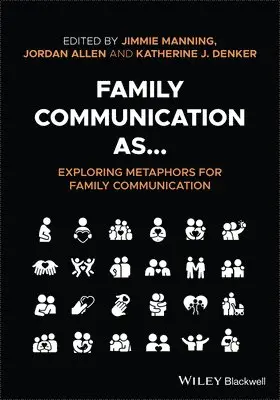
    Family Communication as... Exploring Metaphors for Family Communication

    AvJimmie Manning,Jimmie Manning

    Häftad, Engelska, 2022

    745 kr

    Beställningsvara. Skickas inom 5-8 vardagar. Fri frakt över 249 kr.

    Beskrivning

    An innovative textbook that presents a novel and compelling examination of family communication studies Family Communication as… Exploring Metaphors for Family Communication presents a series of metaphors through which students explore the nuances and complexities of family interaction. With a unique approach to the foundational theories and real-world practices of family communication, this easily accessible textbook helps students develop a clear understanding of what family communication is and what it can be. Contributions by both prominent and newer scholars theorize about family communication, offer new perspectives, challenge long-held assumptions, and describe original research to provide students with an up-to-date representation of the leading thinking in the field. Each concise chapter focuses on a specific element of family life, engaging key metaphors to stimulate classroom discussion about family in contexts ranging from ritual and embodiment to estrangement and heteronormativity. Throughout the text, students examine family metaphorically—as memory, as social identity, as estrangement, as loss, as resilience, as raced, and more. Presents a metaphorical examination of creating, materializing, contextualizing, politicizing, and complicating family communicationOffers an innovative alternative to standard textbooks on the subjectFeatures a thorough introduction advocating for the use of metaphors in teaching Discusses the key topics and theoretical approaches that have defined the fieldIncludes detailed references, additional readings, and an instructor’s companion website Family Communication as… Exploring Metaphors for Family Communication is an excellent textbook for advanced undergraduate and graduate students in courses including family communication, family studies, interpersonal communication, relational communication, and communication theory. It is also a highly useful resource for scholars in fields such as media studies, psychology, sociology, social work, counseling, and public health.

    Produktinformation

    • Utgivningsdatum:2022-12-15
    • Mått:10 x 10 x 10 mm
    • Vikt:454 g
    • Format:Häftad
    • Språk:Engelska
    • Antal sidor:256
    • Förlag:John Wiley and Sons Ltd
    • ISBN:9781119668398

    Utforska kategorier

    • Sociologi och antropologi inom Samhälle och politik

    Mer om författaren

    JIMMIE MANNING is Professor and Chair of Communication Studies at the University of Nevada, Reno. He has authored over 100 publications including Researching Interpersonal Relationships: Qualitative Methods, Studies, and Analysis. He has received numerous teaching honors including the National Communication Association Outstanding Mentor in Master’s Education Award. JORDAN ALLEN is Assistant Professor of Communication at Utah Valley University, where she teaches classes in interpersonal communication, family communication, research methods, and the dark side of interpersonal/family communication. Her program of research interrogates how nonnormative family relationships are symbolically and materially constituted in communication. KATHERINE J. DENKER is Professor, Basic Course Director, and Director of Graduate Studies in Communication Studies at Ball State University. She has received the Organization for the Study of Language Communication and Gender (OSCLG) Feminist Teacher Mentor Award. Her research program centers on issues of power and marginalization in instructional and interpersonal relationships.

    Innehållsförteckning

    • FORWARD INTRODUCTION:1. Family Communication as… Choice: Thinking about and Theorizing Family Communication Studies Using Metaphors –Jordan Allen, Utah Valley University; Katherine J. Denker, Ball State University; and Jimmie Manning, University of Nevada, RenoPART I: CREATING AND SUSTAINING FAMILY: FAMILY COMMUNICATION AS…2. Relationship – Mary Anne Fitzpatrick, University of South Carolina3. Ritual – Dawn O. Braithwaite and Robert D. Hall, University of Nebraska-Lincoln4. Biology – Anuraj Dhillon, California Polytechnic State University and Amanda Denes, University of Connecticut5. Maintenance – Scott A. Myers, West Virginia University6. Transition – Carolyn K. Shue and Glen H. Stamp, Ball State UniversityPART II: MATERIALIZING FAMILY: FAMILY COMMUNICATION AS…7. Social Identity – Jordan Soliz and Morgan April, University of Nebraska-Lincoln8. Heteronormative – Yachao Li, College of New Jersey9. Raced – Shardé M. Davis, University of Connecticut and Megan E. Cardwell, University of Nebraska, Lincoln10. Embodied – Laura L. Ellingson, Santa Clara University11. Performance – Bernadette Marie Calafell, Gonzaga University and Nivea Castaneda, Boise State University12. Narrative – Jody Koenig Kellas and Toni Morgan, University of Nebraska, Lincoln13.  Dialogue – Elizabeth A. Suter, University of Denver and Leah M. Seurer, University of South Dakota14.  Object – Devika Chawla, Ohio UniversityPART III: CONTEXTUALIZING FAMILY: FAMILY COMMUNICATION AS…15.  Memory – Robin M. Boylorn, University of Alabama16.  Boundary – Jeffrey T. Child, Kent State University17.  Organization – Caryn E. Medved, State University of New York Baruch College18.  Health – Christina G. Yoshimura, University of Montana19.  Mediated – Rebecca Johnson, University of Kansas and Danielle M. Stern, Christopher Newport University20.  Art – Sandra L. Faulkner, Laura Stafford, and Kimberly Kuiper, Bowling Green State UniversityPART IV: COMPLICATING FAMILY: FAMILY COMMUNICATION AS…21.  Argument – Jennifer L. Bevan and Erin S. Craw, Chapman University22.  Deviance – Kristina M. Scharp, University of Washington and Elizabeth Dorrance Hall, Michigan State University23.  Taboo – Allison R. Thorson, University of San Francisco and Amanda J. Holman, Creighton University24.  Failure – Andrea Lambert South and Jacqueline Emerine, Northern Kentucky University25.  Loss – Jillian A. Tullis, University of San Diego26.  Forgiveness – Vincent R. Waldron and Douglas L. Kelley, Arizona State University27.  Support – Adrianne Kunkel, University of Kansas; Natalie Hoskins, Middle Tennessee State University; Marissa Wiley, University of Kansas; and Michael Robert Dennis, Emporia State University28.  Resilience – Tamara D. Afifi, Chantel Haughton, and Allison Mazur, University of California Santa Barbara