• Fri frakt över 249 kr
  • •
  • Snabba leveranser
  • •
  • Billiga böcker
Kundservice

Du är på sajten för privatpersoner.

Företag, bibliotek eller offentlig verksamhet?

Du handlar på classic.bokus.com, där alla dina funktioner finns intakta.
Till classic.bokus.com
Bokus logotyp. Gå till startsidan.
  • Erbjudanden
  • Nyheter
  • Student
  • Topplistor
  • Barn & ungdom
  • Bokus Play
  • E-böcker
  • Pocketböcker
  • Spel & pussel

10% rabatt på allt med kod: NYSTART10 →

Sidfot

Mina sidor

    Hjälp

    • Kundservice
    • Vanliga frågor och svar
    • Frakt och leverans
    • Retur vid ångerrätt
    • Reklamera vara
    • Betalning
    • Köpvillkor
    • Allmänna villkor
    • Information om webbplatsens tillgänglighet

    Om Bokus

    • Om oss
    • Pressrum
    • För studenter
    • För företag
    • För bibliotek och offentlig verksamhet
    • För leverantörer
    • Hållbarhet

    Populärt

    • Aktuella erbjudanden
    • Presentkort
    • Studentlitteratur
    • Nya böcker
    • Topplistor
    • Signerade böcker
    • Engelska böcker

    Inspiration

    • Boktips
    • BookTok
    • Populära bokserier
    • Barnbokskaraktärer
    • Populära författare
    Logotyp för Bokus
    Följ oss på Facebook (extern länk)Följ oss på Instagram (extern länk)Följ oss på YouTube (extern länk)Följ oss på TikTok (extern länk)
    bokus @ CookiesAnpassa cookiesIntegritetspolicyKöpvillkor
    Till Citymail hemsida (extern länk)Till Budbee hemsida (extern länk)Till Postnord hemsida (extern länk)Till Schenker hemsida (extern länk)Till Early Bird hemsida (extern länk)Till Walleys hemsida (extern länk)
    1. Naturvetenskap och teknik
    2. Teknik och industri
    3. Elektronik och kommunikationer

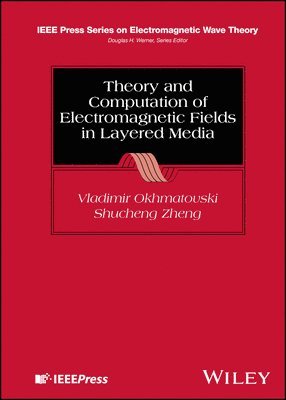
    Theory and Computation of Electromagnetic Fields in Layered Media

    AvVladimir Okhmatovski,Shucheng Zheng

    Inbunden, Engelska, 2024

    Del i serien IEEE Press Series on Electromagnetic Wave Theory and Applications

    1 580 kr

    Beställningsvara. Skickas inom 5-8 vardagar. Fri frakt över 249 kr.

    Beskrivning

    Explore the algorithms and numerical methods used to compute electromagnetic fields in multi-layered media In Theory and Computation of Electromagnetic Fields in Layered Media, two distinguished electrical engineering researchers deliver a detailed and up-to-date overview of the theory and numerical methods used to determine electromagnetic fields in layered media. The book begins with an introduction to Maxwell’s equations, the fundamentals of electromagnetic theory, and concepts and definitions relating to Green’s function. It then moves on to solve canonical problems in vertical and horizontal dipole radiation, describe Method of Moments schemes, discuss integral equations governing electromagnetic fields, and explains the Michalski-Zheng theory of mixed-potential Green’s function representation in multi-layered media. Chapters on the evaluation of Sommerfeld integrals, procedures for far field evaluation, and the theory and application of hierarchical matrices are also included, along with: A thorough introduction to free-space Green’s functions, including the delta-function model for point charge and dipole currentComprehensive explorations of the traditional form of layered medium Green’s function in three dimensionsPractical discussions of electro-quasi-static and magneto-quasi-static fields in layered media, including electrostatic fields in two and three dimensionsIn-depth examinations of the rational function fitting method, including direct spectra fitting with VECTFIT algorithmsPerfect for scholars and students of electromagnetic analysis in layered media, Theory and Computation of Electromagnetic Fields in Layered Media will also earn a place in the libraries of CAD industry engineers and software developers working in the area of computational electromagnetics.

    Produktinformation

    • Utgivningsdatum:2024-03-28
    • Mått:178 x 254 x 40 mm
    • Vikt:1 512 g
    • Format:Inbunden
    • Språk:Engelska
    • Serie:IEEE Press Series on Electromagnetic Wave Theory and Applications
    • Antal sidor:752
    • Förlag:John Wiley & Sons Inc
    • ISBN:9781119763192

    Utforska kategorier

    • Elektronik och kommunikationer inom Naturvetenskap och teknik

    Mer om författaren

    VLADIMIR OKHMATOVSKI, PHD, is a Professor in the Department of Electrical and Computer Engineering at the University of Manitoba in Canada. His research is focused on fast algorithms of electromagnetics, high-performance computing, modeling of interconnects, and inverse problems. SHUCHENG ZHENG is a Postdoctoral Fellow in the Department of Electrical and Computer Engineering at the University of Manitoba. His current research interests include computational electromagnetics, multi-layered media Green’s functions, high-performance computing, the modeling of high-speed interconnects, and transient analysis of power systems.

    Innehållsförteckning

    • About the Authors xviiForeword xixPreface xxiAcknowledgments xxiiiAcronyms xxvIntroduction xxvii1 Foundations of Electromagnetic Theory 11.1 Maxwell Equations 21.2 Curl–Curl Equations for the Electric and Magnetic Fields 61.3 Boundary Conditions 71.4 Poynting Theorem 111.5 Vector and Scalar Potentials 151.6 Quasi-Electrostatics. Scalar Potential. Capacitance 191.7 Quasi-Magnetostatics 211.8 Theory of DC and AC Circuits as a Limiting form of Maxwell Equations 311.9 Conclusions 352 Green’s Functions in Free Space 372.1 1D Green’s Function 372.2 3D Green’s Function Expansion in Cartesian Coordinates 412.3 3D Green’s Function in Cylindrical Coordinates 442.4 Physical Interpretation of Conical Waves Forming Sommerfeld Identity 462.5 Integral Field Representation Using Green’s Function 502.6 Field Decomposition into TE- and TM-waves in Cartesian Coordinates 512.7 Free-space Dyadic Green’s Functions of Electric and Magnetic Fields 542.8 Conclusions 593 Equivalence Principle and Integral Equations in Layered Media 613.1 Quasi-Electrostatics Reciprocity Relations in Layered Media 623.2 Equivalence Principle for the External Electrostatic Field in Layered Media 633.3 Integral Equation of Electrostatics for Metal Object in Layered Media 683.4 Integral Equation of Electrostatics for Disjoint Metal and Dielectric Objects in Layered Media 703.5 Integral Equation of Electrostatics for Metal and Dielectric Objects Sharing a Common Boundary and Situated in Layered Media 743.6 Integral Equation of Electrostatics for Dielectric Objects Sharing a Common Boundary and Situated in Layered Media 773.7 Integral Equations of Quasi-Magnetostatics for Wires in Layered Media 813.8 Full-Wave Reciprocity Relations in Layered Media 853.9 Integral Representations of Electromagnetic Fields via Equivalence Principle 913.10 Electric Field Integral Equation (EFIE) for PEC Object in Layered Medium 1053.11 Magnetic Field Integral Equation (MFIE) for PEC Object 1063.12 Coupled EFIEs for Penetrable Object 1103.13 Coupled MFIEs for Penetrable Object 1113.14 Muller, PMCHWT, and CFIE Formulations for Penetrable Object 1133.15 Volume Integral Equation 1153.16 Single-Source Integral Field Representations and Integral Equations 1183.17 Conclusions 1204 Canonical Problems of Vertical and Horizontal Dipoles Radiation in Layered Media 1214.1 The Electromagnetics of Dipole Currents in Open Planar Multi-layered Media 1214.2 Sommerfeld Problem: Vertical Electric Dipole Above Half-Space 1224.3 Vertical Magnetic Dipole in Layered Media 1264.4 Vertical Magnetic Dipole (VMD) in 3-Layer Medium 1284.5 Horizontal Electric Dipole in Layered Media 1344.6 Integration Paths of Complex Plane k >ρ > 1514.7 Conclusions 1585 Computation of Fields Via Integration Along Branch Cuts 1595.1 Transformation of SIP to Integrals Along Banks of Branch Cuts 1595.2 Parametrization of the Path Along Branch Cut Banks Under 2π√-Convention 1655.3 Parametrization of the Path Along Branch Cut Banks Under π∕2√ Convention 1695.4 Surface Waves 1715.5 Conclusions 1876 Computation of Fields Via Integration Along Steepest Descent Path 1896.1 Definition of Integrand and Spherical Wave SDP S >1 > 1926.2 Saddle Point on Plane k >ρ > and SDP in Its Vicinity 1936.3 Parametrization of Spherical Wave SDP S >1 > 1966.4 Crossing Point k >ρ > = k >1 >/sin θ on the SDP S >1 >1996.5 Case 1: SDP S >1 > Switches Riemann Sheets After Crossing Branch Cut 2016.6 Case 2: SDP S >1 > Remains on Same Riemann Sheet After Crossing Branch Cut 2096.7 Final Remark on Numerical Integration Along SDP 2116.8 Reflected Far Field from Saddle Point: Spherical Wave 2126.9 Reflected Far Field from Branch Point: Lateral (Conical) Wave 2136.10 Conclusions 2197 Computation of Fields Via Angular Spectral Representation 2217.1 Transformation of SIP to a Path on Complex Plane of Angles τ 2217.2 Reflected Field as Integral on Complex Plane of Angles τ 2247.3 Modification of Integration Path on Angles Plane τ to the SDP 2287.4 Accounting for Branch Cut and Surface Wave Poles in Integration Along SDP on Plane τ 2297.5 Asymptotic Evaluation of SDP Integrals for k >1 >R ≫ 1 2367.6 Conclusions 2458 Fields in Spherical Layered Media 2478.1 Scalar Green’s Function in Spherical Coordinates 2478.2 Electromagnetic Field in Terms of Debye Potentials 2508.3 Radial Electric Dipole (RED) in Spherical Layered Media 2538.4 Tangential Electric Dipole (TED) in Spherical Layered Media 2588.5 Conclusions 2679 Mixed-Potential Integral Equation 2699.1 Mixed-Potential Integral Equations in Free Space 2699.2 MPIE Formulation in Layered Medium 2749.3 Reduction of 3D Vector Maxwell’s Equations to 1D Scalar Telegraphers Equations 2859.4 Telegraphers Equations for Transmission Line Voltages and Currents and Their 1D Green’s Functions 2999.5 Relations of 3D Dyadic Green’s Functions to 1D Transmission Line Green’s Functions 3009.6 Transmission Line Formulation of Mixed-potential Green’s Function Components in Formulation C 3039.7 Closed-form Expressions for Voltages and Currents in General Layered Medium 3169.8 Conclusions 33610 Discretization of the MPIE with Shape Functions-based RWG MoM 33710.1 MPIE with Augmented Vector Potential Dyadic Green’s Function 33710.2 Current Expansion Over RWG- and Half-RWG (Ramp) Basis Functions 33810.3 Representation of MoM Matrix Elements in Terms of Shape Function Interactions 34910.4 Delta-gap Port Model and Pertinent Discretization 35510.5 Conclusions 36411 Computation of Incident Field from Electric Dipole Situated in the Far Zone 36511.1 Reciprocity Theorem Application 36511.2 The Method of Stationary Phase and Green’s Function Components K >A,zz >, When Dipole Is Situated in the Top Layer 36611.3 Green’s Function Components K >A,xx >, When Dipole Is Situated in the Top Layer 37311.4 Green’s Function Components K >A,zt >, When Dipole Is Situated in the Top Layer 37411.5 Green’s Function Components K >A,tz >, When Dipole Is Situated in the Top Layer 37711.6 Green’s Function Components ∇∇′K >φ >, When Dipole Is Situated in the Top Layer 37911.7 Conclusions 38512 Surface-Volume–Surface Electric Field Integral Equation 38712.1 Surface–Volume Equivalence Principle Augmented with Single-Source Representations 38712.2 SVS-VS-EFIE Formulation: SVS-EFIE Coupled to MPIE and VIE 39012.3 Method of Moments Discretization of SVS-S-V-EFIE Operators 39512.4 Conclusions 41513 Electromagnetic Analysis with Method of Moments in Shielded Layered Media 41713.1 The Electromagnetics of Dipole Fields in Shielded Planar Multi-layered Media 41713.2 Electric and Magnetic Field Dyadic Green’s Functions in Shielded Layered Media 42013.3 Electric Field Integral Equation 42913.4 Spectral Domain Method of Moment Discretization on Manhattan Grid 43013.5 Space-Domain Method of Moments with Manhattan Gridded Discretization 44413.6 Conclusions 45114 Method of Weighted Averages (Mosig–Michalski Extrapolation Algorithm) 45314.1 Introduction 45314.2 Classic First-Order Weighted Average Approximation 46114.3 Recursive Weighted Average Algorithm 46614.4 Conclusions 49215 Extraction of Quasi-Static Images 49315.1 Introduction 49315.2 Prioritized Ray Tracing Algorithm 49415.3 Static Images for Voltages and Currents 50415.4 Static Image Contributions to Green’s Function Components in the Michalski–Zheng’s Mixed-Potential Form: Source and Observer Points are in the Same Layer 50915.5 Static Image Contributions to Green’s Function Components in the Michalski–Zheng’s Mixed-Mixed-Potential Form: Source Point Layer Is Below Observer Point Layer 52915.6 Static Image Contributions to Green’s Function Components in the Michalski–Zheng’s Mixed-Potential Form: Source Point Layer Is Above Observer Point Layer 53715.7 Conclusions 54216 Discrete Complex Image Method 54516.1 Introduction 54516.2 Complex Exponentials Fitting 54716.3 Single-level DCIM 55116.4 Two-level DCIM 55316.5 Conclusions 55517 Extraction of Singular Integrals from MoM Reaction Integrals and Their Analytic Evaluation 55717.1 Source Point and the Observation Point Are in the Same Layer 55817.2 Source Layer Below Observation Layer 56317.3 Source Layer Above Observation Layer 56517.4 Conclusions 56618 Methods Based on Rational Function Approximation of Green’s Function Spectra 56718.1 Rational Function Fitting Method (RFFM) 56818.2 Spectral Differential Equations Approximation Method (SDEAM) for Vector Potential Green’s Function 57518.3 SDEAM for Mixed-Potential Green’s Functions 58018.4 Higher-Order SDEAM Solutions and Their Error Bounds 59218.5 Dependence on Number of Terms on Radial Distance ρ 59318.6 SDEAM for Spherical Layered Media 59318.7 Advantages of High-Order SDEAM for Spherical Layered Media 59918.8 Conclusions 600Appendix A Multivalued Complex Functions, Branch Cuts, and Riemann Surfaces 601A.1 Multivalued Complex Functions, Branches, Branch Points, and Branch Cuts 601A.1.1 Contour Mapping from Plane k >ρ > to Plane k >z > 608A.1.2 Branch Cut Method for Ensuring Analyticity of Multifunctions 611A.1.3 Riemann Surface Representation of Multifunctions 613A.1.4 Practical Considerations for Evaluation of ̇√k2 − k >ρ >2 Directly Versus as a Product √k − k >ρ >√k + k >ρ > 618Appendix B Evaluation of Singular Integrals 621B.1 Evaluation Over Triangles of Integrals Containing e−ιkR∕R Green’s Function 621B.2 Evaluation Over Triangles of Integrals Containing Product of e−ιkR∕R Green’s Function and a Linear Function 635Appendix C Reduction of Cos–Cos Series to DFT 643C.1 Cos–Cos Series Rearrangement 643C.2 Casting Cos–Cos Series into DFT Form 645Appendix D Properties of Vector Potential and Its Derivatives Near a Sheet of Current 647D.1 Vector Potential Near Small Disk σ 647D.2 Tangential Derivative of the Vector Potential 649D.3 Second Tangential Derivative of the Vector Potential 649D.4 Normal Derivative of Vector Potential 650D.5 Mixed Second-order Derivative of Vector Potential Over Tangential Coordinates 651D.6 Mixed Second-order Derivatives Over X and Z 652Appendix E Basis Definitions of Dyadic, Tensor, and Operations with Them 655Appendix F Equivalence Principle for the External Electric Field in Free Space 659Appendix G Physically Consistent Model for the Extraction of Conductance in Lossy Dielectrics 665Appendix H Alternative Expression of Equivalence Principle for the External Magnetic Field 669Appendix I Definition of Inductance and Resistance in Frequency Domain 673Appendix J Integral Equations of Electrostatics in Multi-Region Scenarios with Free-Space Green’s Functions 677J.1 Equivalence Principle for the External Electrostatic Field in Layered Media 677J.2 Integral Equation of Electrostatics for Metal Object in Homogeneous Space 679J.3 Integral Equation of Quasi-Electrostatics for Disjoint Metal and Dielectric Objects 679J.4 Integral Equation of Quasi-Electrostatics for Metal and Dielectric Objects Sharing a Common Boundary and Situated in Homogeneous Media 682J.5 Integral Equation of Quasi-Electrostatics for Dielectric Objects Sharing a Common Boundary and Situated in Free Space 683J.6 Method of Moments Solution of Electrostatic Integral Equations 687References 691Index 701