• Fri frakt över 249 kr
  • •
  • Snabba leveranser
  • •
  • Billiga böcker
Kundservice

Du är på sajten för privatpersoner.

Företag, bibliotek eller offentlig verksamhet?

Du handlar på classic.bokus.com, där alla dina funktioner finns intakta.
Till classic.bokus.com
Bokus logotyp. Gå till startsidan.
  • Erbjudanden
  • Nyheter
  • Student
  • Topplistor
  • Barn & ungdom
  • Bokus Play
  • E-böcker
  • Pocketböcker
  • Spel & pussel

10% rabatt på allt med kod: NYSTART10 →

Sidfot

Mina sidor

    Hjälp

    • Kundservice
    • Vanliga frågor och svar
    • Frakt och leverans
    • Retur vid ångerrätt
    • Reklamera vara
    • Betalning
    • Köpvillkor
    • Allmänna villkor
    • Information om webbplatsens tillgänglighet

    Om Bokus

    • Om oss
    • Pressrum
    • För studenter
    • För företag
    • För bibliotek och offentlig verksamhet
    • För leverantörer
    • Hållbarhet

    Populärt

    • Aktuella erbjudanden
    • Presentkort
    • Studentlitteratur
    • Nya böcker
    • Topplistor
    • Signerade böcker
    • Engelska böcker

    Inspiration

    • Boktips
    • BookTok
    • Populära bokserier
    • Barnbokskaraktärer
    • Populära författare
    Logotyp för Bokus
    Följ oss på Facebook (extern länk)Följ oss på Instagram (extern länk)Följ oss på YouTube (extern länk)Följ oss på TikTok (extern länk)
    bokus @ CookiesAnpassa cookiesIntegritetspolicyKöpvillkor
    Till Citymail hemsida (extern länk)Till Budbee hemsida (extern länk)Till Postnord hemsida (extern länk)Till Schenker hemsida (extern länk)Till Early Bird hemsida (extern länk)Till Walleys hemsida (extern länk)
    1. Ekonomi och Ledarskap
    2. Företagsekonomi
    3. Redovisning och finansiering
    4. Finansiering

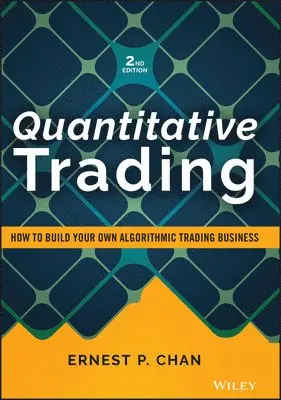
    Quantitative Trading

    How to Build Your Own Algorithmic Trading Business

    AvErnest P. Chan

    Inbunden, Engelska, 2021

    Del i serien Wiley Trading

    539 kr

    Beställningsvara. Skickas inom 3-6 vardagar. Fri frakt över 249 kr.

    Fler format och utgåvor

    Häftad

    240 kr

    E-bok

    488 kr

    E-bok

    489 kr

    E-bok

    342 kr

    E-bok

    342 kr

    Beskrivning

    Master the lucrative discipline of quantitative trading with this insightful handbook from a master in the fieldIn the newly revised Second Edition of Quantitative Trading: How to Build Your Own Algorithmic Trading Business, quant trading expert Dr. Ernest P. Chan shows you how to apply both time-tested and novel quantitative trading strategies to develop or improve your own trading firm.You'll discover new case studies and updated information on the application of cutting-edge machine learning investment techniques, as well as: Updated back tests on a variety of trading strategies, with included Python and R code examplesA new technique on optimizing parameters with changing market regimes using machine learning.A guide to selecting the best traders and advisors to manage your moneyPerfect for independent retail traders seeking to start their own quantitative trading business, or investors looking to invest in such traders, this new edition of Quantitative Trading will also earn a place in the libraries of individual investors interested in exploring a career at a major financial institution.

    Produktinformation

    • Utgivningsdatum:2021-09-16
    • Mått:160 x 232 x 26 mm
    • Vikt:440 g
    • Format:Inbunden
    • Språk:Engelska
    • Serie:Wiley Trading
    • Antal sidor:256
    • Upplaga:2
    • Förlag:John Wiley & Sons Inc
    • ISBN:9781119800064

    Utforska kategorier

    • Finansiering inom Ekonomi och Ledarskap

    Mer om författaren

    ERNEST P. CHAN, PhD, is an expert in the application of statistical models and software for trading currencies, futures, and stocks. He holds a doctorate in theoretical physics from Cornell University and is Managing Member of investment management firm QTS Capital Management and founder of financial machine learning firm Predictnow.ai.

    Innehållsförteckning

    • Preface to the 2nd Edition xiPreface xvAcknowledgments xxiChapter 1: The Whats, Whos, and Whys of Quantitative Trading 1Who Can Become a Quantitative Trader? 2The Business Case for Quantitative Trading 4Scalability 5Demand on Time 5The Nonnecessity of Marketing 7The Way Forward 8Chapter 2: Fishing for Ideas 11How to Identify a Strategy that Suits You 14Your Working Hours 14Your Programming Skills 15Your Trading Capital 15Your Goal 19A Taste for Plausible Strategies and Their Pitfalls 20How Does It Compare with a Benchmark, and How Consistent Are Its Returns? 20How Deep and Long Is the Drawdown? 23How Will Transaction Costs Affect the Strategy? 24Does the Data Suffer from Survivorship Bias? 26How Did the Performance of the Strategy Change over the Years? 27Does the Strategy Suffer from Data-Snooping Bias? 28Does the Strategy “Fly under the Radar” of Institutional Money Managers? 30Summary 30References 31Chapter 3: Backtesting 33Common Backtesting Platforms 34Excel 34MATLAB 34Python 36R 38QuantConnect 40Blueshift 40Finding and Using Historical Databases 40Are the Data Split and Dividend Adjusted? 41Are the Data Survivorship-Bias Free? 44Does Your Strategy Use High and Low Data? 46Performance Measurement 47Common Backtesting Pitfalls to Avoid 57Look-Ahead Bias 58Data-Snooping Bias 59Transaction Costs 72Strategy Refinement 77Summary 78References 79Chapter 4: Setting Up Your Business 81Business Structure: Retail or Proprietary? 81Choosing a Brokerage or Proprietary Trading Firm 85Physical Infrastructure 87Summary 89References 91Chapter 5: Execution Systems 93What an Automated Trading System Can Do for You 93Building a Semiautomated Trading System 95Building a Fully Automated Trading System 98Minimizing Transaction Costs 101Testing Your System by Paper Trading 103Why Does Actual Performance Diverge from Expectations? 104Summary 107Chapter 6: Money and Risk Management 109Optimal Capital Allocation and Leverage 109Risk Management 120Model Risk 124Software Risk 125Natural Disaster Risk 125Psychological Preparedness 125Summary 130Appendix: A Simple Derivation of the Kelly Formula when Return Distribution Is Gaussian 131References 132Chapter 7: Special Topics in Quantitative Trading 133Mean-Reverting versus Momentum Strategies 134Regime Change and Conditional Parameter Optimization 137Stationarity and Cointegration 147Factor Models 160What Is Your Exit Strategy? 169Seasonal Trading Strategies 174High-Frequency Trading Strategies 186Is it Better to Have a High-Leverage versus a High-Beta Portfolio? 188Summary 190References 192Chapter 8: Conclusion 193Next Steps 197References 198Appendix: A Quick Survey of MATLAB 199Bibliography 205About the Author 209Index 211