• Fri frakt över 249 kr
  • •
  • Snabba leveranser
  • •
  • Billiga böcker
Kundservice

Du är på sajten för privatpersoner.

Företag, bibliotek eller offentlig verksamhet?

Du handlar på classic.bokus.com, där alla dina funktioner finns intakta.
Till classic.bokus.com
Bokus logotyp. Gå till startsidan.
  • Erbjudanden
  • Nyheter
  • Student
  • Topplistor
  • Barn & ungdom
  • Bokus Play
  • E-böcker
  • Pocketböcker
  • Spel & pussel

10% rabatt på allt med kod: NYSTART10 →

Sidfot

Mina sidor

    Hjälp

    • Kundservice
    • Vanliga frågor och svar
    • Frakt och leverans
    • Retur vid ångerrätt
    • Reklamera vara
    • Betalning
    • Köpvillkor
    • Allmänna villkor
    • Information om webbplatsens tillgänglighet

    Om Bokus

    • Om oss
    • Pressrum
    • För studenter
    • För företag
    • För bibliotek och offentlig verksamhet
    • För leverantörer
    • Hållbarhet

    Populärt

    • Aktuella erbjudanden
    • Presentkort
    • Studentlitteratur
    • Nya böcker
    • Topplistor
    • Signerade böcker
    • Engelska böcker

    Inspiration

    • Boktips
    • BookTok
    • Populära bokserier
    • Barnbokskaraktärer
    • Populära författare
    Logotyp för Bokus
    Följ oss på Facebook (extern länk)Följ oss på Instagram (extern länk)Följ oss på YouTube (extern länk)Följ oss på TikTok (extern länk)
    bokus @ CookiesAnpassa cookiesIntegritetspolicyKöpvillkor
    Till Citymail hemsida (extern länk)Till Budbee hemsida (extern länk)Till Postnord hemsida (extern länk)Till Schenker hemsida (extern länk)Till Early Bird hemsida (extern länk)Till Walleys hemsida (extern länk)
    1. Juridik
    2. Rättsvetenskap

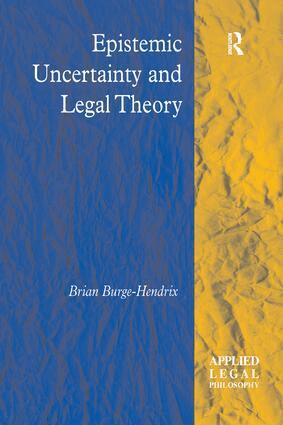
    Epistemic Uncertainty and Legal Theory

    AvBrian Burge-Hendrix

    Häftad, Engelska, 2016

    Del i serien Applied Legal Philosophy

    755 kr

    Beställningsvara. Skickas inom 10-15 vardagar. Fri frakt över 249 kr.

    Fler format och utgåvor

    Inbunden

    2 227 kr

    E-bok

    895 kr

    E-bok

    897 kr

    Beskrivning

    Crossing the usual boundaries of abstract legal theory, this book considers actual charter systems - legal systems with explicitly posited moral-political rights, such as those of Canada and the United States - as well as cases in constitutional adjudication. It shows the worth of careful reflection on methodological and meta-theoretical issues for a comprehensive account of a present-day legal system which is fast becoming the norm. The author explicitly connects the ongoing Methodology Debate within legal philosophy to constitutional adjudication and Canadian law. By drawing out the implications of the Methodology Debate and the challenge of giving a proper account of constitutional adjudication in a general theory of law, the study examines how a descriptive, morally and politically neutral legal theory can deal with epistemic uncertainty - uncertainty about the actual status of moral-political legal provisions and their jurisprudential function - in a thoroughgoing manner. It also demonstrates the merits of a minimalist version of Legal Positivism with regard to the practical importance of charters in charter systems and societies.

    Produktinformation

    • Utgivningsdatum:2016-11-17
    • Mått:156 x 234 x 12 mm
    • Vikt:453 g
    • Format:Häftad
    • Språk:Engelska
    • Serie:Applied Legal Philosophy
    • Antal sidor:212
    • Förlag:Taylor & Francis Ltd
    • ISBN:9781138267794

    Utforska kategorier

    • Rättsvetenskap inom Juridik
    • Juridik: metod och teori inom Juridik

    Mer om författaren

    Brian Burge-Hendrix is a Fellow of Churchill College, Cambridge, and a member of the Cambridge Forum for Legal and Political Philosophy. Educated in Canada, he has lectured extensively to students on legal philosophy, political philosophy, and applied ethics at several Canadian universities, including McMaster University and the University of Toronto. Dr Burge-Hendrix has published widely on contemporary legal philosophy, ancient legal theory, and the philosophy of music.

    Recensioner i media

    'Epistemic Uncertainty and Legal Theory admirably succeeds in its chosen task of developing meta-theoretical criteria according to which we can evaluate competing theories of law. It offers a convincing and highly original argument for the preferability of inclusive over exclusive positivism as an account of the legal ordering of societies founded on constitutionally-entrenched charters of rights. The style is elegant and marked by a beautifully controlled economy of argument. An influential book that is a pleasure to read.' Antje du Bois-Pedain, University of Cambridge, UK

    Innehållsförteckning

    • Contents: Preface; Epistemic uncertainty and the methodology debate; Concept or concepts of law?; Choosing a theory of law; 'Methodological' positivism; Uncertainly on the ground; Understanding the Canadian constitution: the division of labour in legal theory; Perspectival differences; Bibliography; Index.