• Fri frakt över 249 kr
  • •
  • Snabba leveranser
  • •
  • Billiga böcker
Kundservice

Du är på sajten för privatpersoner.

Företag, bibliotek eller offentlig verksamhet?

Du handlar på classic.bokus.com, där alla dina funktioner finns intakta.
Till classic.bokus.com
Bokus logotyp. Gå till startsidan.
  • Erbjudanden
  • Nyheter
  • Student
  • Topplistor
  • Barn & ungdom
  • Bokus Play
  • E-böcker
  • Pocketböcker
  • Spel & pussel

10% rabatt på allt med kod NYSTART10 →

Sidfot

Mina sidor

    Hjälp

    • Kundservice
    • Vanliga frågor och svar
    • Frakt och leverans
    • Retur vid ångerrätt
    • Reklamera vara
    • Betalning
    • Köpvillkor
    • Allmänna villkor
    • Information om webbplatsens tillgänglighet

    Om Bokus

    • Om oss
    • Pressrum
    • För studenter
    • För företag
    • För bibliotek och offentlig verksamhet
    • För leverantörer
    • Hållbarhet

    Populärt

    • Aktuella erbjudanden
    • Presentkort
    • Studentlitteratur
    • Nya böcker
    • Topplistor
    • Signerade böcker
    • Engelska böcker

    Inspiration

    • Boktips
    • BookTok
    • Populära bokserier
    • Barnbokskaraktärer
    • Populära författare
    Logotyp för Bokus
    Följ oss på Facebook (extern länk)Följ oss på Instagram (extern länk)Följ oss på YouTube (extern länk)Följ oss på TikTok (extern länk)
    bokus @ CookiesAnpassa cookiesIntegritetspolicyKöpvillkor
    Till Citymail hemsida (extern länk)Till Budbee hemsida (extern länk)Till Postnord hemsida (extern länk)Till Schenker hemsida (extern länk)Till Early Bird hemsida (extern länk)Till Walleys hemsida (extern länk)
    1. Ekonomi och Ledarskap
    2. Företagsekonomi
    3. Redovisning och finansiering
    4. Redovisning

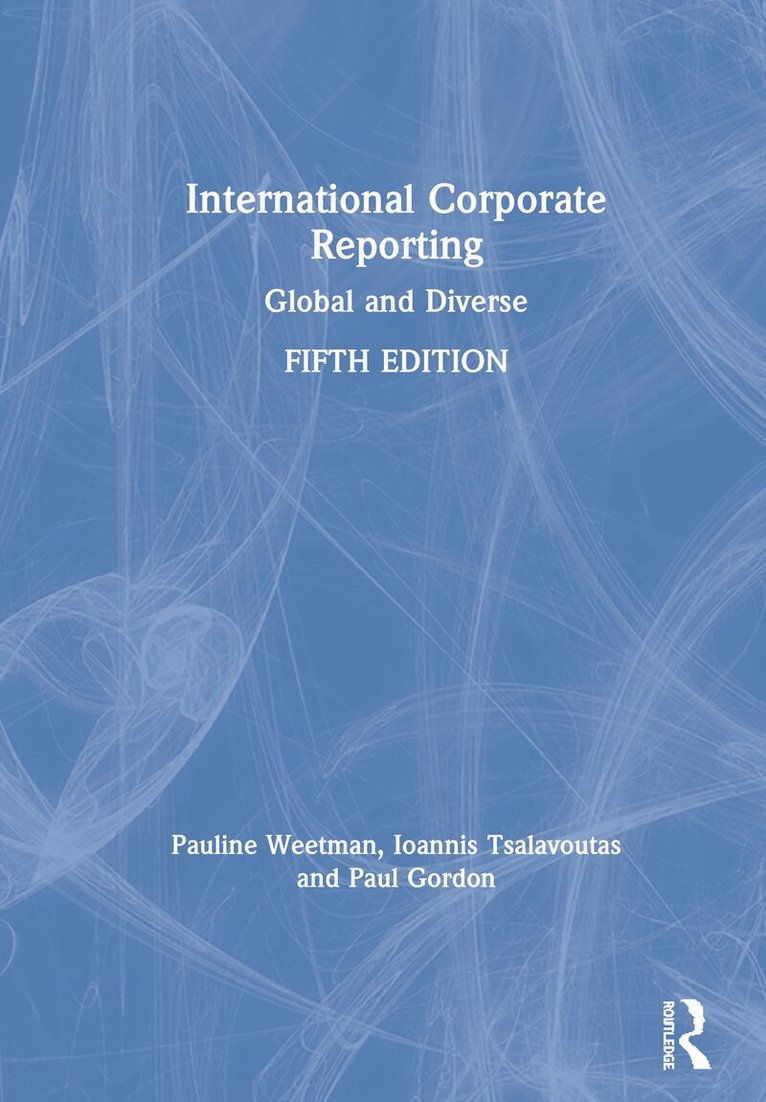
    International Corporate Reporting

    Global and Diverse

    AvPauline Weetman,Ioannis Tsalavoutas

    Inbunden, Engelska, 2020

    3 045 kr

    Beställningsvara. Skickas inom 10-15 vardagar. Fri frakt över 249 kr.

    Fler format och utgåvor

    Häftad

    933 kr

    Beskrivning

    This textbook provides a comprehensive overview of international corporate reporting which enhances students’ understanding of diversity and convergence in the field. The authors discuss the institutional and cultural context in which international corporate reporting has developed over the years as well as the global reach of IFRS Standards from the IASB throughout and beyond the European Union, into interest groups and emerging economies. Other key elements explored throughout the book include assurance through auditing and corporate governance, narrative reporting, strategic and corporate social responsibility, group accounting, current accounting issues and taxation in corporate reports. Indicative research examples show how the methods used in research papers may be understood and applied. Case studies outline short projects based on corporate cases, with related links to material on corporate websites. Helpful and reliable sources of information and data are identified through hyperlinks to accessible websites. End-of-chapter questions encourage discussion of the main issues. Throughout there is a focus on accountability and the information needs of stakeholders.This new edition of a classic text is fully revised and updated in order to remain essential reading for students of international accounting and corporate reporting globally. The book will be an invaluable resource for postgraduate taught programmes and final-year undergraduate courses in accounting, finance and business studies.

    Produktinformation

    • Utgivningsdatum:2020-03-10
    • Mått:174 x 246 x 29 mm
    • Vikt:1 043 g
    • Format:Inbunden
    • Språk:Engelska
    • Antal sidor:446
    • Upplaga:5
    • Förlag:Taylor & Francis Ltd
    • ISBN:9781138364981

    Utforska kategorier

    • Redovisning inom Ekonomi och Ledarskap

    Mer om författaren

    Pauline Weetman is Professor Emerita in Accounting at the University of Edinburgh and holds the Distinguished Academic Award 2005 of the British Accounting and Finance Association. She is a co-editor of The Routledge Companion to Accounting in Emerging Economies.Ioannis Tsalavoutas is Professor of Accounting and Finance at the University of Glasgow and holds a PhD in Accounting from the University of Edinburgh. His research on financial accounting and reporting has featured in leading journals. He is a co-editor of The Routledge Companion to Accounting in Emerging Economies.Paul Gordon is a lecturer in accounting and finance at Heriot-Watt University, having previously held positions at Glasgow, Aberdeen and Bangor. His teaching interests include international accounting and financial analysis.

    Recensioner i media

    'This is an outstanding new (fifth) edition of a well-established international accounting textbook from a highly experienced team of authors. Notably, there is a valuable focus on cultural and institutional influences along with a comprehensive coverage of key reporting issues.' — Professor Sid Gray, University of Sydney, Australia'International Corporate Reporting is always part of my recommended textbooks to students across a wide variety of masters’ courses I have taught. It is a must for those who want to understand the current global corporate reporting landscape. And it is truly international in perspective!' — Paul André, PhD, CPA-CA, Professor of Accounting, HEC Lausanne, Switzerland'International Corporate Reporting is about anything corporate reporting that is not financial accounting theory or financial statement preparation. It is logically structured, combines breadth with depth, and is impressive in its academic treatment of a great variety of relevant topics.' — Carien van Mourik, Senior Lecturer in Accounting, The Open University, Faculty of Business and Law, UK'The book discusses a good variety of topics related to international accounting practice and regulation. Chapters are laid out in an easy-to-follow fashion, offering different ways in which to engage with the content, from brief overviews to detailed case studies. A very worthwhile read for those interested in the topic!' — Anna Samsonova-Taddei, Professor of Accounting, Alliance Manchester Business School, University of Manchester, PhD Director (Accounting Pathway), UK'International Corporate Reporting by Weetman, Tsalavoutas, and Gordon is an excellent resource with a vast amount of information about the major international financial and accounting institutional structures. While the text is broad in its scope and includes discussions regarding China, Japan, and the US, its focus is definitely from a European perspective. Thus, it could greatly assist US graduate accounting and finance students in learning about the broader environments in which accounting and auditing functions in today’s global economy.' — Robert K. Larson, Professor of Accounting, Editor-in-Chief, Journal of International Accounting, Auditing & Taxation, Carl H. Lindner College of Business, University of Cincinnati'This textbook, written in a friendly style with clear descriptions, discussions, and explanations, provides a thoughtful presentation that helps the reader understand and appreciate the multi-dimensional process involved in corporate reporting. The emphasis on institutional settings and cultures enhance our conceptual understanding and practical aspects of corporate reporting. This book is a must read for any student of corporate reporting.' — Theodore Sougiannis, KMPG Distinguished Professor of Accountancy, University of Illinois at Urbana-Champaign

    Innehållsförteckning

    • List of exhibits and case studiesAuthor biographiesPrefaceAcknowledgementsPart I Institutions, culture and research methodsChapter 1 Global corporate reportingLearning outcomes1.1 Current trends in global corporate reporting1.2 Overview of corporate reporting 1.3 Our approach in this book1.4 The language we use1.5 Establishing global authority in corporate reporting1.6 Challenging globalisation1.7 Summary and key pointsQuestionsReferencesChapter 2 Institutional and external influences Learning outcomes 2.1 Introduction 2.2 Factors influencing the development of accounting systems 2.3 The political and economic system 2.4 The legal system 2.5 The taxation system 2.6 The corporate financing system 2.7 The accounting profession 2.8 Religious institutions 2.9 Other influences 2.10 Indicative research examples 2.11. Summary and key points Questions References Chapter 3 Cultural influences Learning outcomes 3.1 Introduction 3.2 Defining culture 3.3 Culture and business 3.4 Culture and accounting 3.5 Is culture an important influence on accounting? 3.6 Indicative research examples 3.7 Summary and key points Questions References Chapter 4 Classification of accounting systemsLearning outcomes4.1 Introduction 4.2 Reasons for classifying accounting systems 4.3 Deductive and inductive classification 4.4 Approaches to classification 4.5 Development of classification studies 4.6 Is classification successful? 4.7 Summary and key points Questions References Chapter 5 Measuring harmonisation and diversityLearning outcomes 5.1 Introduction 5.2 Similarities and differences in the accounting methods used 5.3 Good news, bad news and earnings ‘conservatism’ 5.4 Similarities and differences in narrative disclosure 5.5 Summary and key points Questions References Part II Global reach of international standardsChapter 6 Developing international financial reporting standardsLearning outcomes 6.1 Introduction 6.2 Structure for setting IFRS Standards 6.3 Operation of the IASB 6.4 Challenges to the IASB 6.5 The International Federation of Accountants 6.6 Indicative research examples 6.7 Summary and key points QuestionsReferencesChapter 7 European accounting and reportingLearning outcomes7.1 Introduction 7.2 European Union (EU) 7.3 Accounting in EU member states7.4 National standard setters in Europe7.5 European Securities Markets Authority (ESMA)7.6 Indicative research examples7.7 Summary and key pointsAppendix to Chapter 7QuestionsReferencesChapter 8 Global organisations and interest groupsLearning outcomes8.1 Introduction 8.2 Political influence 8.3 Initiatives from the business community 8.4 Cooperation in the accountancy profession 8.5 Regional groups in the accountancy profession8.6 Indicative research examples8.7 Summary and key pointsQuestionsReferencesChapter 9 Broadening the influence of IFRS StandardsLearning outcomes 9.1 Introduction 9.2 Differential reporting9.3 Balancing national control with IFRS convergence9.4 Public sector accounting standards9.5 Indicative research examples9.6 Summary and key pointsQuestionsReferencesPart III AssuranceChapter 10 AuditingLearning outcomes10.1 Introduction10.2 International Auditing and Assurance Standards Board 10.3 National monitoring and review of audit firms10.4 Developing the audit report10.5 Competition and audit reform10.6 Indicative research examples10.7 Summary and key pointsQuestionsReferencesChapter 11 Corporate governance Learning outcomes11.1 Introduction11.2 Organisation for Economic Cooperation and Development (OECD) 11.3 Corporate governance models11.4 Corporate governance codes11.5 Enforcement and ratings11.6 Indicative research examples11.7 Summary and key pointsQuestionsReferencesPart IV Narrative corporate reportingChapter 12 Management commentary and strategic reportingLearning outcomes12.1 Introduction 12.2 Management discussion and analysis in the US12.3 Management reports through the EU Accounting Directive12.4 IASB Management commentary12.5 Remuneration reports12.6 Dual listing and investor communication12.7 The meaning of ‘transparency’12.8 Indicative research examples12.9 Summary and key pointsQuestionsReferencesChapter 13 Corporate social responsibility and sustainabilityLearning outcomes13.1 Introduction 13.2 Initiatives supported by the United Nations13.3 Governmental-backed strategies 13.4 Global networks and interest groups13.5 Market ratings13.6 Is CSR reporting effective for sustainability?13.7 Indicative research examples13.8 Summary and key pointsQuestionsReferencesPart VI Accounting and taxationChapter 14 Group reportingLearning outcomes14.1 Introduction 14.2 Group accounting14.3 Goodwill and impairment14.4 Associates and joint ventures14.5 Foreign currency and hyperinflation14.6 Summary and key pointsQuestionsReferencesChapter 15 Current issues in accountingLearning outcomes15.1 Introduction 15.2 Fair value accounting15.3 Investment properties15.4 Revenue recognition 15.5 Research and development expenditure15.6 Leases15.7 Alternative performance measures (non-GAAP reporting)15.8 Indicative research examples15.9 Summary and key pointsQuestionsReferencesChapter 16 Corporate tax reportingLearning outcomes16.1 Introduction16.2 Tax systems16.3 IAS 12 Accounting for income taxes16.4 Tax planning and transfer pricing16.5 Country-by-country reporting16.6 Indicative research examples16.7 Summary and key pointsQuestionsReferencesPart VI National interests in an environment of global reportingChapter 17 United StatesLearning outcomes 17.1 Introduction17.2 Institutional and external influences17.3 Development of accounting regulation17.4 The corporate reporting system17.5 Auditing and corporate governance17.6 Indicative research examples17.7 Summary and key pointsQuestionsReferencesChapter 18 ChinaLearning outcomes18.1 Introduction18.2 Institutions18.3 Development of accounting regulation18.4 Corporate reporting framework18.5 Auditing and corporate governance18.6 Hong Kong18.7 Indicative research examplesQuestionsReferencesChapter 19 JapanLearning outcomes19.1 Introduction 19.2 Institutions19.3 External influences on accounting19.4 Development of accounting regulation19.5 The corporate reporting system19.6 Auditing and corporate governance19.7 Indicative research examples19.8 Summary and key pointsQuestionsReferencesIndex