• Fri frakt över 249 kr
  • •
  • Snabba leveranser
  • •
  • Billiga böcker
Kundservice

Du är på sajten för privatpersoner.

Företag, bibliotek eller offentlig verksamhet?

Du handlar på classic.bokus.com, där alla dina funktioner finns intakta.
Till classic.bokus.com
Bokus logotyp. Gå till startsidan.
  • Erbjudanden
  • Nyheter
  • Student
  • Topplistor
  • Barn & ungdom
  • Bokus Play
  • E-böcker
  • Pocketböcker
  • Spel & pussel

Må bättre, för mindre! Upp till 50% rabatt på hälsoböcker

Sidfot

Mina sidor

    Hjälp

    • Kundservice
    • Vanliga frågor och svar
    • Frakt och leverans
    • Retur vid ångerrätt
    • Reklamera vara
    • Betalning
    • Köpvillkor
    • Allmänna villkor
    • Information om webbplatsens tillgänglighet

    Om Bokus

    • Om oss
    • Pressrum
    • För studenter
    • För företag
    • För bibliotek och offentlig verksamhet
    • För leverantörer
    • Hållbarhet

    Populärt

    • Aktuella erbjudanden
    • Presentkort
    • Studentlitteratur
    • Nya böcker
    • Topplistor
    • Signerade böcker
    • Engelska böcker

    Inspiration

    • Boktips
    • BookTok
    • Populära bokserier
    • Barnbokskaraktärer
    • Populära författare
    Logotyp för Bokus
    Följ oss på Facebook (extern länk)Följ oss på Instagram (extern länk)Följ oss på YouTube (extern länk)Följ oss på TikTok (extern länk)
    bokus @ CookiesAnpassa cookiesIntegritetspolicyKöpvillkor
    Till Citymail hemsida (extern länk)Till Budbee hemsida (extern länk)Till Postnord hemsida (extern länk)Till Schenker hemsida (extern länk)Till Early Bird hemsida (extern länk)Till Walleys hemsida (extern länk)
    1. Ekonomi och Ledarskap
    2. Ledarskapsböcker

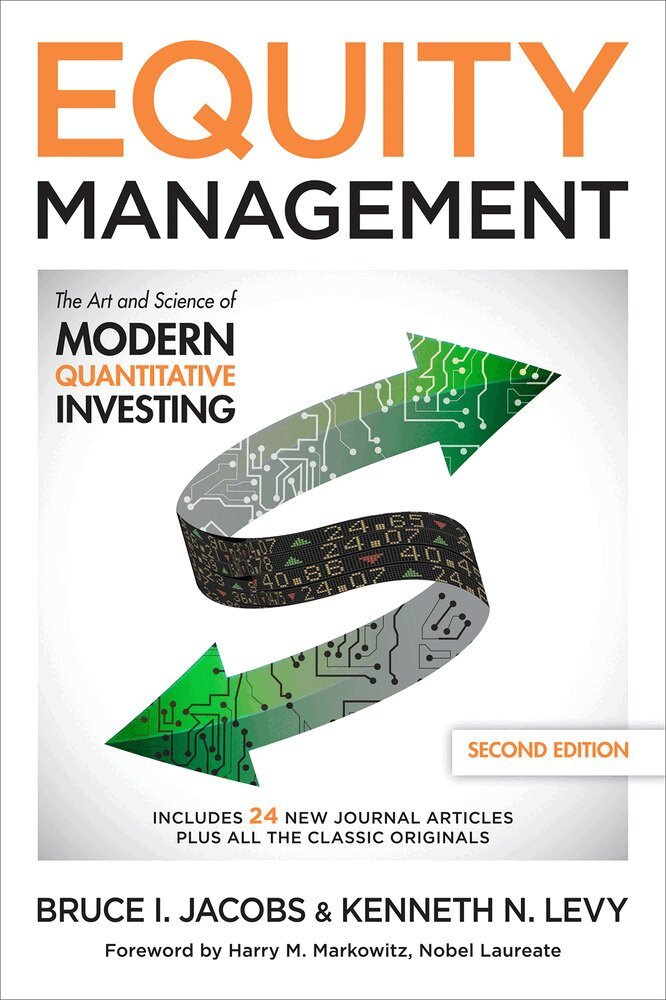
    Equity Management: The Art and Science of Modern Quantitative Investing, Second Edition

    AvBruce Jacobs,Kenneth Levy

    Inbunden, Engelska, 2016

    830 kr

    Beställningsvara. Skickas inom 3-6 vardagar. Fri frakt över 249 kr.

    Beskrivning

    The classic guide to quantitative investing—expanded and updated for today’s increasingly complex markets

    From Bruce Jacobs and Ken Levy—two pioneers of quantitative equity management— the go-to guide to stock selection has been substantially updated to help you build portfolios in today’s transformed investing landscape.

    A powerful combination of in-depth research and expert insights gained from decades of experience, Equity Management, Second Edition includes 24 new peer-reviewed articles that help leveraged long-short investors and leverage-averse investors navigate today’s complex and unpredictable markets.

    Retaining all the content that made an instant classic of the first edition—including the authors’ innovative approach to disentangling the many factors that influence stock returns, unifying the investment process, and integrating long and short portfolio positions—this new edition addresses critical issues. Among them--

    • What’s the best leverage level for long-short and leveraged long-only portfolios?
    • Which behavioral characteristics explain the recent financial meltdown and previous crises?
    • What is smart beta—and why should you think twice about using it? 
    • How do option-pricing theory and arbitrage strategies lead to market instability?
    • Why are factor-based strategies on the rise?

    Equity Management provides the most comprehensive treatment of the subject to date. More than a mere compilation of articles, this collection provides a carefully structured view of modern quantitative investing. You’ll come away with levels of insight and understanding that will give you an edge in increasingly complex and unpredictable markets.

    Well-established as two of today’s most innovative thinkers, Jacobs and Levy take you to the next level of investing. Read Equity Management and design the perfect portfolio for your investing goals. 

    Produktinformation

    • Utgivningsdatum:2016-11-16
    • Mått:162 x 236 x 66 mm
    • Vikt:1 360 g
    • Format:Inbunden
    • Språk:Engelska
    • Antal sidor:896
    • Upplaga:2
    • Förlag:McGraw-Hill Education
    • ISBN:9781259835247

    Utforska kategorier

    • Ledarskapsböcker inom Ekonomi och Ledarskap
    • Finansiering inom Ekonomi och Ledarskap

    Mer om författaren

    Bruce I. Jacobs holds a Ph.D. in finance from the Wharton School of the University of Pennsylvania. He is the author of Too Smart for Our Own Good: Ingenious Investment Strategies, Illusions of Safety, and Market Crashes, and Capital Ideas and Market Realities: Option Replication, Investor Behavior, and Stock Market Crashes, and co-editor, with Ken Levy, of Market Neutral Strategies. He serves on the advisory board of the Journal of Portfolio Management.  Kenneth N. Levy holds an MBA and an MA in applied economics from the Wharton School of the University of Pennsylvania. He is co-editor, with Bruce Jacobs, of Market Neutral Strategies. A Chartered Financial Analyst, he has served on the CFA Institute's candidate curriculum committee.Bruce I. Jacobs and Kenneth N. Levy are cofounders and cochief investment officers of Jacobs Levy Equity Management, which manages $8 billion for a prestigious global roster of corporate defined benefit and defined contribution plans, public retirement systems, subadvised funds, and endowments/foundations.

    Innehållsförteckning

    • Foreword to First Edition by Harry M. Markowitz, Nobel LaureateForeword to Second Edition by Harry M. Markowitz, Nobel LaureatePrefaceAcknowledgmentsINTRODUCTIONOur Approach to Quantitative InvestingPART ONEProfiting in a Multidimensional, Dynamic WorldChapter 1Ten Investment Insights that MatterThe Stock Market Is a Complex SystemMarket Complexity Can be Exploited with a Rich, Multidimensional ModelReturn-Predictor Relationships Should Be DisentangledAn Investment Firm Should Abide By the Law of One AlphaThe Investment Process Should Be Dynamic and TransparentA Customized, Integrated Investment Process Preserves InsightsIntegrated Long-Short Optimization Can Provide Enhanced Returns and Risk Control for Market-Neutral and 130-30 PortfoliosAlpha from Security Selection Can Be Transported to Any Asset ClassPortfolio Optimization Should Take into Account an Investor’s Aversion to LeverageBeware of Risk Shifting, Free Lunches, and Irrational MarketsConclusionChapter 2The Complexity of the Stock MarketThe Evolution of Investment PracticeWeb of Return RegularitiesDisentangling and Purifying ReturnsAdvantages of DisentanglingEvidence of InefficiencyValue Modeling in an Inefficient MarketRisk Modeling versus Return ModelingPure Return EffectsAnomalous Pockets of InefficiencyEmpirical Return RegularitiesModeling Empirical Return RegularitiesBayesian Random Walk ForecastingConclusionChapter 3Disentangling Equity Return Regularities: New Insights and Investment OpportunitiesPrevious ResearchReturn Regularities We ConsiderMethodologyThe Results on Return RegularitiesP/E and Size EffectsYield, Neglect, Price, and RiskTrends and ReversalsSome ImplicationsJanuary versus Rest-of-Year ReturnsAutocorrelation of Return RegularitiesReturn Regularities and Their Macroeconomic LinkagesConclusionChapter 4On the Value of ‘Value’Value and Equity AttributesMarket Psychology, Value, and Equity AttributesThe Importance of Equity AttributesExamining the DDMMethodologyStability of Equity AttributesExpected ReturnsNaïve Expected ReturnsPure Expected ReturnsActual ReturnsPower of the DDMPower of Equity AttributesForecasting DDM ReturnsConclusionChapter 5Calendar Anomalies: Abnormal Returns at Calendar Turning PointsThe January EffectRationalesThe Turn-of-the-Month EffectThe Day-of-the-Week EffectRationalesThe Holiday EffectThe Time-of-Day EffectConclusionChapter 6Forecasting the Size EffectThe Size EffectSize and Transaction CostsSize and Risk MeasurementSize and Risk PremiumsSize and Other Cross-Sectional EffectsSize and Calendar EffectsModeling the Size EffectSimple Extrapolation TechniquesTime-Series TechniquesTransfer FunctionsVector Time-Series ModelsStructural Macroeconomic ModelsBayesian Vector Time-Series ModelsChapter 7Earnings Estimates, Predictor Specification, and Measurement ErrorPredictor Specification and Measurement ErrorAlternative Specifications of E/P and Earnings Trend for ScreeningAlternative Specifications of E/P and Trend for Modeling ReturnsPredictor Specification with Missing ValuesPredictor Specification and Analyst CoverageThe Return-Predictor Relationship and Analyst CoverageSummaryPART TWOManaging Portfolios in a Multidimensional, Dynamic WorldChapter 8Engineering Portfolios: A Unified ApproachIs the Market Segmented or Unified?A Unified ModelA Common Evaluation FrameworkPortfolio Construction and EvaluationEngineering ‘Benchmark’ StrategiesAdded FlexibilityEconomiesChapter 9The Law of One AlphaChapter 10Residual Risk: How Much Is Too Much?Beyond the CurtainSome ImplicationsChapter 11High-Definition Style RotationHigh-Definition StylePure Style ReturnsImplicationsHigh-Definition ManagementBenefits of High-Definition StyleChapter 12Smart Beta versus Smart AlphaSupported By Theory?Active or Passive?Forward-Looking and Dynamic?Concentrated Risk Exposures?Unintended Risk Exposures?Factor Integration and Risk Control?Turnover Levels?Liquidity and Overcrowding?Transparent or Proprietary?ConclusionChapter 13Smart Beta: Too Good To Be True?Smart Beta Portfolios are PassiveSmart Beta Targets the Most Significant Return-Generating FactorsSmart Beta Portfolios are Well DiversifiedSmart Beta Factors Perform ConsistentlySmart Beta Portfolios Benefit from Mean-Reversion in PricesSmart Beta Portfolios Can be Efficiently CombinedSmart Beta Benefits from TransparencySmart Beta has Nearly Unlimited CapacitySmart Beta Streamlines the Investment Decision Process for InvestorsSmart Beta Costs Less than Active InvestingConclusionChapter 14Is Smart Beta State of the Art?Chapter 15Investing in a Multidimensional MarketThe Market’s MultidimensionalityAdvantages of a Multidimensional ApproachConclusionPART THREEExpanding Opportunities with Market-Neutral Long-Short PortfoliosChapter 16Long-Short Equity InvestingLong-Short Equity StrategiesSocietal Advantages of Short-SellingEquilibrium Models, Short-Selling, and Security PricesPractical Benefits of Long-Short InvestingPortfolio Payoff PatternsLong-Short Mechanics and ReturnsTheoretical Tracking ErrorAdvantages of the Market-Neutral Strategy over Long Manager plus Short ManagerAdvantages of the Equitized Strategy over Traditional Long Equity ManagementImplementation of Long-Short Strategies: Quantitative versus JudgmentalImplementation of Long-Short Strategies: Portfolio Construction AlternativesPractical Issues and ConcernsShorting IssuesTrading IssuesCustody IssuesLegal IssuesMorality IssuesWhat Asset Class Is Long-Short?ConclusionChapter 1720 Myths About Long-ShortChapter 18The Long and Short on Long-ShortBuilding a Market-Neutral PortfolioA Question of EfficiencyBenefits of Long-ShortEquitizing Long-ShortTrading Long-ShortEvaluating Long-ShortChapter 19Long-Short Portfolio Management: An Integrated ApproachLong-Short: Benefits and CostsThe Real Benefits of Long-ShortCosts: Perception versus RealityThe Optimal PortfolioNeutral PortfoliosOptimal EquitizationConclusionChapter 20Alpha Transport with DerivativesAsset Allocation or Security SelectionAsset Allocation and Security SelectionTransporter MalfunctionsMatter-Antimatter Warp DriveTo Boldly GoPART FOURExpanding Opportunities with Enhanced Active 130-30 PortfoliosChapter 21Enhanced Active Equity Strategies: Relaxing the Long-Only Constraint in the Pursuit of Active ReturnApproaches to Equity ManagementEnhanced Active Equity PortfoliosPerformance: An IllustrationThe Enhanced Prime Brokerage StructureOperational ConsiderationsComparison to Other Long-Short StrategiesConclusionAppendix: Weighted-Average Capitalization WeightsChapter 2220 Myths About Enhanced Active 120-20 StrategiesChapter 23Enhanced Active Equity Portfolios Are Trim Equitized Long-Short PortfoliosMarket-Neutral, Equitized, and Enhanced Active PortfoliosTrimming an Equitized PortfolioEnhanced Active versus Equitized PortfoliosBenchmark Index ChoicesConclusionChapter 24On the Optimality of Long-Short StrategiesPortfolio Construction and Problem FormulationOptimal Long-Short PortfoliosOptimality of Dollar NeutralityOptimality of Beta NeutralityOptimal Long-Short Portfolio with Minimum Residual RiskOptimal Long-Short Portfolio with Specified Residual RiskOptimal Equitized Long-Short PortfolioOptimality of Dollar Neutrality with EquitizationOptimality of Beta Neutrality with EquitizationOptimal Equitized Long-Short Portfolio with Specified Residual RiskOptimal Equitized Long-Short Portfolio with Constrained BetaConclusionPART FIVEOptimizing Portfolios with Short PositionsChapter 25Trimability and Fast Optimization of Long-Short PortfoliosGeneral Mean-Variance ProblemLong-Short Constraints in PracticeDiagonalized Models of CovarianceFactor ModelsScenario ModelsHistorical Covariance ModelsModeling Long-Short PortfoliosApplying Fast Techniques to the Long-Short ModelTrimabilityConsequences of TrimabilityExampleSummaryChapter 26Portfolio Optimization with Factors, Scenarios, and Realistic Short PositionsThe General Mean-Variance ProblemSolution to the General ProblemDiagonalizable Models of CovarianceFactor ModelsScenario ModelsHistorical Covariance MatricesShort Sales in PracticeModeling Short SalesSolution to Long-Short ModelExampleSummaryPART SIXOptimizing Portfolios for Leverage-Averse InvestorsChapter 27Leverage Aversion and Portfolio OptimalityOptimal Enhancement with Leverage AversionAn Example with Leverage AversionConclusionChapter 28Leverage Aversion, Efficient Frontiers, and the Efficient RegionSpecifying the Leverage-Aversion TermSpecification of the Leverage-Aversion Term Using Portfolio Total VolatilityOptimal Portfolios with Leverage-Aversion Based on Portfolio Total VolatilityEfficient Frontiers With and Without Leverage AversionEfficient Frontiers for Various Leverage-Tolerance CasesThe Efficient RegionConclusionAppendix: Comparison of the Enhancement Surfaces Using Two Different SpecificationsChapter 29Introducing Leverage Aversion into Portfolio Theory and PracticeChapter 30A Comparison of the Mean-Variance-Leverage Optimization Model and the Markowitz General Mean-Variance Portfolio Selection ModelLeverage Risk—A Third DimensionQuartic versus Quadratic OptimizationPractical Insights from the MVL Optimization ModelConclusionChapter 31Traditional Optimization is Not Optimal for Leverage-Averse InvestorsMean-Variance Optimization with a Leverage ConstraintThe Leverage-Averse Investor’s Utility of Optimal Mean-Variance PortfoliosMean-Variance-Leverage Optimization versus Leverage-Constrained Mean-Variance OptimizationConclusionChapter 32The Unique Risks of Portfolio Leverage: Why Modern Portfolio Theory Fails and How to Fix ItThe Limitations of Mean-Variance OptimizationMean-Variance Optimization with Leverage ConstraintsMean-Variance-Leverage OptimizationOptimal Mean-Variance-Leverage Portfolios and Efficient FrontiersThe Mean-Variance-Leverage Efficient RegionThe Mean-Variance-Leverage Efficient SurfaceOptimal Mean-Variance-Leverage Portfolios versus Optimal Mean-Variance PortfoliosVolatility and Leverage in Real-Life SituationsConclusionPART SEVENShifting Risk Can Lead to Financial CrisesChapter 33Option Pricing Theory and its Unintended ConsequencesChapter 34When Seemingly Infallible Arbitrage Strategies FailChapter 35Momentum Trading: The New AlchemyChapter 36Risk Avoidance and Market FragilityInsuring Specific versus Systematic RiskInsurance and Systemic RiskRisk Sharing versus Risk ShiftingChapter 37Tumbling Tower of Babel: Subprime Securitization and the Credit CrisisRisk-Shifting Building BlocksRMBSsABCP, SIVs, and CDOsCDSsWhat Goes Up…The Rise of SubprimeLow Risk for Sellers and BuyersHigh Risk for the System…Must Come DownPositive Feedback’s Negative ConsequencesFault LinesConclusion: Building From the RuinsPART EIGHTSimulating Security MarketsChapter 38Financial Market SimulationTypes of Dynamic ModelsJLM SimulatorStatusEventsInitializationReoptimizationOrder ReviewEnd of DayObjectives and ExtensionsAlternative Investor and Trader BehaviorsModel SizeAdvantages of Asynchronous Finance ModelsCaveatConclusionChapter 39Simulating Security Markets in Dynamic and Equilibrium ModesSimulation OverviewDynamic AnalysisDifferent Initial Random SeedsDifferent Ratios of Momentum to Value InvestorsTrading and Anchoring RulesTrading rulesAnchoring rulesCapital Market EquilibriumExpected Return Estimation MethodCase StudyConclusionIndex