• Fri frakt över 249 kr
  • •
  • Snabba leveranser
  • •
  • Billiga böcker
Kundservice

Du är på sajten för privatpersoner.

Företag, bibliotek eller offentlig verksamhet?

Du handlar på classic.bokus.com, där alla dina funktioner finns intakta.
Till classic.bokus.com
Bokus logotyp. Gå till startsidan.
  • Erbjudanden
  • Nyheter
  • Student
  • Topplistor
  • Barn & ungdom
  • Bokus Play
  • E-böcker
  • Pocketböcker
  • Spel & pussel

10% rabatt på allt med kod: NYSTART10 →

Sidfot

Mina sidor

    Hjälp

    • Kundservice
    • Vanliga frågor och svar
    • Frakt och leverans
    • Retur vid ångerrätt
    • Reklamera vara
    • Betalning
    • Köpvillkor
    • Allmänna villkor
    • Information om webbplatsens tillgänglighet

    Om Bokus

    • Om oss
    • Pressrum
    • För studenter
    • För företag
    • För bibliotek och offentlig verksamhet
    • För leverantörer
    • Hållbarhet

    Populärt

    • Aktuella erbjudanden
    • Presentkort
    • Studentlitteratur
    • Nya böcker
    • Topplistor
    • Signerade böcker
    • Engelska böcker

    Inspiration

    • Boktips
    • BookTok
    • Populära bokserier
    • Barnbokskaraktärer
    • Populära författare
    Logotyp för Bokus
    Följ oss på Facebook (extern länk)Följ oss på Instagram (extern länk)Följ oss på YouTube (extern länk)Följ oss på TikTok (extern länk)
    bokus @ CookiesAnpassa cookiesIntegritetspolicyKöpvillkor
    Till Citymail hemsida (extern länk)Till Budbee hemsida (extern länk)Till Postnord hemsida (extern länk)Till Schenker hemsida (extern länk)Till Early Bird hemsida (extern länk)Till Walleys hemsida (extern länk)
    1. Naturvetenskap och teknik
    2. Teknik och industri
    3. Byggnadsteknik

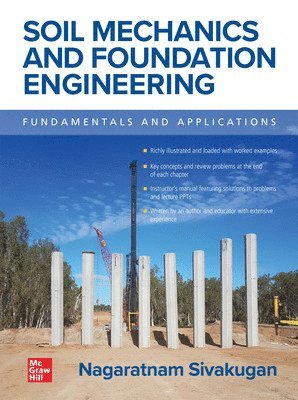
    Soil Mechanics and Foundation Engineering: Fundamentals and Applications

    AvNagaratnam Sivakugan

    Inbunden, Engelska, 2021

    1 548 kr

    Beställningsvara. Skickas inom 3-6 vardagar. Fri frakt över 249 kr.

    Beskrivning

    Publisher's Note: Products purchased from Third Party sellers are not guaranteed by the publisher for quality, authenticity, or access to any online entitlements included with the product.

    Learn the basics of soil mechanics and foundation engineering
     
    This hands-on guide shows, step by step, how soil mechanics principles can be applied to solve geotechnical and foundation engineering problems. Presented in a straightforward, engaging style by an experienced PE, Soil Mechanics and Foundation Engineering: Fundamentals and Applications starts with the basics, assuming no prior knowledge, and gradually proceeds to more advanced topics. You will get rich illustrations, worked-out examples, and real-world case studies that help you absorb the critical points in a short time.

    Coverage includes:

    • Phase relations
    • Soil classification
    • Compaction
    • Effective stresses
    • Permeability and seepage
    • Vertical stresses under loaded areas
    • Consolidation
    • Shear strength
    • Lateral earth pressures
    • Site investigation
    • Shallow and deep foundations
    • Earth retaining structures
    • Slope stability
    • Reliability-based design


    Produktinformation

    • Utgivningsdatum:2021-09-08
    • Mått:195 x 243 x 40 mm
    • Vikt:1 305 g
    • Format:Inbunden
    • Språk:Engelska
    • Antal sidor:640
    • Förlag:McGraw-Hill Education
    • ISBN:9781260468489

    Utforska kategorier

    • Byggnadsteknik inom Naturvetenskap och teknik

    Innehållsförteckning

    • PrefaceSymbols1 Geotechnical Engineering1.1 Introduction1.2 Soils and Other Engineering Materials1.3 Geotechnical Applications1.4 Standards, Measurements, and Significant Digits1.5 Physical and Numerical Modeling1.6 Geotechnical Engineering Literature1.7 Workplace Health and Safety and Risk Assessment1.8 Factor of Safety1.9 Professional Registration and Continuing Professional DevelopmentReferencesPart 1 Fundamentals2 Phase Relations2.1 Introduction2.2 Phase Diagram and Definitions2.3 Phase Diagram for Vs = 12.4 Laboratory Measurements2.5 Main PointsReview ExercisesReferences3 Soil Classification3.1 Introduction3.2 Origin of Soils3.3 Grain Size Distribution3.4 Atterberg Limits3.5 Unified Soil Classification System3.6 AASHTO Soil Classification System3.7 Visual Classification and Description3.8 Clay Mineralogy3.9 Main PointsReview ExercisesReferences4 Compaction4.1 Introduction4.2 Ground Improvement Techniques4.3 Compaction Curve4.4 Laboratory Compaction4.5 Zero Air Void Curve4.6 Field Compaction4.7 Compaction Specifications and Control4.8 California Bearing Ratio4.9 Other Ground Improvement Techniques4.10 Main PointsReview ExercisesReferences5 Effective Stresses5.1 Introduction5.2 Vertical Overburden Stresses5.3 Terzaghi’s Effective Stress Principle5.4 Capillary Effects in Soils5.5 Main PointsReview ExercisesReferences6 Permeability and Seepage6.1 Introduction6.2 Bernoulli’s Equation6.3 Darcy’s Law6.4 Laboratory Determination of Hydraulic Conductivity6.5 Field Determination of Hydraulic Conductivity6.6 Stresses in Soils due to Flow6.7 Equivalent Hydraulic Conductivity of Stratified Soils6.8 Flow Nets6.9 Design of Granular Filters6.10 Seepage through an Embankment on an Impervious Base6.11 Method of Fragments6.12 Main PointsReview ExercisesReferences7 Vertical Stresses under Loaded Areas7.1 Introduction7.2 Vertical Stress Increase due to a Point Load7.3 Vertical Stress Increase due to a Line Load7.4 Vertical Stress Increase due to a Strip Load7.5 Vertical Stress Increase under the Corner of a Rectangular Load7.6 2:1 Distribution for a Uniform Rectangular Load7.7 Pressure Isobars under Square and Strip Flexible Uniform Loads7.8 Vertical Stress Increase under an Embankment Load7.9 Vertical Stress Increase beneath the Center of a Uniform Circular Load7.10 Newmark’s Chart7.11 Main PointsReview ExercisesReferences8 Consolidation8.1 Introduction8.2 Fundamentals8.3 One-Dimensional Consolidation8.4 One-Dimensional Consolidation Test8.5 Field Corrections to e vs. log σ′v Plot Developed in the Laboratory8.6 Determination of Final Consolidation Settlement8.7 Preloading8.8 Time Rate of Consolidation8.9 Secondary Compression8.10 A Note on Preloading8.11 Main PointsReview ExercisesReferences9 Shear Strength9.1 Introduction9.2 Mohr’s Circles—A Review9.3 Mohr-Coulomb Failure Criterion9.4 A Simple Loading Scenario and Relevance of Mohr’s Circle9.5 Mohr’s Circles and Failure Envelopes in Terms of Total and Effective Stresses9.6 Drained and Undrained Loadings9.7 Triaxial Test9.8 Direct Shear Test9.9 Peak, Residual, and Critical States9.10 Skempton’s Pore Pressure Coefficients for Undrained Loading9.11 Relationship between σ1 and σ3 at Failure9.12 Stress Paths9.13 Critical State Soil Mechanics9.14 Main PointsReview ExercisesReferences10 Lateral Earth Pressures10.1 Introduction10.2 At-Rest State and K010.3 Active and Passive States10.4 Rankine’s Earth Pressure Theory10.5 Coulomb’s Earth Pressure Theory10.6 Lateral Earth Pressures Based on Elastic Analysis10.7 Main PointsReview ExercisesReferencesPart 2 Applications11 Site Investigation11.1 Introduction11.2 Spacing and Depth of Investigation11.3 Boring and Sampling11.4 Laboratory versus In Situ Tests11.5 In Situ Testing11.6 Standard Penetration Test11.7 Cone Penetration Test11.8 Vane Shear Test11.9 Other In Situ Tests11.10 Bore Logs11.11 Geotechnical Instrumentation11.12 Geophysical Methods11.13 Main PointsReview ExercisesReferences12 Shallow Foundations12.1 Introduction12.2 General, Local, and Punching Shear Failure Modes12.3 Terzaghi’s Bearing Capacity Theory12.4 Gross and Net Pressures12.5 The General Bearing Capacity Equation12.6 Pressure Distributions beneath Eccentrically Loaded Foundations12.7 Raft Foundations12.8 Total and Differential Settlements12.9 Settlement Computation Based on Elastic Analysis (Drained Soils)12.10 Settlement Computations in Granular Soils12.11 Settlement Computations in Cohesive Soils12.12 Main PointsReview ExercisesReferences13 Deep Foundations13.1 Introduction13.2 Pile Materials13.3 Pile Installation13.4 Shaft and Tip Loads13.5 Pile Load Transfer Mechanism13.6 Load-Carrying Capacity of a Single Pile13.7 Pile Driving13.8 Pile Load Test13.9 Settlement of a Pile13.10 Pile Groups13.11 Foundations for Super-Tall Buildings13.12 Rock-Socketed Piles13.13 Main PointsReview ExercisesReferences14 Earth Retaining Structures14.1 Introduction14.2 Retaining Walls14.3 Cantilever Sheet Pile Walls14.4 Anchored Sheet Piles14.5 Braced Excavations14.6 Retaining Walls Made of Piles14.7 Main PointsReview ExercisesReferences15 Slope Stability15.1 Introduction15.2 Factor of Safety15.3 Stability of Homogeneous Undrained Clay Slopes15.4 Taylor’s Stability Chart for Undrained Clays15.5 Taylor’s Stability Chart for c′ − φ′ Soils15.6 Cousins’ Stability Chart15.7 Michalowski’s (2002) Stability Charts for Slopes Subjected to Pore Water Pressures15.8 Method of Slices15.9 Infinite Slopes15.10 Main PointsReview ExercisesReferences16 Reliability-Based Design16.1 Introduction16.2 Capacity-Demand Model16.3 Allowable Stress Design16.4 Load and Resistance Factor Design16.5 A Probabilistic Approach16.6 Determination of the Mean and Standard Deviation of Capacity and Demand16.7 Main PointsReview ExercisesReferencesA Unsaturated Soil Mechanics B Vesic’s (1973) Factors for Eq. (12.11) C Units and Conversions Index