• Fri frakt över 249 kr
  • •
  • Snabba leveranser
  • •
  • Billiga böcker
Kundservice

Du är på sajten för privatpersoner.

Företag, bibliotek eller offentlig verksamhet?

Du handlar på classic.bokus.com, där alla dina funktioner finns intakta.
Till classic.bokus.com
Bokus logotyp. Gå till startsidan.
  • Erbjudanden
  • Nyheter
  • Student
  • Topplistor
  • Barn & ungdom
  • Bokus Play
  • E-böcker
  • Pocketböcker
  • Spel & pussel

Må bättre, för mindre! Upp till 50% rabatt på hälsoböcker

Sidfot

Mina sidor

    Hjälp

    • Kundservice
    • Vanliga frågor och svar
    • Frakt och leverans
    • Retur vid ångerrätt
    • Reklamera vara
    • Betalning
    • Köpvillkor
    • Allmänna villkor
    • Information om webbplatsens tillgänglighet

    Om Bokus

    • Om oss
    • Pressrum
    • För studenter
    • För företag
    • För bibliotek och offentlig verksamhet
    • För leverantörer
    • Hållbarhet

    Populärt

    • Aktuella erbjudanden
    • Presentkort
    • Studentlitteratur
    • Nya böcker
    • Topplistor
    • Signerade böcker
    • Engelska böcker

    Inspiration

    • Boktips
    • BookTok
    • Populära bokserier
    • Barnbokskaraktärer
    • Populära författare
    Logotyp för Bokus
    Följ oss på Facebook (extern länk)Följ oss på Instagram (extern länk)Följ oss på YouTube (extern länk)Följ oss på TikTok (extern länk)
    bokus @ CookiesAnpassa cookiesIntegritetspolicyKöpvillkor
    Till Citymail hemsida (extern länk)Till Budbee hemsida (extern länk)Till Postnord hemsida (extern länk)Till Schenker hemsida (extern länk)Till Early Bird hemsida (extern länk)Till Walleys hemsida (extern länk)
    1. Ekonomi och Ledarskap
    2. Företagsekonomi
    3. Redovisning och finansiering
    4. Redovisning

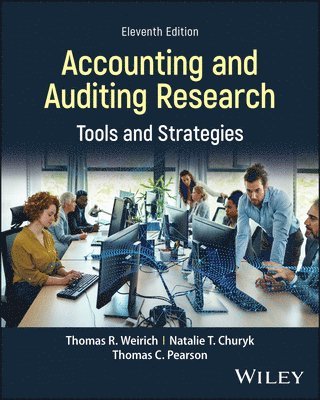
    Accounting and Auditing Research

    Tools and Strategies

    AvThomas R. Weirich,Natalie Tatiana Churyk

    Häftad, Engelska, 2025

    1 768 kr

    Beställningsvara. Skickas inom 5-8 vardagar. Fri frakt över 249 kr.

    Fler format och utgåvor

    Häftad

    1 776 kr

    Beskrivning

    Provides clear and accessible coverage of effective research solutions in a broad range of practical applications Accounting and Auditing Research: Tools and Strategies equips students and early-stage practitioners with the essential research skills to navigate complex problems by finding authoritative, justifiable solutions. Now in its eleventh edition, this comprehensive textbook thoroughly covers the research methodologies, databases, and auditing tools needed to tackle financial accounting, business auditing, tax planning, and a variety of modern challenges such as fraud detection and sustainability assurance. With a clear, step-by-step approach, Accounting and Auditing Research walks readers through all key areas of the research process, supported by expert tips, informational boxes, hands-on exercises, and real-world applications in each chapter. Throughout the text, the expertly structured pedagogy enhances critical thinking and strengthens writing skills to ensure readers are prepared for professional roles and industry certifications. Accounting and Auditing Research: Tools and Strategies is ideal for intermediate, advanced, and specialized courses in the subject, ensuring undergraduate and graduate students are well-prepared for professional roles and industry certifications. It is also ideal for in-house training programs and early-stage practitioners looking to develop their professional skills. New to this Edition: New chapter on Artificial Intelligence (AI) in accounting and auditing research, with practical examples and exercisesIntegration of AI applications throughout, with dedicated questions and cases in every chapterNew content on international accounting standards, including sustainability accountingNew “Research Tips” and “Quick Facts,” boxes Improved readability to increase comprehension and retentionEnhanced problems and cases for more effective student engagement and skill developmentUpdated guidance on the use of ACL, IDEA, Mindbridge AI, and other key research tools Additional problems, case studies, figures, charts, and diagramsWiley Advantage: Provides clear and systematic guidance on conducting professional accounting and auditing researchEmphasizes practical skill development to prepare students for modern accounting challenges Covers both well-established strategies and cutting-edge technologies, including AI-driven toolsOffers complete and up-to-date coverage of key databases, audit software, and research systems such as AICPA, FASB, and IDEAContains end-of-chapter discussion questions and hands-on exercises to support deeper understandingIncludes a companion website with a solutions manual, presentation slides, and additional teaching resources

    Produktinformation

    • Utgivningsdatum:2025-04-28
    • Mått:203 x 252 x 13 mm
    • Vikt:499 g
    • Format:Häftad
    • Språk:Engelska
    • Antal sidor:288
    • Upplaga:11
    • Förlag:John Wiley & Sons Inc
    • ISBN:9781394304707

    Utforska kategorier

    • Redovisning inom Ekonomi och Ledarskap

    Mer om författaren

    Thomas R. Weirich, PhD, CPA, currently a full professor of Accounting at Central Michigan University, was the “AICPA Distinguished Involvement in Accounting Education Award” winner for 2023. He has served as the Academic Fellow to the Office of Chief Accountant at the U.S. Securities and Exchange Commission and a Faculty in Residence position with Arthur Andersen, LLP, in their Business Fraud and Investigative Services Division. Dr. Weirich also has served as a consultant to the Public Oversight Board’s Panel on Audit Effectiveness and as an expert witness for the SEC and other organizations. Professor Weirich is the coauthor of four textbooks and has written numerous articles in academic and professional journals. He has received many teaching and professional awards, including the Michigan Association of Governing Boards Distinguished Faculty Award, the Michigan Association of CPAs’ Distinguished Achievement in Accounting Education Award, and the Michigan Association of CPAs Accounting Teaching Excellence Award. He served on the AICPA’s Board of Examiners and the Auditing Subcommittee for the CPA Exam and also served as chair of the Michigan Board of Accountancy. Natalie T. Churyk, PhD, CPA, is PwC Professor of Accountancy at Northern Illinois University and Editor-in-Chief of Journal of Accounting Education. With more than 50 publications and 130 conference presentations, her research spans financial reporting, fraud, education, ethics, and auditing. Dr. Churyk currently serves on the American Accounting Association Board as Vice-President – Education. She has received numerous teaching and research accolades for her work in accounting education. Thomas C. Pearson, LLM, JD, CPA, is Professor of Accounting at the University of Hawaii at Manoa. He holds advanced law and business degrees from NYU, the University of Denver, Vanderbilt University, and Dartmouth College. A published author of nearly 50 articles, Dr. Pearson’s work spans both legal and accounting journals. He has received numerous teaching awards, including the University of Hawaii’s Board of Regents Teaching Excellence Award, and has served on Hawaii’s Tax Review Commission.

    Innehållsförteckning

    • About the Authors xiiiPreface xv1 Introduction to Applied Professional Research 1What Is Research? 2Research Questions 3Nature of Professional Research 5Critical Thinking and Effective Communication 6Economic Consequences of Standards Setting 7Role of Research in the Accounting Firm 7Skills Needed for the CPA Exam and Practice 9Overview of the Research Process 10Step One: Identify the Relevant Facts and Issues 11Step Two: Collect the Evidence 12Step Three: Analyze the Results and Identify the Alternatives 12Step Four: Develop a Conclusion 13Step Five: Communicate the Results 13Data Analytics/AI in Accounting and Auditing Research 14Summary 15Discussion Questions 16Exercises 172 AI’s Impact on Accounting and Auditing Research 18Brief History of AI 19Emergence of Generative AI 20Large Language Models (LLMs): Development and Types 20Limitations and Ethical Concerns of LLMs 21Hallucinations in LLMs 21Performance Limitations 22Biases in Training Data 22Ethical Concerns and Responsible Use 22Legal Considerations 22Lack of Transparency 23Applications of Generative AI 24Text Generation Translation and Summarization Through LLMs 24Significance of User-Friendly Interfaces in LLM Accessibility 25Revolutionizing the Accounting Landscape 25Effective Prompts Engineering 26General Tips for Prompt Engineering 26Engineering Prompts for Accounting 27Current Regulations of AI 29Summary 30Discussion Questions 30Exercises 313 Critical Thinking and Effective Writing Skills for the Professional Accountant 32Critical Thinking Skills 32Levels of Thinking 34Universal Elements of Reasoning 37An Example of Using Critical Thinking Skills 38Effective Writing Skills 39Writing as a Process 40Punctuation Primer 41Improved Writing Skills Required 41Active Voice 43Short Sentences 43Definite Concrete Everyday Language 43Tabular Presentation 44Limited Jargon and Technical Terms 44No Multiple Negatives 44Elements of Plain English 45Writing Effective Texts e-mails and Letters 45Writing Memos to the File 46AI’s Impact on Communication 48Summary 48Discussion Questions 49Exercises 494 The Environment of Accounting Research 52The Accounting Environment 52The SEC and the Standard-Setting Environment 53Rules-Based vs. Principles-Based Accounting Standards 55Financial Accounting Standards Board 56FASB Strives to Simplify Standards 57Content of Authorities 57FASB Due Process 59FASB Conceptual Framework Project 61Statements of Financial Accounting Concepts Nos. 1–8 61American Institute of Certified Public Accountants (AICPA) 62Governmental Accounting Standards Board 63Other Organizations Influencing Standard Setting 65U.S. Generally Accepted Accounting Principles (U.S. GAAP) 67The FASB Accounting Standards Codification TM 68Using Authoritative Support 69Reading an Authoritative Pronouncement 70Accounting Choices Have Economic Consequences 72AI and Standard Setters 72Summary 73Discussion Questions 73Exercises 745 Financial Accounting Research Tools 76Accounting Research Online 77Database Research Strategies 77Step One: Define the Information Needed 77Step Two: Determine the Sources to Search 77Step Three: Use Appropriate Search Methods 78Step Four: View the Results and Manage the Information 78Step Five: Communicate the Search Results 78FASB Accounting Standards Codification TM Research System 78The Research Process 80Locating U.S. GAAP Using the Codification 83Examples Using the Codification 84SEC Accounting for Public Companies 85SEC Regulations and Sources 86The SEC’s Published Views and Interpretations 86SEC Staff Policy/Interpretations 87Accessing SEC Filings and Regulations 89Cases to Practice Accounting Research 91Data Analytics and AI for the Accounting Researcher 92Summary 94Discussion Questions 94Exercises 95Knowledge Busters: The Codification 986 The Environment of International Research 104International Accounting Environment 104IFRS Structure 107IASB/ISSB/IFRIC Authorities 109IASB and ISSB Due Process 110Interpretations Committee Due Process 111IASB’s Conceptual Framework 112Principles-Based Accounting Standards 113IFRS Funding Regulation and Enforcement 113International Financial Reporting Standards (IFRS) Research 115IFRS Hierarchy 115IFRS Access 115The Use of AI 117Summary 118Discussion Questions 118Exercises 119Accessing IFRS - IFRS Accounting/ISSB Sustainability Standards Navigator 120Knowledge Busters 1217 Other Research Databases and Tools 123Database Research Strategies 123Step One: Define the Information Needed 123Step Two: Determine the Sources to Search 124Step Three: Use Search Techniques and Tools 125Step Four: View the Results and Manage the Information 126Step Five: Communicate the Search Results 126Commercial Accounting Databases and Tools 127U.S. Accounting Research Tools 127U.S. Government Accounting Databases 128Financial Research Databases 129Leading Publishers of Global Financial Information 130S&P Capital IQ 131Mergent Online 132Other Financial Databases and Sources 133Business Research Databases and Challenges 134Article Index Sources 135Other Specialized Research Sources 135Legal Research Databases and Tools 136LexisNexis Database Products 137Westlaw Database Products 138Recent Legal Database Competitors 139AI’s Increased Presence in Databases 139Summary 140Discussion Questions 140Exercises 141AI Questions and Exercises 142Knowledge Busters 143Appendix 7A-1: Website Addresses 1438 Tax Research for Compliance and Tax Planning 146Tax Planning Goals Challenges and Databases 146Tax Research Goals 147Tax Research Challenges 148Tax Research Databases 149Primary Tax Authorities 150Statutory Law: The Code 151Administrative Law: The Treasury Regulations 153Revenue Rulings and Revenue Procedures 155Lesser Administrative Sources (Non-precedential) 155Judicial Law: Court Cases 156U.S. Tax Court 156Other Judicial Sources of Authority 157Steps in Conducting Tax Research 159Step One: Investigate the Facts and Identify the Issues 159Step Two: Collect the Appropriate Authorities 160Step Three: Analyze the Research 163Step Four: Develop the Reasoning and Conclusion 165Step Five: Communicate the Results 166Professional Concerns and Evolving Changes 168Professional Standards for Tax Services 169AI in Tax Research 170Data Analytics in Tax Research 171Summary 172Discussion Questions 172Exercises 173AI Questions and Exercises 176Knowledge Busters 176Appendix 8A-1: Website Addresses 1789 Assurance Services and Auditing Research 179Assurance Services 179Consulting Services and Standards 180Attestation Services and Standards 182Auditing Standard-Setting Environment 184Auditing Standard-Setting Process 184Public Company Accounting Oversight Board (PCAOB) 185Auditing Standards Board (ASB) 186International Auditing and Assurance Standards Board (IAASB) 190AICPA Online Professional Library 190AICPA Code of Professional Conduct 192Thomson Reuters Checkpoint 194Auditing Standards in the Public Sector 194Preparation Compilation and Review Services 198Role of Judgment and Professional Skepticism in Accounting and Auditing 199Economic Consequences 200Data Analytics/AI in Audit Practice & Research 200Summary 202Discussion Questions 202Exercises 203Knowledge Busters 20410 Refining the Research Process 206Method for Conducting Research 206Step One: Identify the Preliminary Issues or Problems 207Step Two: Collect the Evidence 211Step Three: Analyze the Results and Identify Alternatives 216Step Four: Develop a Conclusion 217Step Five: Communicate the Results 218Advice for the Future 220Remain Current in Accounting Knowledge and Skills 220Check AI But Don’t Rely on It 221Understand Complexities in Practice 221Develop Professional Skills Needed for Practice 222Summary 223Discussion Questions 223Exercises 223AI Questions and Exercises 224Knowledge Busters 224Appendix 10A-1: Certifications and Associations for Accounting Auditing and Tax 226Appendix 10A-2: Research Sources from AICPA FASB PCAOB and Others 227Appendix 10A-3: Abbreviations for International Canadian and U.K. Standards 22911 Forensic Accounting Research 231Forensic Accounting Standards 232Definition of Fraud 233Types of Fraud 233The Fraud Triangle 234Overview of a Financial Statement Fraud Examination 237Step One: Identify the Issue and Plan the Investigation 238Step Two: Gather the Evidence and Complete the Investigation Phase 238Step Three: Evaluate the Evidence 239Step Four: Report Findings to Management or Legal Counsel 240Business Investigations 240Computer Technology in Fraud Investigations 241Data-Mining Software 241Data Analytics 242CaseWare IDEA 242MindBridge Ai 243ACL 244Public Databases 244Courthouse Records 244Company Records 245Online Databases 246The Internet 246Instant Checkmate (www.instantcheckmate.com) 247Zoominfo.com (www.zoominfo.com) 247Other Websites 247AI in Forensic Accounting 247Fraud Investigation Regulations 249Summary 250Discussion Questions 250Exercises 250Knowledge Busters 251Index I- 1