• Fri frakt över 249 kr
  • •
  • Snabba leveranser
  • •
  • Billiga böcker
Kundservice

Du är på sajten för privatpersoner.

Företag, bibliotek eller offentlig verksamhet?

Du handlar på classic.bokus.com, där alla dina funktioner finns intakta.
Till classic.bokus.com
Bokus logotyp. Gå till startsidan.
  • Erbjudanden
  • Nyheter
  • Student
  • Topplistor
  • Barn & ungdom
  • Bokus Play
  • E-böcker
  • Pocketböcker
  • Spel & pussel

10% rabatt på allt med kod: NYSTART10 →

Sidfot

Mina sidor

    Hjälp

    • Kundservice
    • Vanliga frågor och svar
    • Frakt och leverans
    • Retur vid ångerrätt
    • Reklamera vara
    • Betalning
    • Köpvillkor
    • Allmänna villkor
    • Information om webbplatsens tillgänglighet

    Om Bokus

    • Om oss
    • Pressrum
    • För studenter
    • För företag
    • För bibliotek och offentlig verksamhet
    • För leverantörer
    • Hållbarhet

    Populärt

    • Aktuella erbjudanden
    • Presentkort
    • Studentlitteratur
    • Nya böcker
    • Topplistor
    • Signerade böcker
    • Engelska böcker

    Inspiration

    • Boktips
    • BookTok
    • Populära bokserier
    • Barnbokskaraktärer
    • Populära författare
    Logotyp för Bokus
    Följ oss på Facebook (extern länk)Följ oss på Instagram (extern länk)Följ oss på YouTube (extern länk)Följ oss på TikTok (extern länk)
    bokus @ CookiesAnpassa cookiesIntegritetspolicyKöpvillkor
    Till Citymail hemsida (extern länk)Till Budbee hemsida (extern länk)Till Postnord hemsida (extern länk)Till Schenker hemsida (extern länk)Till Early Bird hemsida (extern länk)Till Walleys hemsida (extern länk)
    1. Naturvetenskap och teknik
    2. Matematik och naturvetenskap
    3. Astronomi

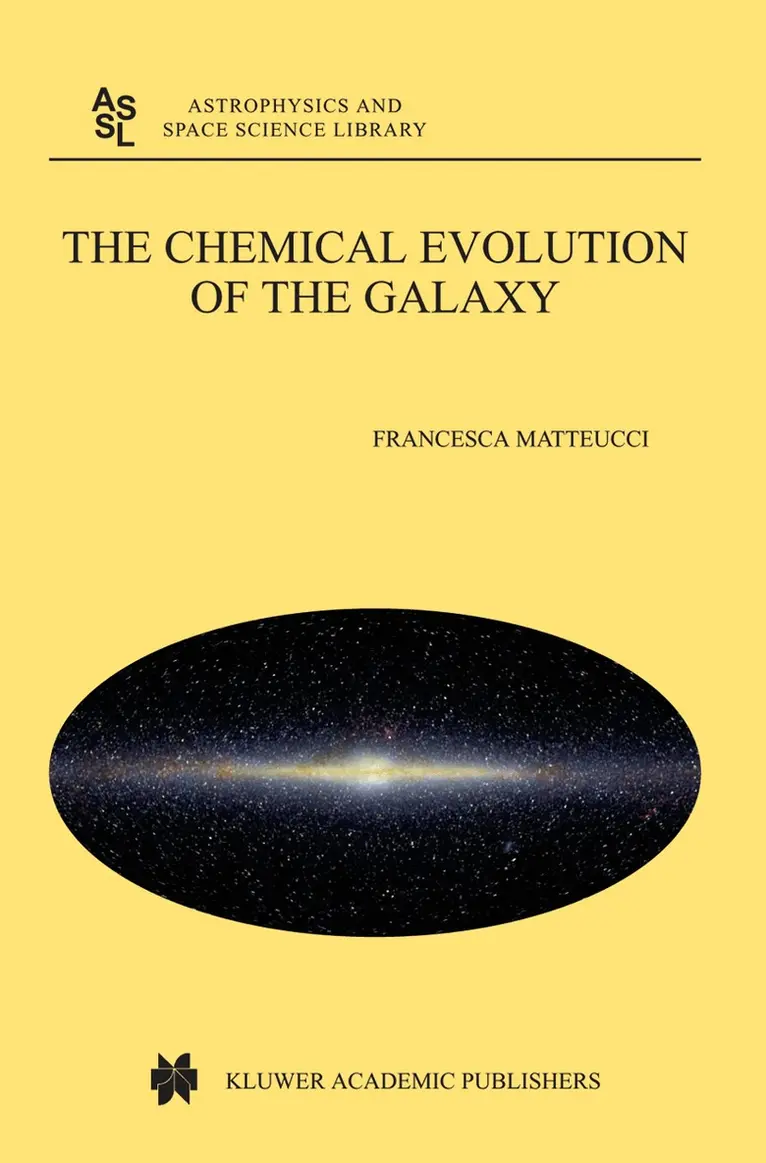
    Chemical Evolution of the Galaxy

    AvFrancesca Matteucci

    Häftad, Engelska, 2003

    Del 253 i serien Astrophysics and Space Science Library

    1 086 kr

    Beställningsvara. Skickas inom 10-15 vardagar. Fri frakt över 249 kr.

    Fler format och utgåvor

    Inbunden

    1 086 kr

    E-bok

    1 413 kr

    Beskrivning

    This book is based partly on a. lecture course given at the University of Tri­ este, but mostly on my own research experience in the field of galactic chemical evolution. The subject of galactic chemical evolution was started and developed by Beat­ rice Tinsley in the seventies and now is a flourishing subject. This book is dedi­ cated to the chemical evolution of our Galaxy and aims at giving an up-to-date review of what we have learned since Tinsley's pioneering efforts. At the time of writing, in fact, books of this kind were not available with the exception of the excellent book by Bernard Pagel on "Nucleosynthesis and Chemical Evolution of Galaxies" (Cambridge University Press, 1997), and the subject of galactic chem­ ical evolution has appeared only as short chapters in books devoted to other subjects. Therefore, I felt that a book of this kind could be useful. The book summarizes the observational facts which allow us to reconstruct the chemical history of our Galaxy, in particular the abundances in stars and in­ terstellar medium; in the last decade, a great deal of observational work, mostly abundance determinations in stars in the solar vicinity, has shed light on the pro­ duction and distribution of chemical elements. Even more recently more abun­ dance data have accumulated for external galaxies at both low and high redshift, thus providing precious information on the chemical evolution of different types of galaxies and on the early stages of galaxy evolution.

    Produktinformation

    • Utgivningsdatum:2003-10-31
    • Mått:160 x 240 x 17 mm
    • Vikt:458 g
    • Format:Häftad
    • Språk:Engelska
    • Serie:Astrophysics and Space Science Library
    • Antal sidor:285
    • Upplaga:2003
    • Förlag:Kluwer Academic Publishers
    • ISBN:9781402016523

    Utforska kategorier

    • Astronomi inom Naturvetenskap och teknik

    Recensioner i media

    "The development of the field (of galactic chemical evolution) in the past two decades is impressive, Matteucci herself having made significant contributions. As a planetary geochemist, I found her clear and precise treatment very useful... the book is an example of straightforward writing...it is easy to find one's way around." (Stuart Ross Taylor, Dept. of Geology, Australian National University, Canberra in Nature 414:253 (2001)

    Innehållsförteckning

    • 1. Observational Evidence for Chemical Evolution.- 1.1 Overview and historical perspective.- 1.2 Abundances in stars.- 1.3 Abundances in globular clusters.- 1.4 The metallicity distribution of the local disk G-dwarfs.- 1.5 The metallicity distribution of halo stars.- 1.6 The age-metallicity relation.- 1.7 Abundances in the bulge stars.- 1.8 Abundances from planetary nebulae.- 1.9 Abundances from HII regions, B stars, open clusters.- 1.10 Isotopic ratios.- 1.11 The abundances of light elements.- 1.12 The mass distribution in the Galaxy.- 1.13 Supernovae and supernova rates.- 1.14 Nova rates.- 2. Stellar Evolution and Nucleosynthesis.- 2.1 The evolution of single stars.- 2.2 Nucleosynthesis.- 2.3 The evolution of binary systems.- 2.4 Stellar yields.- 2.5 Local abundances and nuclear processes.- 2.6 Algorithms to compute the stellar yields.- 2.7 The influence of mass loss and overshooting on the stellar yields.- 2.8 Galactic yields.- 3. The Stellar Birthrate.- 3.1 The process of star formation.- 3.2 Derivation of the stellar birthrate.- 3.3 The parametrizations of the SFR.- 4. Gas Flows.- 4.1 Infall of gas onto the Galaxy.- 4.2 Radial flows along the galactic disk.- 4.3 Galactic winds.- 5. Basic Equations of Chemical Evolution.- 5.1 Analytical models.- 5.2 Numerical models.- 5.3 Chemo-dynamical models.- 6. Formation and Evolution of the Milky Way.- 6.1 Abundances and kinematics.- 6.2 The globular clusters ages and the formation of the halo.- 6.3 Abundance ratios and galaxy formation.- 6.4 Serial formation.- 6.5 Parallel formation.- 6.6 Two-infall formation.- 6.7 The evolution of the solar neighbourhood.- 6.8 The evolution of the galactic disk.- 6.9 The evolution of light elements and their impact on cosmology.- 6.10 The chemical evolution of the galactic bulge.- 6.11 How reliable are chemical evolution models?.- 7. Nucleochronology and the Age of the Galaxy.- 7.1 Radioactive dating of elements.- 7.2 The age of the galaxy.- 8. The Milky Way and other Spiral Galaxies.- 8.1 Abundances and abundance gradients.- 8.2 Correlations between abundances and galaxy properties.- 8.3 Field and cluster spirals.- 8.4 Formation and evolution of galactic disks.- 8.5 The Milky Way at high redshift.- 9. References.- Acknowledgments.