• Fri frakt över 249 kr
  • •
  • Snabba leveranser
  • •
  • Billiga böcker
Kundservice

Du är på sajten för privatpersoner.

Företag, bibliotek eller offentlig verksamhet?

Du handlar på classic.bokus.com, där alla dina funktioner finns intakta.
Till classic.bokus.com
Bokus logotyp. Gå till startsidan.
  • Erbjudanden
  • Nyheter
  • Student
  • Topplistor
  • Barn & ungdom
  • Bokus Play
  • E-böcker
  • Pocketböcker
  • Spel & pussel

10% rabatt på allt med kod: NYSTART10 →

Sidfot

Mina sidor

    Hjälp

    • Kundservice
    • Vanliga frågor och svar
    • Frakt och leverans
    • Retur vid ångerrätt
    • Reklamera vara
    • Betalning
    • Köpvillkor
    • Allmänna villkor
    • Information om webbplatsens tillgänglighet

    Om Bokus

    • Om oss
    • Pressrum
    • För studenter
    • För företag
    • För bibliotek och offentlig verksamhet
    • För leverantörer
    • Hållbarhet

    Populärt

    • Aktuella erbjudanden
    • Presentkort
    • Studentlitteratur
    • Nya böcker
    • Topplistor
    • Signerade böcker
    • Engelska böcker

    Inspiration

    • Boktips
    • BookTok
    • Populära bokserier
    • Barnbokskaraktärer
    • Populära författare
    Logotyp för Bokus
    Följ oss på Facebook (extern länk)Följ oss på Instagram (extern länk)Följ oss på YouTube (extern länk)Följ oss på TikTok (extern länk)
    bokus @ CookiesAnpassa cookiesIntegritetspolicyKöpvillkor
    Till Citymail hemsida (extern länk)Till Budbee hemsida (extern länk)Till Postnord hemsida (extern länk)Till Schenker hemsida (extern länk)Till Early Bird hemsida (extern länk)Till Walleys hemsida (extern länk)
    1. Ekonomi och Ledarskap
    2. Nationalekonomi

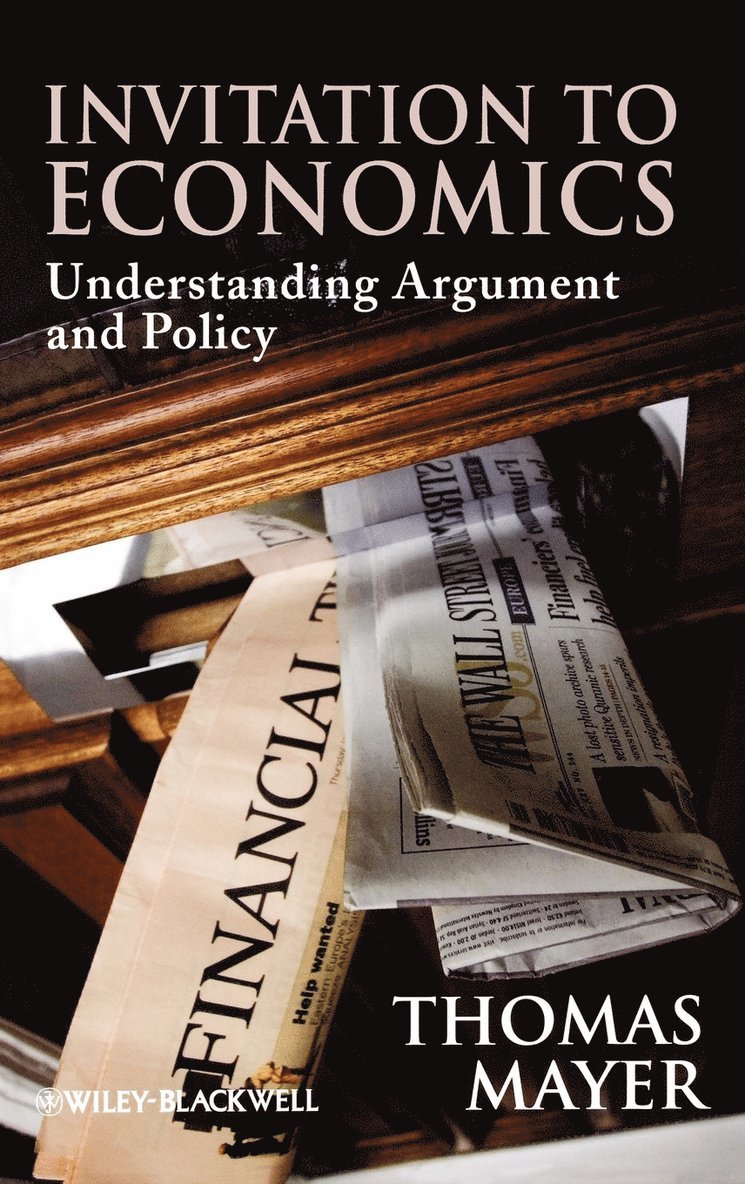
    Invitation to Economics

    Understanding Argument and Policy

    AvThomas Mayer

    Inbunden, Engelska, 2008

    1 089 kr

    Beställningsvara. Skickas inom 5-8 vardagar. Fri frakt över 249 kr.

    Beskrivning

    Invitation to Economics empowers the reader to spot naive and spurious economic arguments by inculcating an intuitive 'feel' for economics. A unique and critical guide to understanding economic arguments in the mediaFocuses on microeconomics, specifically on the idea that economic policies often have important indirect effectsKey ideas are applied repeatedly in numerous case studies drawn from newspapers and other mediaEconomic principles are presented in an accessible and non-rigorous format using case studiesIncorporates the value judgments and political judgments that underlie economic policies

    Produktinformation

    • Utgivningsdatum:2008-12-19
    • Mått:160 x 238 x 25 mm
    • Vikt:635 g
    • Format:Inbunden
    • Språk:Engelska
    • Antal sidor:352
    • Förlag:John Wiley and Sons Ltd
    • ISBN:9781405183581

    Utforska kategorier

    • Nationalekonomi inom Ekonomi och Ledarskap

    Mer om författaren

    Thomas Mayer is Emeritus Professor of Economics, University of California, Davis. He has also taught at Notre Dame University and Michigan State University, and as a visitor at West Virginia University and the University of California, Berkeley. He has written numerous articles in professional journals, and is the author or co-author of eight previous books. In 1978 he served as president of the Western Economic Association and in 1978-79 as chairman of the International Network for Economic Method, and has served on the editorial boards of several professional journals.

    Recensioner i media

    “This well-written, clearly organized book presents a nontechnical, overarching view of economic theory and how it gets applied and interpreted” (Choice Reviews, June 2009)

    Innehållsförteckning

    • List of Boxes xiPreface xiii1 Introduction 11.1 What This Book Provides 11.2 Looking around Corners 41.3 Ideological Stance 51.4 Economics Embedded in Philosophy and Sociology 71.5 My Own Biases 81.6 What Is to Come? 9Part I the Subject of Economics 132 What Economists Do 152.1 What Economics Encompasses 152.2 How Economists Work 182.3 Some Characteristics of Economics 32Appendix 2.1: Unrealistic Assumptions Can a Good Theory Make 37Appendix 2.2: Is the Stock Market Efficient? 393 How Well Do They Do It? 433.1 Forecasting 433.2 Choosing the Right Policies: The Problem of Value Judgments 473.3 Implementing Economic Policies 513.4 Biases 523.5 Disagreement among Economists 57Appendix 3.1: A Survey of American Academic Economists’ Opinions 60Part II Some Infrastructure 634 Beguiling Words 654.1 Some Widely Used Terms and Phrases 664.2 Some Terms and Phrases Relating to Economics and Politics 715 Important Economic Ideas: Often Misunderstood 845.1 Levels versus Rates of Change 845.2 Stocks versus Flows 865.3 Real versus Nominal 905.4 Future versus Current Dollars 915.5 The Price Level versus Relative Prices 975.6 Stable Prices versus Low Prices 985.7 Gross versus Net and Single versus Double Counting 985.8 Opportunity Costs versus Monetary Costs 995.9 Cost–Benefit Analysis 1025.10 Wage Rates versus Labor Costs 1045.11 Capital Goods versus Human Capital 1055.12 Marginal versus Average Utility 1065.13 Marginal versus Average Costs 1075.14 Big Business versus Market Power 1085.15 Pro-market versus Pro-business 1096.16 “Should” and “Can” versus “Will” 1095.17 Comparative versus Absolute Advantage 110Part III Economic Theory and Policy 1136 The Crown Jewel of Economics: The Price Mechanism 1156.1 An Overview of the Price Mechanism 1156.2 Equilibrium 1186.3 Shortages 1206.4 A Digression: The Equilibrium of the Firm 1216.5 What Happens in the Absence of a Price Mechanism? 1226.6 The Dark Side of the Price Mechanism 1266.7 The Upshot 144Appendix 6.1: More on Supply and Demand 1477 Risk Taking and Incentives 1567.1 Risk Bearing and Entrepreneurship 1567.2 Incentives 1598 Looking around Corners 1758.1 Do Easier Bankruptcy Laws Help the Poor? 1778.2 Should Artists Receive a Share of the Capital Gain When Their Work Is Resold? 1798.3 Do We Want Fewer People Exploiting the Poor? 1818.4 Cut the Gas Tax to Slow the Rise of Soaring Gas Prices? 1838.5 A Costless Way to Alleviate Destitution in Third World Countries? 1858.6 Ban or Fine All Speculators? 1878.7 Is Limiting Tobacco Advertising an Effective Policy? 1918.8 Would Importing Pharmaceuticals from Canada Substantially Lower Drug Prices? 1928.9 An Efficient and Humane Way to Reduce Cocaine Production? 1938.10 Protecting Lives by Requiring Use of Seatbelts? 1958.11 Do You Really Want Your Bid to Win? 1968.12 Is Fast Chinese Economic Growth Bad for the United States? 1978.13 In Emergencies Should Prices Ration Supply, Thus Letting the Rich Outbid the Poor? 2018.14 Is Gaining from Someone’s Misfortune a Moral Wrong? 2028.15 Should Those Close at Hand Have a Special Responsibility to Alleviate Misery? 2048.16 Seven Short Ones 2058.17 On the Other Hand 2089 Natural Resources and Environmental Economics 2109.1 Running Out of Privately Owned Natural Resources 2109.2 The Tragedy of the Commons 2159.3 Pollution Permits and Taxes on Pollutants 2179.4 Tail-pipe Pollution 2229.5 Protecting Endangered Species 223Part IV Looking at Data 22510 Empirical Economics 22710.1 Role of Empirical Work in Economics 22710.2 Types of Empirical Evidence 22810.3 What to Watch Out for in Statistics: Some General Problems 230Appendix 10.1: Survey Data 242Appendix 10.2: Measuring GDP, Savings Rates, Price Indexes, Employment, and Poverty 24411 Some Simple (?) Ways of Presenting Data: Percentages, Figures, and Graphs 25211.1 Percentages 25211.2 Figures and Graphs 25512 Samples and Their Problems 26012.1 Selecting a Representative Sample 26012.2 Watching for Inappropriate Samples 26112.3 The Regression Fallacy: Building a Bias into the Sample 26212.4 Sample Size and Coincidence 26412.5 Sampling Error, Confidence Intervals, and Significance 26512.6 Some Warnings about Significance Tests 268Appendix 12.1: The Normal Distribution 26913 Regressions: The Workhorse of Empirical Economics 27213.1 The Regression Coefficient 27313.2 How Well Does the Regression Fit the Data? 27513.3 What Should You Look at in a Regression? 27713.4 A Summing Up 27913.5 Looking the Workhorse in the Mouth 27913.6 In Conclusion 29014 The Workhorse in Action: Some Examples of Empirical Economics 29214.1 Consumption and Saving 29314.2 Should You Choose a Large Mutual Fund? 30014.3 The Slave Trade and African Economic Development 30314.4 The Effect of Tax Changes on Real GDP 306Epilogue 311Index 315