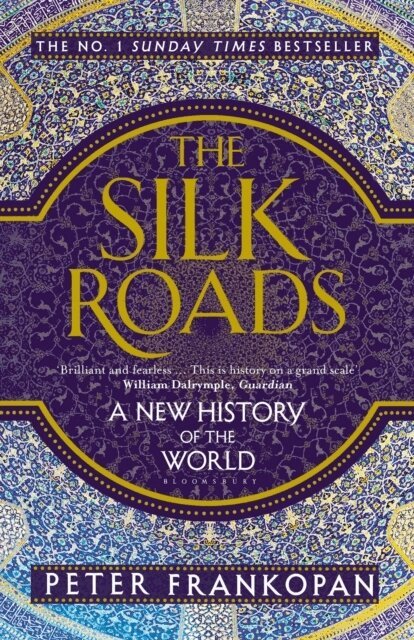
Häftad, Engelska, 2016
Silk Roads
192 kr
Skickas torsdag 29/10. Fri frakt över 249 kr.
Beskrivning
Produktinformation
- Utgivningsdatum: 2016-06-01
- Mått: 128 x 196 x 40 mm
- Vikt: 480 g
- Format: Häftad
- Språk: Engelska
- Serie: Bloomsbury Paperbacks
- Antal sidor: 736
- Förlag: Bloomsbury Publishing PLC
- ISBN: 9781408839997
Utforska kategorier
Betyg & recensioner
6 recensioner, genomsnitt 5/5
- 5/5 Dag V
En storslagen genomgång av världshistorien och hur inflytande från öst och väst har påverkat historiens gång. Den invändning jag har är att Frankopan har en för mekanistisk världsåskådning, dvs han förklarar utvecklingen beroende av yttre materiella faktorer men lägger allt för liten vikt vid idéers utveckling och deras konsekvenser.
Här är utdrag av en engelsk recension jag publicerade på Amazon:
Peter Frankopan gives us an amazingly broad description of the history of the world and the waves of influences from east and west. He is also aware of the influence of Eastern thought and religions upon the rise of Christianity and gives a not too well-known account of how Christianity also spread to the east, to Persia and beyond before Constantine sort of hijacked Christianity.
In his effort to stress the importance of Middle East, he makes a point of stressing the insignificance of western Europe and their ideas. When he says that France, Germany, Austria, Spain and Portugal had nothing to do with Greece and their philosophy, that is not quite true. In fact, if you study how governance and civil administration in these countries evolved. Medieval philosophers as Augustine, Anselm, Thomas Aquinas, William of Ockham were all referring to and discussing Greek philosophical ideas. These ideas had very much to do with the development of Western Europe as well.
The author gives surprisingly little attention to development of ideas and their influences. On the contrary, he seems to have a rather materialistic/mechanical cause - effect way of thinking: Europe became powerful and rich in the 16th century due to riches flowing in from Americas and other colonies, which of course is a large part of the truth. But, it is a description where world views and ideas have little influence on development, but rather differences in people's fortunes and expressions of might and cruelty.
Having said that, his story of the power rivalries between the big powers, England, France, Germany and Russia and the struggle to control the black gold and the Middle East is brilliant and revealing. This story is not one sided. He shows how the imperialist ambitions of the British buys into the corrupt leaders and systems in Persia for example as he earlier in the book shows how traditional slave systems in Africa fits well into the new human trafficking ambitions of unscrupulous western slave traders. He also has a very interesting description about how the communists in Russia/Soviet Union realigned their foreign policy, especially by the initiative of Trotsky, to find common ground between political Muslim movements in the east and the Russian revolution. Both were sort of monotheistic movements after all. He also dares to describe common interests between Muslim leaders and Nazi Germany prior to and during WWII. - 5/5 Stangenberg M
- 5/5 Ove T
- 5/5 Göran B
- 5/5 Else-Len M