• Fri frakt över 249 kr
  • •
  • Snabba leveranser
  • •
  • Billiga böcker
Kundservice

Du är på sajten för privatpersoner.

Företag, bibliotek eller offentlig verksamhet?

Du handlar på classic.bokus.com, där alla dina funktioner finns intakta.
Till classic.bokus.com
Bokus logotyp. Gå till startsidan.
  • Erbjudanden
  • Nyheter
  • Student
  • Topplistor
  • Barn & ungdom
  • Bokus Play
  • E-böcker
  • Pocketböcker
  • Spel & pussel

10% rabatt på allt med kod: NYSTART10 →

Sidfot

Mina sidor

    Hjälp

    • Kundservice
    • Vanliga frågor och svar
    • Frakt och leverans
    • Retur vid ångerrätt
    • Reklamera vara
    • Betalning
    • Köpvillkor
    • Allmänna villkor
    • Information om webbplatsens tillgänglighet

    Om Bokus

    • Om oss
    • Pressrum
    • För studenter
    • För företag
    • För bibliotek och offentlig verksamhet
    • För leverantörer
    • Hållbarhet

    Populärt

    • Aktuella erbjudanden
    • Presentkort
    • Studentlitteratur
    • Nya böcker
    • Topplistor
    • Signerade böcker
    • Engelska böcker

    Inspiration

    • Boktips
    • BookTok
    • Populära bokserier
    • Barnbokskaraktärer
    • Populära författare
    Logotyp för Bokus
    Följ oss på Facebook (extern länk)Följ oss på Instagram (extern länk)Följ oss på YouTube (extern länk)Följ oss på TikTok (extern länk)
    bokus @ CookiesAnpassa cookiesIntegritetspolicyKöpvillkor
    Till Citymail hemsida (extern länk)Till Budbee hemsida (extern länk)Till Postnord hemsida (extern länk)Till Schenker hemsida (extern länk)Till Early Bird hemsida (extern länk)Till Walleys hemsida (extern länk)
    1. Djur och Natur
    2. Djurböcker

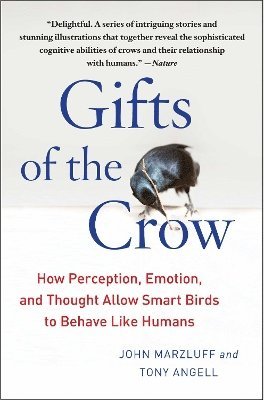
    Gifts of the Crow

    How Perception, Emotion, and Thought Allow Smart Birds to Behave Like Humans

    AvJohn Marzluff,Tony Angell

    Häftad, Engelska, 2015

    168 kr

    Skickas . Fri frakt över 249 kr.

    Beskrivning

    Playful, social, and passionate, crows have brains that are huge for their body size, which allows them to think, plan, and reconsider their actions. They also exhibit an avian kind of eloquence, mate for life, and associate with relatives and neighbours for years. And to people who care for them and feed them, they often give oddly touching gifts in return.The ongoing connection between humans and crows-a cultural coevolution-has shaped both species for millions of years. Scientist John Marzluff teams up with artist-naturalist Tony Angell to tell amazing stories of these brilliant birds. With Marzluff's extraordinary original research on the intelligence and startling abilities of corvids-crows, ravens, and jays-Angell's gorgeous line drawings, and a lively joint narrative, the authors offer an in-depth look at these complex creatures and the traits and behaviours we share, including language, delinquency, frolic, passion, wrath, risk taking, and awareness. Crows gather around their dead, warn of impending doom, recognize people, commit murder of other crows, lure animals to their death, swill coffee and drink beer, design and use tools-including cars as nutcrackers-and windsurf and sled to play.With its abundance of funny, awe-inspiring, and poignant stories, Gifts of the Crowportrays creatures who are nothing short of amazing.

    Produktinformation

    • Utgivningsdatum:2015-05-21
    • Mått:137 x 211 x 20 mm
    • Vikt:272 g
    • Format:Häftad
    • Språk:Engelska
    • Antal sidor:320
    • Förlag:Atria Books
    • ISBN:9781439198742

    Utforska kategorier

    • Djurböcker inom Djur och Natur

    Mer om författaren

    John Marzluff, PhD, is Professor of Wildlife Science at the University of Washington. The author of four books and over one hundred scientific papers on various aspects of bird behavior, he is the recipient of the A. Brazier Howell, Board of Directors, and H.R. Painton awards from the Cooper Ornithological Society. Tony Angell has authored and/or illustrated a dozen award-winning books related to natural history.

    Recensioner i media

    “Researchers writing about comparative human and nonhuman cognition always make brief, obligatory reference to the underlying neurological and hormonal systems, but Marzluff and Angell actually provide us with the details. In lucid, logical, and articulate prose, they carefully explain all the interrelated mechanisms involved in the fascinating behavior patterns of their corvid subjects and how these mechanisms relate to those of humans. Their book is indeed a gift, not only to those of us eager to learn about corvid behavior but also but also to those who wish to understand the bases for these actions.”