• Fri frakt över 249 kr
  • •
  • Snabba leveranser
  • •
  • Billiga böcker
Kundservice

Du är på sajten för privatpersoner.

Företag, bibliotek eller offentlig verksamhet?

Du handlar på classic.bokus.com, där alla dina funktioner finns intakta.
Till classic.bokus.com
Bokus logotyp. Gå till startsidan.
  • Erbjudanden
  • Nyheter
  • Student
  • Topplistor
  • Barn & ungdom
  • Bokus Play
  • E-böcker
  • Pocketböcker
  • Spel & pussel

10% rabatt på allt med kod: NYSTART10 →

Sidfot

Mina sidor

    Hjälp

    • Kundservice
    • Vanliga frågor och svar
    • Frakt och leverans
    • Retur vid ångerrätt
    • Reklamera vara
    • Betalning
    • Köpvillkor
    • Allmänna villkor
    • Information om webbplatsens tillgänglighet

    Om Bokus

    • Om oss
    • Pressrum
    • För studenter
    • För företag
    • För bibliotek och offentlig verksamhet
    • För leverantörer
    • Hållbarhet

    Populärt

    • Aktuella erbjudanden
    • Presentkort
    • Studentlitteratur
    • Nya böcker
    • Topplistor
    • Signerade böcker
    • Engelska böcker

    Inspiration

    • Boktips
    • BookTok
    • Populära bokserier
    • Barnbokskaraktärer
    • Populära författare
    Logotyp för Bokus
    Följ oss på Facebook (extern länk)Följ oss på Instagram (extern länk)Följ oss på YouTube (extern länk)Följ oss på TikTok (extern länk)
    bokus @ CookiesAnpassa cookiesIntegritetspolicyKöpvillkor
    Till Citymail hemsida (extern länk)Till Budbee hemsida (extern länk)Till Postnord hemsida (extern länk)Till Schenker hemsida (extern länk)Till Early Bird hemsida (extern länk)Till Walleys hemsida (extern länk)
    1. Medicin
    2. Andra medicinska specialiteter
    3. Psykiatri

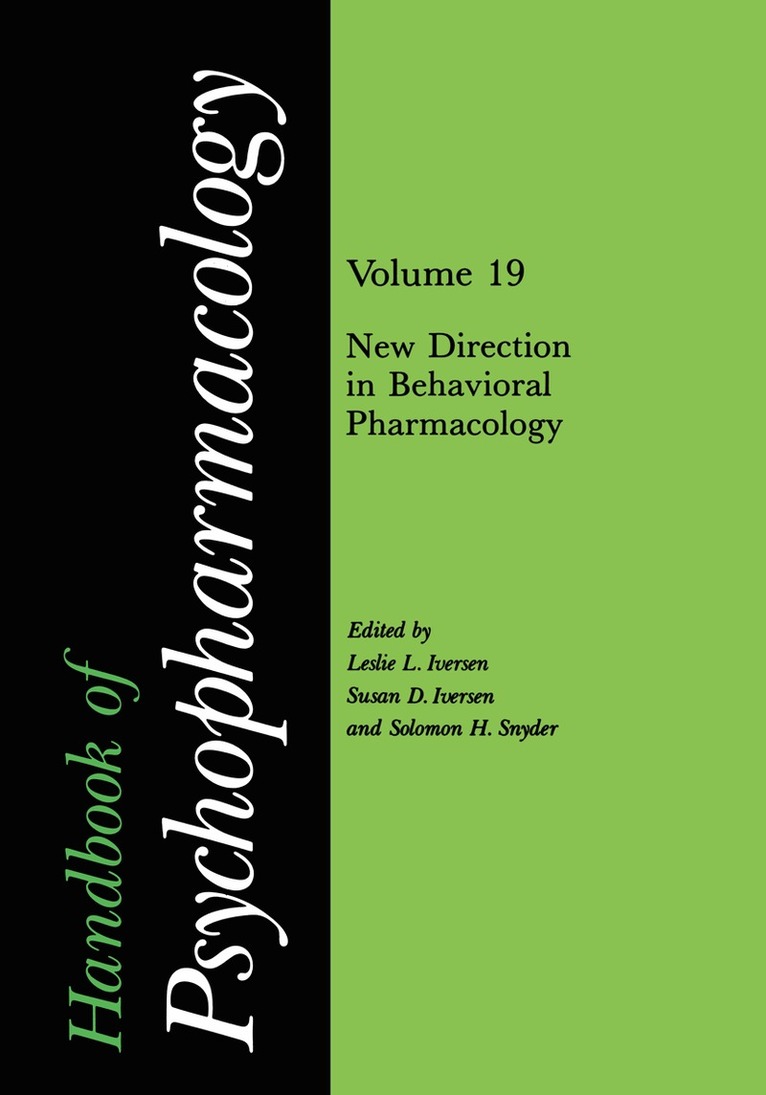
    Handbook of Psychopharmacology

    Volume 19 New Directions in Behavioral Pharmacology

    AvLeslie Iversen,Solomon H. Snyder

    Häftad, Engelska, 2011

    563 kr

    Beställningsvara. Skickas inom 10-15 vardagar. Fri frakt över 249 kr.

    Beskrivning

    Volumes 7 and 8 of the Handbook were published in 1977. In Volume 7 methods for studying unconditioned and conditioned behavior were reviewed. Attention was given to both ethological methods and operant conditioning techniques as applied to some selected aspects of behavior. Genetic, developmental, and environmental factors influencing behavior were also discussed. In Volume 8, neurotransmitter systems, and in par­ ticular brain circuits, were discussed in relation to behavior and to the effects of psychoactive drugs on behavior. The coverage was not exhaus­ tive because of space limitations. The topics selected for review were, at the time, the focus of considerable experimental effort; they included homeostasis-motivated behaviors: sleep, locomotion, feeding, drinking, and sexual behavior. Brain dopamine systems were therefore discussed in depth, since they were already known to be centrally involved in motivated behaviors. Learning mechanisms and emotion were reviewed in the remaining chapters. In 1984 we initiated an update of behavioral pharmacology to review areas of progress within the same scope as the earlier volumes. This update continues in Volume 19. Among the contributions are several that represent important advances in analyzing behavior and the use of more sophisticated methods to define the effect of drugs on particular aspects of behavior. The chapters by Blundell on feeding and Miczek on aggres­ sion illustrate the sophistication of modern ethopharmacology.

    Produktinformation

    • Utgivningsdatum:2011-11-12
    • Mått:178 x 254 x 36 mm
    • Vikt:1 221 g
    • Format:Häftad
    • Språk:Engelska
    • Antal sidor:642
    • Upplaga:1987
    • Förlag:Springer-Verlag New York Inc.
    • ISBN:9781461290179

    Utforska kategorier

    • Psykiatri inom Medicin
    • Farmakologi inom Medicin
    • Neurologi och klinisk neurofysiologi inom Medicin

    Innehållsförteckning

    • 1 Conditioned Drug Effects.- 1. Introduction.- 2. Conditioned Drug Effects: Evidence and Explanations.- 3. Implications.- 4. References.- 2 Developmental Neuropharmacology: Clinical and Neurochemical Perspectives on the Regulation of Attention, Learning, and Movement.- 1. Clinical Phenomena and Research Design.- 2. Attention Deficit Disorder with Hyperactivity.- 3. Learning Disorders.- 4. Tourette’s Syndrome of Chronic, Multiple Tics.- 5. Overview.- 6. References.- 3 Structure, Process, and Mechanism: Case Studies in the Psychopharmacology of Feeding.- 1. Introduction.- 2. Control of Feeding: A First Look.- 3. Drugs and Food Intake.- 4. Interpretation of Pharmacological Action.- 5. Contextual and Temporal Dimensions of Behavior.- 6. Structure, Process, and Mechanism.- 7. Methodological Developments.- 8. Case Studies in the Pharmacological Analysis of Feeding.- 9. Control of Feeding: A Second Look.- 10. References.- 4 The Psychopharmacology of Aggression.- 1. Recent History of Psychopharmacological Aggression Research.- 2. Framework for the Behavioral Analysis of Aggression.- 3. Preclinical and Clinical Aggression Research.- 4. References.- 5 The Electrophysiological and Biochemical Pharmacology of the Mesolimbic and Mesocortical Dopamine Neurons.- 1. Introduction.- 2. Anatomy of Midbrain Dopamine Systems.- 3. Distinguishing between A9 and A10 Dopamine Systems.- 4. Identification and Characterization.- 5. Dopamine Neuron Function Regulation.- 6. Effects of Neurotransmitters on A10 Dopamine Neuron Activity.- 7. Summary.- 8. References.- 6 Psychopharmacology of Repeated Seizures: Possible Relevance to the Mechanism of Action of Electroconvulsive Therapy.- 1. Introduction.- 2. Functional Changes after Seizures.- 3. Biochemical Consequences of Seizures.- 4. NeuroendocrineMarkers of Neurotransmitter Changes Following Electroconvulsive Shock.- 5. Are Any Biochemical and Functional Changes Associated?.- 6. Can Biochemical or Behavioral Changes Be Associated with Antidepressant Action of Electroconvulsive Shock?.- 7. References.- 7 Psychopharmacology of Nicotine: Stimulus Effects and Receptor Mechanisms.- 1. Introduction.- 2. Nicotine as a Positive Reinforcer.- 3. Nicotine as an Aversive Stimulus.- 4. Discriminative Stimulus of Nicotine.- 5. Nicotine and Brain Mechanisms of Reward.- 6. General Conclusions.- 7. References.- 8 The Behavioral Effects of Opiates.- 1. Introduction.- 2. The Effects of Opiates on Pain.- 3. The Effects of Opiates on Reward.- 4. The Effects of Opiates on Cardiovascular Function.- 5. Other Effects of Opiates on Behavior.- 6. References.- 9 Neuropeptides and Memory.- 1. Neuropeptides.- 2. Conceptual and Methodological Considerations.- 3. Hypophyseal Peptides and Memory.- 4. Nonhypophyseal Peptides and Memory.- 5. Synthesis.- 6. References.- 10 The Actions of Neuroleptic Drugs on Appetitive Instrumental Behaviors.- 1. Introduction.- 2. Hypotheses on the Behavioral Actions of Neuroleptics.- 3. Evaluation of Experiments on Dopaminergic Involvement in Reinforcement.- 4. Incentive Explanation of Neuroleptic Actions.- 5. An Alternative Explanation of Dopamine Antagonist Effects on Operant Behavior.- 6. References.- 11 Second-Generation Antidepressants.- 1. Introduction.- 2. General Properties of Second-Generation Antidepressants.- 3. Methodological Approaches.- 4. Summary and Conclusions.- 5. References.