• Fri frakt över 249 kr
  • •
  • Snabba leveranser
  • •
  • Billiga böcker
Kundservice

Du är på sajten för privatpersoner.

Företag, bibliotek eller offentlig verksamhet?

Du handlar på classic.bokus.com, där alla dina funktioner finns intakta.
Till classic.bokus.com
Bokus logotyp. Gå till startsidan.
  • Erbjudanden
  • Nyheter
  • Student
  • Topplistor
  • Barn & ungdom
  • Bokus Play
  • E-böcker
  • Pocketböcker
  • Spel & pussel

10% rabatt på allt med kod: NYSTART10 →

Sidfot

Mina sidor

    Hjälp

    • Kundservice
    • Vanliga frågor och svar
    • Frakt och leverans
    • Retur vid ångerrätt
    • Reklamera vara
    • Betalning
    • Köpvillkor
    • Allmänna villkor
    • Information om webbplatsens tillgänglighet

    Om Bokus

    • Om oss
    • Pressrum
    • För studenter
    • För företag
    • För bibliotek och offentlig verksamhet
    • För leverantörer
    • Hållbarhet

    Populärt

    • Aktuella erbjudanden
    • Presentkort
    • Studentlitteratur
    • Nya böcker
    • Topplistor
    • Signerade böcker
    • Engelska böcker

    Inspiration

    • Boktips
    • BookTok
    • Populära bokserier
    • Barnbokskaraktärer
    • Populära författare
    Logotyp för Bokus
    Följ oss på Facebook (extern länk)Följ oss på Instagram (extern länk)Följ oss på YouTube (extern länk)Följ oss på TikTok (extern länk)
    bokus @ CookiesAnpassa cookiesIntegritetspolicyKöpvillkor
    Till Citymail hemsida (extern länk)Till Budbee hemsida (extern länk)Till Postnord hemsida (extern länk)Till Schenker hemsida (extern länk)Till Early Bird hemsida (extern länk)Till Walleys hemsida (extern länk)
    1. Medicin
    2. Andra medicinska specialiteter
    3. Psykiatri

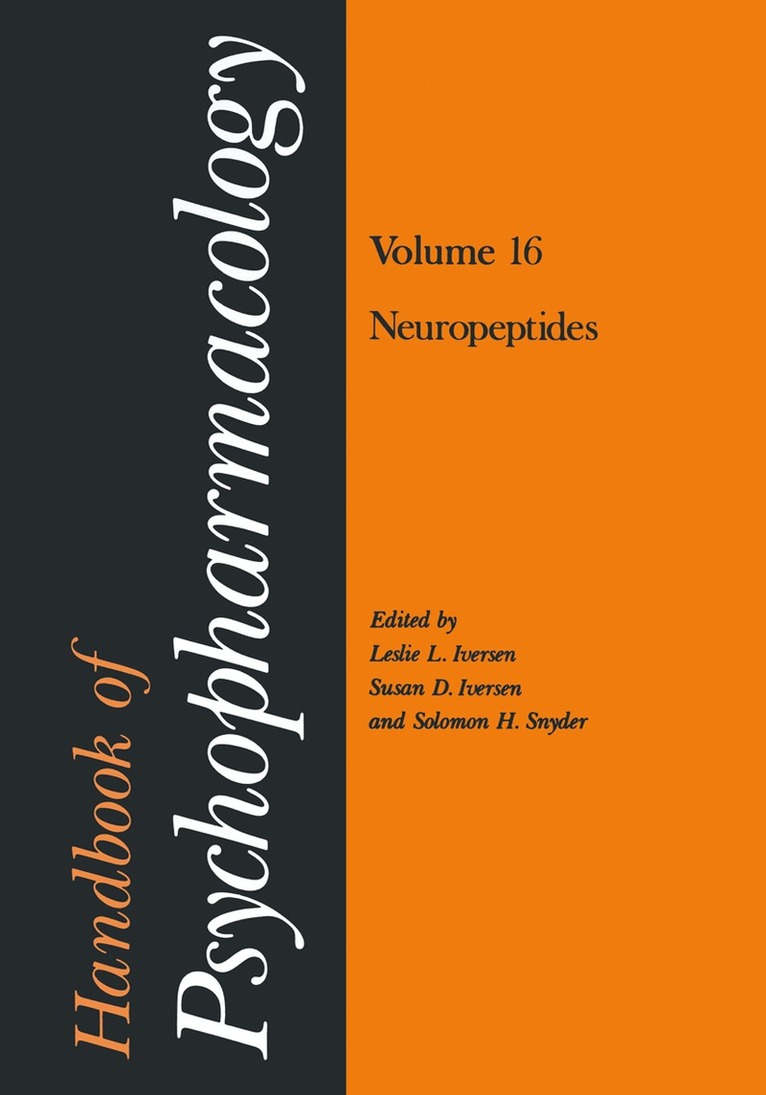
    Handbook of Psychopharmacology

    Volume 16 Neuropeptides

    AvLeslie L. Iversen,Susan D. Iversen

    Häftad, Engelska, 2011

    1 119 kr

    Beställningsvara. Skickas inom 10-15 vardagar. Fri frakt över 249 kr.

    Beskrivning

    It is now eight years since the first Handbook volumes on Basic Neuro­ pharmacology were published, and there have been many important advances. As in many other areas in science, progress in this field has depended to a considerable extent on the availability of new experimental methods, and Volume 15 reviews some major recent developments, including new autoradiographic techniques that allow direct visualization of drug and transmitter receptors in the nervous system, and the pin­ pointing of the precise locations of the changes in brain metabolism elicited by various drug treatments. Volumes 16 and 17 cover two of the most active areas for basic research in psychopharmacology at the moment: the characterization of drug and transmitter receptors in brain by radioligand binding techniques, and studies of the role of small peptides in brain function. The latter area, in particular, illustrates how rapidly progress continues to be made in basic research on the mechanisms of chemical communication within the nervous system. Eight years ago when the Handbook first appeared none of the opioid peptides (enkephalins and endorphins) had yet been identified. Since then a whole new area of basic biological research has focused on these substances, and in addition we know of more than thirty other neuropeptides with putative eNS trans­ mitter functions.

    Produktinformation

    • Utgivningsdatum:2011-11-03
    • Mått:170 x 244 x 32 mm
    • Vikt:1 014 g
    • Format:Häftad
    • Språk:Engelska
    • Antal sidor:592
    • Förlag:Springer-Verlag New York Inc.
    • ISBN:9781461335177

    Utforska kategorier

    • Psykiatri inom Medicin
    • Farmakologi inom Medicin
    • Neurologi och klinisk neurofysiologi inom Medicin

    Innehållsförteckning

    • 1 Substance P in the Nervous System.- 1. Introduction.- 2. Methods for Detection and Assay of Substance P.- 3. Neurochemistry of Substance P Neurons.- 4. Substance P in the Peripheral Nervous System.- 5. Substance P in Primary Sensory Neurons.- 6. Substance P in the Central Nervous System.- 7. Coexistence of Substance P with Other Neurotransmitters.- 8. Interaction of Substance P with Other Transmitter Receptors.- 9. Neurological Disorders Affecting Substance P Neurons.- 10. Conclusions.- 11. References.- 2 The Enkephalins.- 1. Introduction.- 2. Enkephalin Biosynthesis.- 3. Regulation of Enkephalin Concentration in the Adrenal Medulla.- 4. Enkephalin Metabolism.- 5. Enkephalin Regulation in Neurons.- 6. Enkephalin Distribution.- 7. Electrophysiology of Enkephalin.- 8. Enkephalin Receptors and Cellular Effects.- 9. Enkephalins and Pain.- 10. Role of Enkephalin in the Gastrointestinal System.- 11. References.- 3 Beta-Endorphin and Biosynthetically Related Peptides in the Central Nervous System.- 1. Introduction.- 2. Immunohistochemistry: ß-LPH, ß-END, ACTH, ?-MSH, and Gamma-MSH (?-MSH).- 3. Biosynthesis of the ACTH, ?-MSH, ß-END/?-MSH Precursor.- 4. Receptors of ß-END, ACTH, ?-MSH.- 5. Physiological and Behavioral Studies.- 6. Psychiatric Studies Using Opioid Peptides and Related Pharmacology.- 7. Future Directions: The Multisubstance Neuron.- 8. References.- 4 Cholecystokinin and Vasoactive Intestinal Polypeptide.- 1. Introduction.- 2. Cholecystokinin.- 3. Vasoactive Intestinal Polypeptide.- 4. Conclusion.- 5. References.- 5 Brain Angiotensin.- 1. The Renin-Angiotensin System.- 2. Effects of Angiotensin on the Brain.- 3. The Brain Renin-Angiotensin System.- 4. References.- 6 Neurotensin and Bombesin.- 1. Introduction.- 2. Neurotensin.- 3. Bombesin.- 4.Discussion.- 5. References.- 7 Extrahypothalamic Distribution and Action of Hypothalamic Hormones.- 1. Introduction.- 2. Luteinizing-Hormone-Releasing Hormone (LH-RH).- 3. Thyrotropin-Releasing Hormone (TRH).- 4. Somatostatin.- 5. Corticotropin-Releasing Factor (CRF).- 6. Vasopressin.- 7. Oxytocin.- 8. Concluding Remarks.- 9. References.- 8 Peptide Effects on the Excitability of Single Nerve Cells.- 1. Introduction.- 2. Invertebrate Studies.- 3. Vertebrate Studies.- 4. Conclusion.- 5. References.- 9 Neuronal Coexistence of Peptides with Other Putative Transmitters.- 1. Introduction.- 2. Methodology.- 3. Adrenal Chromaffin Cells and Some Other Paraneurons.- 4. Peripheral Nervous System.- 5. Central Nervous System.- 6. Concluding Remarks.- 7. References.