• Fri frakt över 249 kr
  • •
  • Snabba leveranser
  • •
  • Billiga böcker
Kundservice

Du är på sajten för privatpersoner.

Företag, bibliotek eller offentlig verksamhet?

Du handlar på classic.bokus.com, där alla dina funktioner finns intakta.
Till classic.bokus.com
Bokus logotyp. Gå till startsidan.
  • Erbjudanden
  • Nyheter
  • Student
  • Topplistor
  • Barn & ungdom
  • Bokus Play
  • E-böcker
  • Pocketböcker
  • Spel & pussel

10% rabatt på allt med kod: NYSTART10 →

Sidfot

Mina sidor

    Hjälp

    • Kundservice
    • Vanliga frågor och svar
    • Frakt och leverans
    • Retur vid ångerrätt
    • Reklamera vara
    • Betalning
    • Köpvillkor
    • Allmänna villkor
    • Information om webbplatsens tillgänglighet

    Om Bokus

    • Om oss
    • Pressrum
    • För studenter
    • För företag
    • För bibliotek och offentlig verksamhet
    • För leverantörer
    • Hållbarhet

    Populärt

    • Aktuella erbjudanden
    • Presentkort
    • Studentlitteratur
    • Nya böcker
    • Topplistor
    • Signerade böcker
    • Engelska böcker

    Inspiration

    • Boktips
    • BookTok
    • Populära bokserier
    • Barnbokskaraktärer
    • Populära författare
    Logotyp för Bokus
    Följ oss på Facebook (extern länk)Följ oss på Instagram (extern länk)Följ oss på YouTube (extern länk)Följ oss på TikTok (extern länk)
    bokus @ CookiesAnpassa cookiesIntegritetspolicyKöpvillkor
    Till Citymail hemsida (extern länk)Till Budbee hemsida (extern länk)Till Postnord hemsida (extern länk)Till Schenker hemsida (extern länk)Till Early Bird hemsida (extern länk)Till Walleys hemsida (extern länk)
    1. Ekonomi och Ledarskap
    2. Företagsekonomi
    3. Redovisning och finansiering
    4. Redovisning

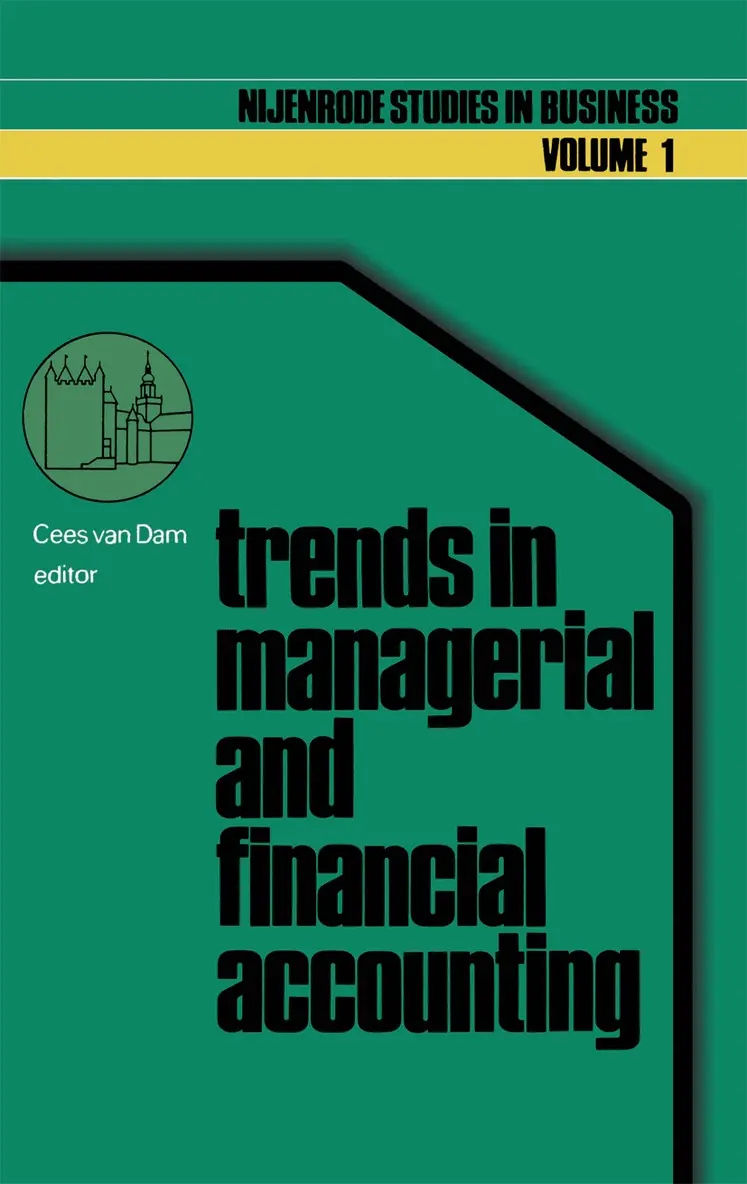
    Trends in managerial and financial accounting

    Income determination and financial reporting

    AvCees van Dam

    Häftad, Engelska, 2011

    Del i serien Nijenrode Studies in Business

    1 119 kr

    Beställningsvara. Skickas inom 10-15 vardagar. Fri frakt över 249 kr.

    Beskrivning

    In August, 1976 the research seminar 'Decision-making in business' was organized at Nijenrode, The Netherlands School of Business. More than fifty scientists and practitioners from nine countries presented research papers in one of the six discussion groups. Some of them also presented some of their ideas in front of a large mixed audience at a one-day symposium. Many of the papers presented at Nijenrode were of such a high quality that the decision to publish a selection of them was an easy one. At the same time the new series Nijenrode studies in business was initiated. All who were involved, the policy committee of the N ijenrode studies, the advisory and editorial board of the series, the publisher, and the organizing committee of the seminar and symposium, acclaimed the idea of publishing three volumes in the new series. A collection of eleven papers could be grouped under the title Trends in managerial andfinancial accounting. Another collection will be published as volume 2 of this series under the title TI'ends in financial decision-making, while volume 3 will consist of papers exploring the theme Trends in business ethics. The books are intended for those who are interested in new developments in the decision-making area. They are especially suitable for graduate or advanced undergraduate courses: volume 1 in managerial or financial accounting courses; volume 2 in courses on managerial finance, capital budgeting or decision­ making; and volume 3 in courses on business ethics or related fields.

    Produktinformation

    • Utgivningsdatum:2011-10-12
    • Mått:155 x 235 x 14 mm
    • Vikt:376 g
    • Format:Häftad
    • Språk:Engelska
    • Serie:Nijenrode Studies in Business
    • Antal sidor:225
    • Förlag:Springer-Verlag New York Inc.
    • ISBN:9781461340645

    Utforska kategorier

    • Redovisning inom Ekonomi och Ledarskap

    Innehållsförteckning

    • I. A synthesis of inflation accounting and replacement value accounting.- 1. Reporting to external users and for management.- 2. Comparison of inflation accounting and replacement value accounting.- 3. Evaluation of the two accounting methods.- 4. The objectives of financial statements.- 5. A proposal for a synthesis.- II. A study in current value accounting.- 1. Introduction: the ideal management information system.- 2. Current value, part of the system’s basic data.- 3. Purchases, sales and stock.- 4. Benefits from the use of current value.- 5. Simplification of the system.- 6. Summary and conclusion.- III. The primacy of accounting income in decisions on expansion: an exercise in arithmetic.- 1. Introduction.- 2. Valuing an expansion path.- 3. The relationship between current and economic income.- 4. The evaluation of expectations.- 5. Expansion-neutral income taxes.- 6. Conclusion.- IV. The cash flow accounting alternative for corporate financial reporting.- 1. Introduction.- 2. Challenges to date.- 3. The U.K. example.- 4. The conceptual argument.- 5. The measurement arguments.- 6. User comprehension.- 7. The future.- V. The rationale of cash flow accounting.- 1. Introduction.- 2. Cash flow accounting and shareholders.- 3. Return to shareholders.- 4. The determinants of dividend and retentions.- 5. Comparison with other accounting systems.- VI. The capital-income statement as a new tool for management.- 1. Introduction.- 2. A new statement to serve specific purposes.- 3. An application.- 4. Epilogue.- VII. The annual statement needs a theory.- 1. What does the annual statement aim at?.- 2. The annual statement lacks a theory of information.- 3. Two major conclusions.- 4. A reliable theory of information.- 5. The statement of income administration.- 6. Thestatement of income distribution.- 7. The statement of capital administration.- 8. The auditors’ certificate.- VIII. Accounting for the cost of interest.- 1. Accounting should adopt the concept of interest used in economics.- 2. Implications of the proposal.- 3. Harmonizing financial accounting and management accounting.- 4. Measuring interest cost.- 5. Accounting procedures.- 6. Effect on financial statements.- 7. Conclusion.- IX. Accounting principles that serve the information needs of corporate investors.- 1. Introduction.- 2. Valuation of an investor’s share.- 3. Estimating net present value.- 4. Corporate financial statements and share prices.- 5. Forecasting and the use of historical data.- 6. Historical and replacement costs in an inflationary environment.- 7. General price level adjusted historical cost (GPLAC).- 8. Conclusions.- X. Stock market efficiency and the information content of financial reports.- 1. Introduction: problem setting.- 2. The efficient market concept.- 3. How realistic is the concept?.- 4. A transparent stock market.- 5. Market efficiency, market transparency and the informational content of financial reports.- 6. Conclusions.- XI. Technical assumptions and review of financial forecasts.- 1. Introduction.- 2. Regulatory pronouncements on publication of financial forecasts.- 3. What is an assumption?.- 4. Scope of the study.- 5. Impact of technical assumptions on the bottom line.- 6. Interpretation of results.- 7. Which assumptions merit disclosure?.- 8. What can assumptions accomplish for the investor?.- Appendix A.- Appendix B.