• Fri frakt över 249 kr
  • •
  • Snabba leveranser
  • •
  • Billiga böcker
Kundservice

Du är på sajten för privatpersoner.

Företag, bibliotek eller offentlig verksamhet?

Du handlar på classic.bokus.com, där alla dina funktioner finns intakta.
Till classic.bokus.com
Bokus logotyp. Gå till startsidan.
  • Erbjudanden
  • Nyheter
  • Student
  • Topplistor
  • Barn & ungdom
  • Bokus Play
  • E-böcker
  • Pocketböcker
  • Spel & pussel

10% rabatt på allt med kod: NYSTART10 →

Sidfot

Mina sidor

    Hjälp

    • Kundservice
    • Vanliga frågor och svar
    • Frakt och leverans
    • Retur vid ångerrätt
    • Reklamera vara
    • Betalning
    • Köpvillkor
    • Allmänna villkor
    • Information om webbplatsens tillgänglighet

    Om Bokus

    • Om oss
    • Pressrum
    • För studenter
    • För företag
    • För bibliotek och offentlig verksamhet
    • För leverantörer
    • Hållbarhet

    Populärt

    • Aktuella erbjudanden
    • Presentkort
    • Studentlitteratur
    • Nya böcker
    • Topplistor
    • Signerade böcker
    • Engelska böcker

    Inspiration

    • Boktips
    • BookTok
    • Populära bokserier
    • Barnbokskaraktärer
    • Populära författare
    Logotyp för Bokus
    Följ oss på Facebook (extern länk)Följ oss på Instagram (extern länk)Följ oss på YouTube (extern länk)Följ oss på TikTok (extern länk)
    bokus @ CookiesAnpassa cookiesIntegritetspolicyKöpvillkor
    Till Citymail hemsida (extern länk)Till Budbee hemsida (extern länk)Till Postnord hemsida (extern länk)Till Schenker hemsida (extern länk)Till Early Bird hemsida (extern länk)Till Walleys hemsida (extern länk)
    1. Naturvetenskap och teknik
    2. Teknik och industri
    3. Elektronik och kommunikationer

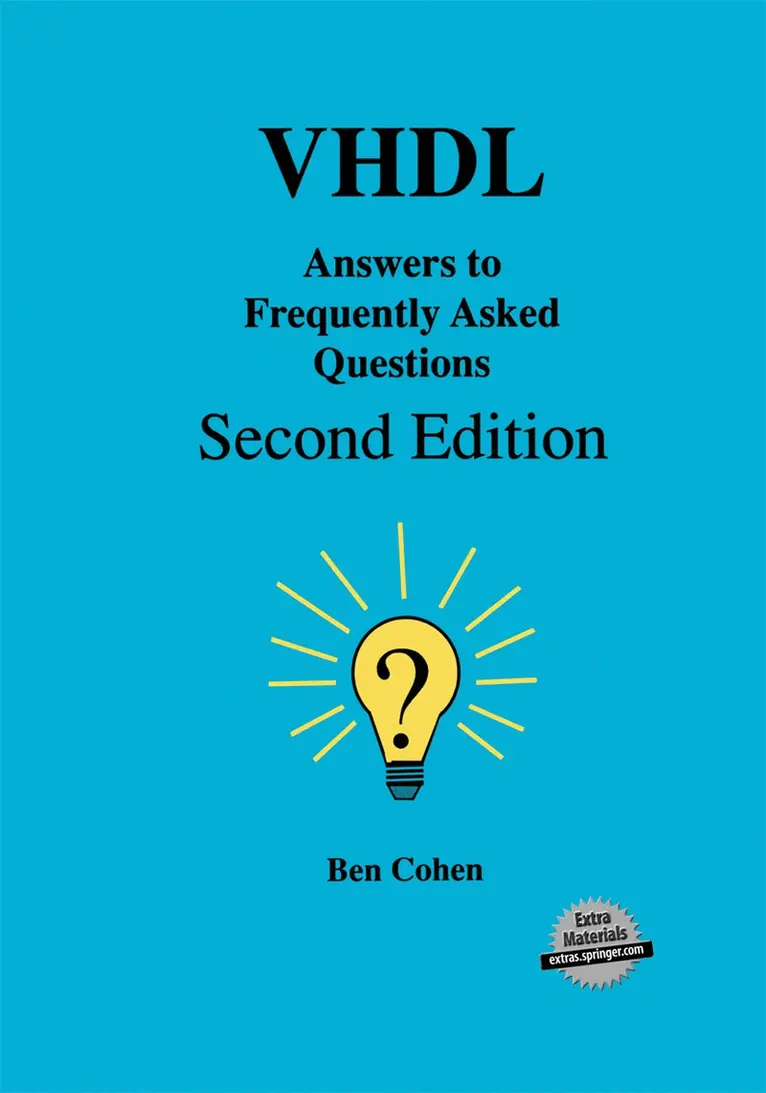
    VHDL Answers to Frequently Asked Questions

    AvBen Cohen

    Häftad, Engelska, 2012

    1 626 kr

    Beställningsvara. Skickas inom 10-15 vardagar. Fri frakt över 249 kr.

    Fler format och utgåvor

    Inbunden

    1 674 kr

    E-bok

    2 049 kr

    E-bok

    1 413 kr

    Häftad

    1 086 kr

    Beskrivning

    VHDL Answers to Frequently asked Questions is a follow-up to the author's book VHDL Coding Styles and Methodologies (ISBN 0-7923-9598-0). On completion of his first book, the author continued teaching VHDL and actively participated in the comp. lang. vhdl newsgroup. During his experiences, he was enlightened by the many interesting issues and questions relating to VHDL and synthesis. These pertained to: misinterpretations in the use of the language; methods for writing error free, and simulation efficient, code for testbench designs and for synthesis; and general principles and guidelines for design verification. As a result of this wealth of public knowledge contributed by a large VHDL community, the author decided to act as a facilitator of this information by collecting different classes of VHDL issues, and by elaborating on these topics through complete simulatable examples. TItis book is intended for those who are seeking an enhanced proficiency in VHDL. Its target audience includes: 1. Engineers. The book addresses a set of problems commonly experienced by real users of VHDL. It provides practical explanations to the questions, and suggests practical solutions to the raised issues. It also includes packages of common utilities that are useful in the generation of debug code and testbench designs. These packages include conversions to strings (the IMAGE package), generation of Linear Feedback Shift Registers (LFSR), Multiple Input Shift Register (MISR), and random number generators.

    Produktinformation

    • Utgivningsdatum:2012-10-08
    • Mått:178 x 254 x 23 mm
    • Vikt:786 g
    • Format:Häftad
    • Språk:Engelska
    • Antal sidor:384
    • Upplaga:2
    • Förlag:Springer-Verlag New York Inc.
    • ISBN:9781461375814

    Utforska kategorier

    • Elektronik och kommunikationer inom Naturvetenskap och teknik
    • CAD-program inom Data och IT
    • Energiteknik inom Naturvetenskap och teknik

    Innehållsförteckning

    • 1. Language Elements.- 1.1 Why VHDL for Digital Designs.- 1.2 Salient Points of Concurrent Statements.- 1.3 Guarded Signal Assignments.- 1.4 Signals and Ports.- 1.5 Configurations.- 1.6 Arithmetic Issues and Operators.- 1.7 PACKAGE STD_LOGIC_1164.- 1.8 Range Constraint in Type Definition.- 1.9 Shared Variables.- 2. Arrays.- 2.1 Array Structure Representations.- 2.2 Arrays — Legal Operations.- 2.3 Array Slices and Ranges.- 2.4 Array Initialization.- 2.5 Constant Arrays in Case.- 2.6 Constrained and Unconstrained Arrays.- 2.7 Mapping Arrays of Different Sizes.- 2.8 Unconstrained Aggregate with “Others ”.- 2.9 Illegal Array Types.- 3. Drivers.- 3.1 Multiple Drivers — Case 1.- 3.2 Multiple Drivers — Case 2.- 3.3 Multiple Drivers Error — Case 3.- 3.4 Multiple Drivers Error — Component.- 3.5 Coding Style for Detection of Multiple Drivers.- 4. Subprograms.- 4.1 Side Effects From A Procedure.- 4.2 Garbage Collection of Dynamically Created Objects.- 4.3 Acceptable Types in Parameter Lists for Function Calls.- 4.4 Files Declarations in Procedures.- 4.5 Multiple Accesses of Same File.- 4.6 File Array.- 4.7 Conversion Function From Integer To Time.- 4.8 Normalization In Subprograms.- 5. Packages.- 5.1 Converting Typed Objects To Strings.- 5.2 Printing Objects From Vhdl.- 5.3 Multiple Input Signature Register (Misr).- 5.4 Design of a Linear Feedback Shift Register (Lfsr).- 5.5 Random Number Generation.- 5.6 Deferred Constant in Package Declaration.- 5.7 Complex Numbers and Overloaded Operators.- 5.8 Ieee Standards.- 6. Models.- 6.1 Large Ram Model For Simulation..- 6.2 Zero Ohm Resistor (Wire, Bridge) Model.- 6.3 Error Injector Model.- 6.4 Transfer Gate (Switch).- 7. Synthesis.- 7.1 Supported/Unsupported Constructs for Synthesis.- 7.2 Synthesis Sensitivity Rules.- 7.3Latch/Register/Combinational Logic.- 7.4 Latch Inferrance in Functions.- 7.5 Variable Initialization and Lifetime.- 7.6 Wait Statement.- 7.7 Defining Shift Registers in Synthesis.- 7.8 Register File.- 7.9 Multiplexer Model.- 7.10 Demultiplexer Model.- 7.11 Barrel Shifter.- 7.12 Use of “don’t Care” in Case Statement.- 7.13 Parameterized Priority Encoder.- 7.14 Generating A Synchronous Precharge.- 7.15 Technology and Vhdl Code Design.- 7.16 Synthesizing Tri-States.- 7.17 Subelement Association.- 7.18 Finite State Machine (Fsm).- 7.19 One-Hot Encoding.- 7.20 Instantiating Synopsys® Designware Components.- 7.21 Resource Sharing.- 7.22 Applying Digital Design Experiences.- 7.23 Address Range Identification Via Inferred Comparator.- 7.24 Port Mapping to Ground Or Vcc.- 7.25 Bit Reversal.- 7.26 How to Design a Timer in Vhdl.- 7.27 Specifying a Multiplier.- 7.28 Behavioral Synthesis.- 8. Design Verification and Testbench.- 8.1 Verification Processes.- 8.2 Functional Verification.- 8.3 Regression Tests.- 8.4 Formal Verification.- 8.5 Bus Functional Model (Bfm) Modeling.- 8.6 Application of Misr, Random, Lfsr Packages for Auto-Regression.- 8.7 Strength Stripper.- 9. Potpourri.- 9.1 Methods To Enhance Simulation Speed.- 9.2 Accessing Signals Internal to Components.- 9.3 Transferring a Line Onto a Signal.- 9.4 Type Declaration in Multiple Packages.- 9.5 Internet - Frequently Asked Questions.- 9.6 Vhdl Text Editor?.- 9.7 Vital.- 9.8 Behavioral Modeling.- 9.9 Final Vhdl Exam.- 10. Design for Reuse.- 10.1 Design Processes for Reusability.- 10.2 Parameterized, Reusable and Readable Code.- 10.3 Documentation of Vhdl Designs.- Appendix A: Vhdl’93 and Vhdl’87 Syntax Summary.- Appendix B: Package Standard.- Appendix C: Package Textio.- Appendix D: Package Std_Logic_1164.-Appendix E: Package Std_Logic_Arith.- Appendix F: Vhdl Predefined Attributes.