• Fri frakt över 249 kr
  • •
  • Snabba leveranser
  • •
  • Billiga böcker
Kundservice

Du är på sajten för privatpersoner.

Företag, bibliotek eller offentlig verksamhet?

Du handlar på classic.bokus.com, där alla dina funktioner finns intakta.
Till classic.bokus.com
Bokus logotyp. Gå till startsidan.
  • Erbjudanden
  • Nyheter
  • Student
  • Topplistor
  • Barn & ungdom
  • Bokus Play
  • E-böcker
  • Pocketböcker
  • Spel & pussel

10% rabatt på allt med kod: NYSTART10 →

Sidfot

Mina sidor

    Hjälp

    • Kundservice
    • Vanliga frågor och svar
    • Frakt och leverans
    • Retur vid ångerrätt
    • Reklamera vara
    • Betalning
    • Köpvillkor
    • Allmänna villkor
    • Information om webbplatsens tillgänglighet

    Om Bokus

    • Om oss
    • Pressrum
    • För studenter
    • För företag
    • För bibliotek och offentlig verksamhet
    • För leverantörer
    • Hållbarhet

    Populärt

    • Aktuella erbjudanden
    • Presentkort
    • Studentlitteratur
    • Nya böcker
    • Topplistor
    • Signerade böcker
    • Engelska böcker

    Inspiration

    • Boktips
    • BookTok
    • Populära bokserier
    • Barnbokskaraktärer
    • Populära författare
    Logotyp för Bokus
    Följ oss på Facebook (extern länk)Följ oss på Instagram (extern länk)Följ oss på YouTube (extern länk)Följ oss på TikTok (extern länk)
    bokus @ CookiesAnpassa cookiesIntegritetspolicyKöpvillkor
    Till Citymail hemsida (extern länk)Till Budbee hemsida (extern länk)Till Postnord hemsida (extern länk)Till Schenker hemsida (extern länk)Till Early Bird hemsida (extern länk)Till Walleys hemsida (extern länk)
    1. Data och IT
    2. Nätverk och kommunikation

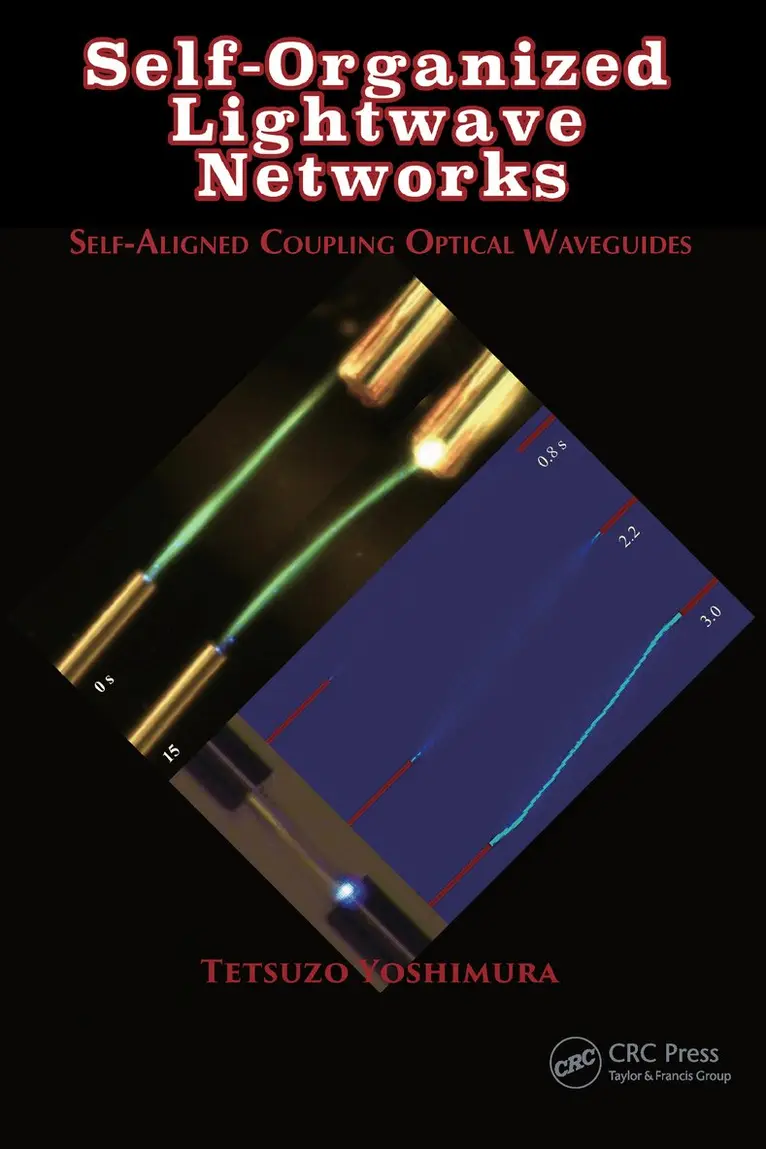
    Self-Organized Lightwave Networks

    Self-Aligned Coupling Optical Waveguides

    AvTetsuzo Yoshimura

    Inbunden, Engelska, 2018

    2 421 kr

    Beställningsvara. Skickas inom 10-15 vardagar. Fri frakt över 249 kr.

    Fler format och utgåvor

    Häftad

    1 200 kr

    E-bok

    1 429 kr

    E-bok

    1 425 kr

    Beskrivning

    This book gives a solution to the problem of constructing lightwave paths in free spaces by proposing the concept of a Self-Organized Lightwave Network (SOLNET). This concept enables us to form self-aligned coupling optical waveguides automatically. SOLNETs are fabricated by self-focusing of lightwaves in photosensitive media, in which the refractive index increases upon light beam exposure, to realize the following functions: 1) Optical solder: Self-aligned optical couplings between misaligned devices with different core sizes 2) Three-dimensional optical wiring 3) Targeting lightwaves onto specific objects SOLNETs are expected to reduce the efforts to implement lightwaves into electronic systems and allow us to create new architectures, thus reducing costs and energy dissipation and improving overall system performance. SOLNETs are also expected to be applied to a wide range of fields where lightwaves are utilized, for example, solar energy conversion systems and biomedical technologies, especially photo-assisted cancer therapies. Readers will systematically learn concepts and features of SOLNETs, SOLNET performance predicted by computer simulations, experimental demonstrations for the proof of concepts, and expected applications. They will also be prepared for future challenges of the applications. This book is intended to be read by scientists, engineers, and graduate students who study advanced optoelectronic systems such as optical interconnects within computers and optical networking systems, and those who produce new ideas or strategies on lightwave-related subjects.


    Produktinformation

    • Utgivningsdatum:2018-04-20
    • Mått:156 x 234 x 19 mm
    • Vikt:521 g
    • Format:Inbunden
    • Språk:Engelska
    • Antal sidor:209
    • Förlag:Taylor & Francis Inc
    • ISBN:9781498779791

    Utforska kategorier

    • Nätverk och kommunikation inom Data och IT
    • Fysik inom Naturvetenskap och teknik

    Recensioner i media

    "This book encapsulates how self-focusing photo-sensitive media can be utilized to enable the automatic formation of self-aligned coupling optical waveguides. Such self-organized lightwave networks (SOLNETs) are offered as a low-cost, low-energy means to introduce lightguides into electronic systems."--K. Alan Shore, Bangor University, U.K.

    Innehållsförteckning

    • 1. Introduction. 2. Related Technologies. 2.1 Self-Focusing of Lightwaves in Nonlinear Optical Media. 2.2 Photosensitive Materials. Photopolymers, Photosensitive glass, Photorefractive crystals. Self-Written Waveguides. 3. Self-Organized Optical Waveguides--- Self-Organized Lightwave Network (SOLNET). 3.1 Concept. Two-Beam-Writing SOLNET (TB-SOLNET), Reflective SOLNET (R-SOLNET), Luminescence-Writing SOLNET (L-SOLNET), Phosphor SOLNET (P-SOLNET), SOLNETs utilizing One-Photon and Two-Photon photochemistry. 3.2 Features Self-aligned optical coupling, 3-D optical wiring, Targeting lightwaves onto specific objects. 4. Proof of Concept by Computer Simulations. 4.1 TB-SOLNET/P-SOLNET. 4.2 R-SOLNET. 4.3 L-SOLNET. 4.4 SOLNET between Microscale and Nanoscale Waveguides. 4.5 Parallel and Branching SOLNET. 4.6 Vertical SOLNET for Optical Z-Connections. 5. Experimental Demonstrations 5.1 TB-SOLNET. Fiber and Fiber. 5.2 R-SOLNET. Fiber and Mirror, Fiber and Luminescent target. 5.3 SOLNET between Microscale and Nanoscale Waveguides. Fiber and LD. 5.4 Branching SOLNET. Fiber and Two luminescent targets. 5.5 Vertical SOLNET. Mask window and Mirror, From 45o mirror in waveguide film. 6. Expected Applications. 6.1 Optical Solder. Self-aligned optical coupling. 6.2 Integrated Optical Interconnects. Self-aligned optical coupling/3-D optical wiring. 6.3 3-D Micro Optical Switching Systems. Self-aligned optical coupling/3-D optical wiring. 6.4 Solar Energy Conversion Systems. Self-aligned optical coupling/3-D optical wiring. 6.5 Cancer therapy. Targeting lightwaves onto specific objects. 7. Future Challenges. Re-writable photosensitive materials for dynamic SOLNET. High-Rn photosensitive materials for high-index-contrast SOLNET. Control of gamma characteristics of photosensitive materials for optimized SOLNET. Interference pattern with SOLNET. 8. Summary. Appendix: Methods for Computer Simulations of SOLNET. Beam propagation method, Finite difference time domain method