• Fri frakt över 249 kr
  • •
  • Snabba leveranser
  • •
  • Billiga böcker
Kundservice

Du är på sajten för privatpersoner.

Företag, bibliotek eller offentlig verksamhet?

Du handlar på classic.bokus.com, där alla dina funktioner finns intakta.
Till classic.bokus.com
Bokus logotyp. Gå till startsidan.
  • Erbjudanden
  • Nyheter
  • Student
  • Topplistor
  • Barn & ungdom
  • Bokus Play
  • E-böcker
  • Pocketböcker
  • Spel & pussel

Må bättre, för mindre! Upp till 50% rabatt på hälsoböcker

Sidfot

Mina sidor

    Hjälp

    • Kundservice
    • Vanliga frågor och svar
    • Frakt och leverans
    • Retur vid ångerrätt
    • Reklamera vara
    • Betalning
    • Köpvillkor
    • Allmänna villkor
    • Information om webbplatsens tillgänglighet

    Om Bokus

    • Om oss
    • Pressrum
    • För studenter
    • För företag
    • För bibliotek och offentlig verksamhet
    • För leverantörer
    • Hållbarhet

    Populärt

    • Aktuella erbjudanden
    • Presentkort
    • Studentlitteratur
    • Nya böcker
    • Topplistor
    • Signerade böcker
    • Engelska böcker

    Inspiration

    • Boktips
    • BookTok
    • Populära bokserier
    • Barnbokskaraktärer
    • Populära författare
    Logotyp för Bokus
    Följ oss på Facebook (extern länk)Följ oss på Instagram (extern länk)Följ oss på YouTube (extern länk)Följ oss på TikTok (extern länk)
    bokus @ CookiesAnpassa cookiesIntegritetspolicyKöpvillkor
    Till Citymail hemsida (extern länk)Till Budbee hemsida (extern länk)Till Postnord hemsida (extern länk)Till Schenker hemsida (extern länk)Till Early Bird hemsida (extern länk)Till Walleys hemsida (extern länk)
    1. Skönlitteratur
    2. Dramatik

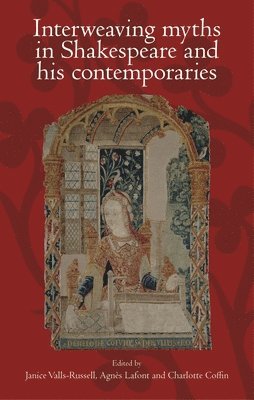
    Interweaving Myths in Shakespeare and His Contemporaries

    AvJanice Valls-Russell,Agnes Lafont

    Inbunden, Engelska, 2017

    1 446 kr

    Beställningsvara. Skickas inom 5-8 vardagar. Fri frakt över 249 kr.

    Beskrivning

    This volume proposes new insights into the uses of classical mythology by Shakespeare and his contemporaries, focusing on interweaving processes in early modern appropriations of myth. Its 11 essays show how early modern writing intertwines diverse myths and plays with variant versions of individual myths that derive from multiple classical sources, as well as medieval, Tudor and early modern retellings and translations. Works discussed include poems and plays by William Shakespeare, Christopher Marlowe and others. Essays concentrate on specific plays including The Merchant of Venice and Dido Queen of Carthage, tracing interactions between myths, chronicles, the Bible and contemporary genres. Mythological figures are considered to demonstrate how the weaving together of sources deconstructs gendered representations. New meanings emerge from these readings, which open up methodological perspectives on multi-textuality, artistic appropriation and cultural hybridity.

    Produktinformation

    • Utgivningsdatum:2017-09-15
    • Mått:138 x 216 x 17 mm
    • Vikt:530 g
    • Format:Inbunden
    • Språk:Engelska
    • Antal sidor:304
    • Förlag:Manchester University Press
    • ISBN:9781526117687

    Utforska kategorier

    • Dramatik inom Skönlitteratur
    • Litteraturvetenskap inom Skönlitteratur

    Mer om författaren

    Janice Valls-Russell is employed by the French National Centre for Scientific Research (CNRS) at Université Paul-Valéry, Montpellier, where she coordinates early modern research projectsAgnès Lafont is Senior Lecturer in Early Modern English Literature at Université Paul Valéry, MontpellierCharlotte Coffin is Senior Lecturer in Early Modern English Literature at Université Paris-Est Créteil Val de Marne

    Recensioner i media

    ‘Each chapter clearly fulfills the collection’s purpose, to reinvestigate the uses of classical mythology by Shakespeare and his peers. The craftsmanship metaphor inherent in the title is apt, given the prevalence of the weaver’s art in foundational narratives from the ancient world and the aesthetic of Ovidian storytelling with its multiplex interconnecting strands. Indeed, the readings “open up methodological perspectives on multi-textuality, artistic appropriation and cultural hybridity.”….I cannot recommend Interweaving Myths highly enough to experts in the field, graduate students, and advanced undergraduates who wish to learn from a group of scholars whose offerings are accessible as well as sophisticated and innovative.’M. L. Stapleton, Purdue University‘Interweaving Myths distinguishes itself not only through its nuanced attention to the subtleties of mythological reception, with contributors stressing that classical authors were themselves ‘receptors and crafters’ of ‘multi-faceted figures and tropes’, but also through the number of chapters that identify instances of early modern authors engaging with ancient Greek sources … many of the chapters … are especially concerned with the gendered or political implications of mythological allusion or patterning in early modern literature. This interest provides an ongoing thread that helps to unite the chapters in this collection, despite the diverse texts and tropes that are considered; recurring references to the framing concepts of interweaving and feuilletage, as well as to Shakespeare’s works, further contribute to the collection’s overall coherence.’Chloe Kathleen Preedy, University of Exeter, Journal of the Northern Renaissance, August 2018‘Big-name literary texts (especially Ovid and Shakespeare) dominate, but they have a lot of company, with considerable attention paid to less often read authors (notably Thomas Heywood, the subject of an online editing project which Peyre´ heads), as well as the great and irregular array of other channels (mythographies, some very free ‘translations’, commentaries, dictionaries, sententiae, annotations which a previous reader made in the copy you happened to be reading, burlesques and travesties) through which knowledge of classical literature actually found its way to early modern consumers. These interests themselves are not in the contemporary scholarly context innovative, but the energy with which they are brought to bear is inventive and skilfully sustained.’Gordon Braden, University of Virginia, Cahiers E´lisabe´thains: A Journal of English Renaissance Studies 97(1)‘This collection of thoughtful essays identifies classical mythology as a potent source of inspiration for early modern intertextual experiments. Because myths reached the period’s authors in multiple textual forms, their meanings offered both overlapping and conflicting tensions. As the book’s editors adroitly show, this multiplicity suggests new models for reimagining literary composition through layered multi-author conversations … Together, these essays form a moving testament to the complex literary possibilities mobilized by persistent prototypes from the ancient world.’T. Pollard, Brooklyn college, Choice Reviews‘This collection of eleven contributions is an in-depth investigation of the interweaving process at work in Elizabethan poets and dramatists’ use of classical mythology. I highly recommend this scholarly, stimulating and excellently written volume.’Jean-Jacques Chardin, Universite de Strasbourg, Revue XVII-XVIII, January 2019

    Innehållsförteckning

    • Introduction: ‘Ariachne’s broken woof’ – Janice Valls-Russell, Agnès Lafont and Charlotte Coffin1 Shakespeare’s mythological feuilletage: A methodological induction – Yves Peyré2 The non-Ovidian Elizabethan epyllion: Thomas Watson, Christopher Marlowe, Richard Barnfield – Tania Demetriou3 ‘This realm is an empire’: Tales of origins in medieval and early modern France and England – Dominique Goy-Blanquet4 Trojan shadows in Shakespeare’s King John – Janice Valls-Russell5 Venetian Jasons, parti-coloured lambs and a tainted wether: Ovine tropes and the Golden Fleece in The Merchant of Venice – Atsuhiko Hirota 6 Fifty ways to kill your brother: Medea and the poetics of fratricide in early modern English literature – Katherine Heavey 7 ‘She, whom Jove transported into Crete’: Europa, between consent and rape – Gaëlle Ginestet8 Subtle weavers, mythological interweavings and feminine political agency: Penelope and Arachne in early modern drama – Nathalie Rivère de Carles 9 Multi-layered conversations in Marlowe’s Dido, Queen of Carthage – Agnès Lafont10 Burlesque or neoplatonic? Popular or elite? The shifting value of classical mythology in Love’s Mistress – Charlotte Coffin11 Pygmalion, once and future myth: Instead of a conclusion – Ruth MorseIndex