• Fri frakt över 249 kr
  • •
  • Snabba leveranser
  • •
  • Billiga böcker
Kundservice

Du är på sajten för privatpersoner.

Företag, bibliotek eller offentlig verksamhet?

Du handlar på classic.bokus.com, där alla dina funktioner finns intakta.
Till classic.bokus.com
Bokus logotyp. Gå till startsidan.
  • Erbjudanden
  • Nyheter
  • Student
  • Topplistor
  • Barn & ungdom
  • Bokus Play
  • E-böcker
  • Pocketböcker
  • Spel & pussel

10% studentrabatt med kod TERM26

Sidfot

Mina sidor

    Hjälp

    • Kundservice
    • Vanliga frågor och svar
    • Frakt och leverans
    • Retur vid ångerrätt
    • Reklamera vara
    • Betalning
    • Köpvillkor
    • Allmänna villkor
    • Information om webbplatsens tillgänglighet

    Om Bokus

    • Om oss
    • Pressrum
    • För studenter
    • För företag
    • För bibliotek och offentlig verksamhet
    • För leverantörer
    • Hållbarhet

    Populärt

    • Aktuella erbjudanden
    • Presentkort
    • Studentlitteratur
    • Nya böcker
    • Topplistor
    • Signerade böcker
    • Engelska böcker

    Inspiration

    • Boktips
    • BookTok
    • Populära bokserier
    • Barnbokskaraktärer
    • Populära författare
    Logotyp för Bokus
    Följ oss på Facebook (extern länk)Följ oss på Instagram (extern länk)Följ oss på YouTube (extern länk)Följ oss på TikTok (extern länk)
    bokus @ CookiesAnpassa cookiesIntegritetspolicyKöpvillkor
    Till Citymail hemsida (extern länk)Till Budbee hemsida (extern länk)Till Postnord hemsida (extern länk)Till Schenker hemsida (extern länk)Till Early Bird hemsida (extern länk)Till Walleys hemsida (extern länk)
    1. Historia och arkeologi
    2. Historia
    3. Amerikas historia

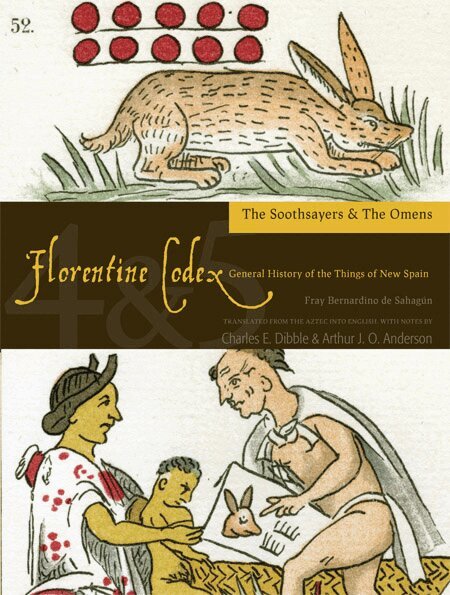
    Florentine Codex, Books Four and Five: the Soothsayers and the Omens

    A General History of the Things of New Spain

    AvCharles E. Dibble,Arthur J.O. Anderson

    Häftad, Engelska, 2012

    501 kr

    Beställningsvara. Skickas inom 5-8 vardagar. Fri frakt över 249 kr.

    Beskrivning

    Two of the world’s leading scholars of the Aztec language and culture have translated Sahagún’s monumental and encyclopedic study of native life in Mexico at the time of the Spanish Conquest. This immense undertaking is the first complete translation into any language of Sahagún’s Nahuatl text, and represents one of the most distinguished contributions in the fields of anthropology, ethnography, and linguistics. Written between 1540 and 1585, the Florentine Codex (so named because the manuscript has been part of the Laurentian Library’s collections since at least 1791) is the most authoritative statement we have of the Aztecs’ lifeways and traditions—a rich and intimate yet panoramic view of a doomed people. The Florentine Codex is divided by subject area into twelve books and includes over 2,000 illustrations drawn by Nahua artists in the sixteenth century. Book Four delves into the Aztec’s complex astrological beliefs. The date of birth was so significant that it ultimately determined one’s personality and future; for example, almost all born on the second day sign called One Ocelot became slaves. Book Five explains the meaning of the many evil omens Aztecs believed in, which usually take the form of animals and insects. It describes the consequences of each omen, and the remedies, if any, that will reverse these effects.

    Produktinformation

    • Utgivningsdatum:2012-03-15
    • Mått:213 x 277 x 13 mm
    • Vikt:681 g
    • Format:Häftad
    • Språk:Engelska
    • Antal sidor:210
    • Upplaga:12002
    • Förlag:University of Utah Press,U.S.
    • ISBN:9781607811602
    • Översättare:Charles E. Dibble, Charles E Dibble, Arthur J O Anderson

    Utforska kategorier

    • Amerikas historia inom Historia och arkeologi

    Innehållsförteckning

    • Table of Contents:BOOK FOUR1. Telleth of the first sign, which was named One Crocodile, and of the good fortune which they merited who were born then2. Telleth of the second [day] sign, which was named One Ocelot, and was not a good sign day for those who were born on it3. Telleth of the third sign, named One Deerand the good forune which those then born merited4. Telleth of the second house, when it was the time of this sign, named Two Rabbitand those then born in it did nothing but drink wine5. Telleth how many kinds of drunkards there were6. Telleth of still another house on the sign [One Deer], called Three Water7. Telleth of the fourth sign, named One Flower8. Telleth of the fifth sign, named One Reed. And it was not a good day....9. Telleth of the sixth sign, called One Death, and of the good fortune belonging to it10. Telleth of still other houses, which were called in part good, and in part evil and miserable11. Telleth of the seventh sign, named One Rain, and of the evil day signs which belonged with it12. Telleth of still other houses. Some were only indifferent and some were in no way good13. Here is told and mentioned what was an evil manifestation for him who stumbled or fell at this time14. Telleth of the good day signs which correspond to the four houses in this sign15. Telleth of the eighth sign, called One Grass, and the evil day signs with it16. Telleth of the ninth sign, called One Serpent17. Telleth of the admonitions of the old merchants when they counseled their sons as they were about to depart18. Here are told [what] the talk and discourse were of these same old merchants which they repeated to their sons who already knew distant lands19. Here are told the offerings, which they made for the sake of those who traveled to far places, and how respect was paid for the sake of those who died20. Telleth of the remaining houses belonging to the sign mentioned21. Telleth of the tenth sign, called One Flint Knife22. Telleth of the eleventh sign, called One Monkey, and of its fortune23. Telleth of the twelfth sign, called One Lizard24. Telleth of the thirteenth sign, called One Motion25. Telleth of the fourteenth sign, called One Dog26. In which it is told how these rulers (upon the day sign mentioned) proclaimed war27. In which it is mentioned the fifteenth sign, named One House28. Telleth still more of the nature and condition of women born in this sign29. Telleth of the sixteenth sign, called One Vulture30. Telleth of the seventeenth sign, called One Water31. Telleth of the eighteenth sign, named One Wind, and the evil, the bad, which was with it32. Telleth of the tears, the lamentations, and the misery of those who had been robbed, whom those who danced with the dead forearm had plundered33. In which is mentioned the nineteenth sign, named One Eagle34. In which are told and mentioned what they did when they visited women recently delivered35. Here is told what was done when they bathed their children, and how food was eaten when they gave them their names36. Telleth how a feast was held, and what the order of service was, and how there was drinking of wine37. In which is mentioned how they festivity was performed38. Telleth of the twentieth and closing sign, called One Rabbit39. Speaketh of all the day signs40. Telleth of the rest [of the day signs] which formed a part of the day countthose still remaining, belonging to the day sign [One Rabbit]Appendix of the Fourth Book, in the Spanish vernacular, which is justification in defense of the truth contained herein• Introduction and explanation, newly made, of the calendar of the Indians of Anauac, that is, of New Spain• Refutation of the above• The treatise by that member of a religious Order proceedeth• Refutation of the above• To the reader• Here followeth the reckoning of all the time-counts which these natives hadBOOK FIVE1. Here are related the omens in which they believed when at night, someone heard some wild animal cry out, or when it seemed as if some old woman wept2. In which is related the evil omen which they regarded in two ways: so it was when they heard that the white hooded hawk cried out....3. In which it is told the omen taken as a portent when at night they heard as if someone shot iron arrows into something or as if he chopped wood....4. In which is told the omen taken as a portent when the horned owl hooted5. In which is told what was the omen of the screech owl6. In which it told what the omen was, so that they took it as a portent, when someone saw a weasel which crossed in front of him7. In which is told the omen so taken as a portent concerning the rabbit when they saw that now it entered one's house8. In which is told the omen which all took as a portent when they saw the chafer9. In which is related the omen which they regarded as a portent when an animal of strong stench, called a skunk, now entered one's home or else sprayed and loosed an odor10. In which is related the omen, by which a portent was drawn, of ants or frogs, and mice11. In which is told the omen from which a portent was drawn when, at night, they saw the towering men, the giants12. In which is related what was another omen, whose name was "bundle of ashes"13. In which are told the rest of the omens which showed themselves at nightAppendix to the Fifth Book1. First Chapter, which telleth of the white amaryllis2. Second Chapter, which telleth of the poinsettia3. Third Chapter, which telleth of flowers artificially arranged4. Fourth Chapter, which telleth of dried grains of maize5. Fifth Chapter, which telleth of stepping over one6. Sixth Chapter, which telleth of drinking7. Seventh Chapter, which telleth of him who dipped into the cooking pot8. Eighth Chapter, which telleth of tamales stuck [to the cooking pot]9. Ninth Chapter, which telleth of the umbilical cord10. Tenth Chapter, which telleth of the pregnant woman11. Eleventh Chapter, which telleth of the woman lately delivered12. Twelfth Chapter, which telleth of earthquakes13. Thirteenth Chapter, which telleth of the [three] hearth stones14. Fourteenth Chapter, which telleth of the tortilla doubled over on the griddle15. Fifteenth Chapter, which telleth of small children who licked the surface of the grinding stone16. Sixteenth Chapter, which telleth of him who leaned against a square pillar17. Seventeenth Chapter, which telleth of the maidens who ate standing18. Eighteenth Chapter, which telleth how maize cobs were burned19. Nineteenth Chapter, which telleth of the woman with child20. Twentieth Chapter, which telleth of the monkey's hand21. Twenty-first Chapter, which telleth of the pestle and griddle22. Twenty-second Chapter, which telleth of mice23. Twenty-third Chapter, which telleth of turkey hens24. Twenty-fourth Chapter, which telleth of turkey chicks25. Twenty-fifth Chapter, which telleth of her wove with yarn26. Twenty-sixth Chapter, which telleth of hail27. Twenty-seventh Chapter, which telleth of sorcerers28. Twenty-eighth Chapter, which telleth of the gnawed leavings of a mouse29. Twenty-ninth, which telleth of nails30. Thirtieth Chapter, which telleth of sneezing31. Thirty-first Chapter, which telleth of small children32. Thirty-second Chapter, which telleth of green stalks of maize33. Thirty-third Chapter, which telleth of creaking roof beams34. Thirty-fourth Chapter, which telleth of grinding stones35. Thirty-fifth Chapter, which telleth of drilling a new fire in the house36. Thirty-seventh Chapter, which telleth of the time when the teeth of small children droppedConclusion