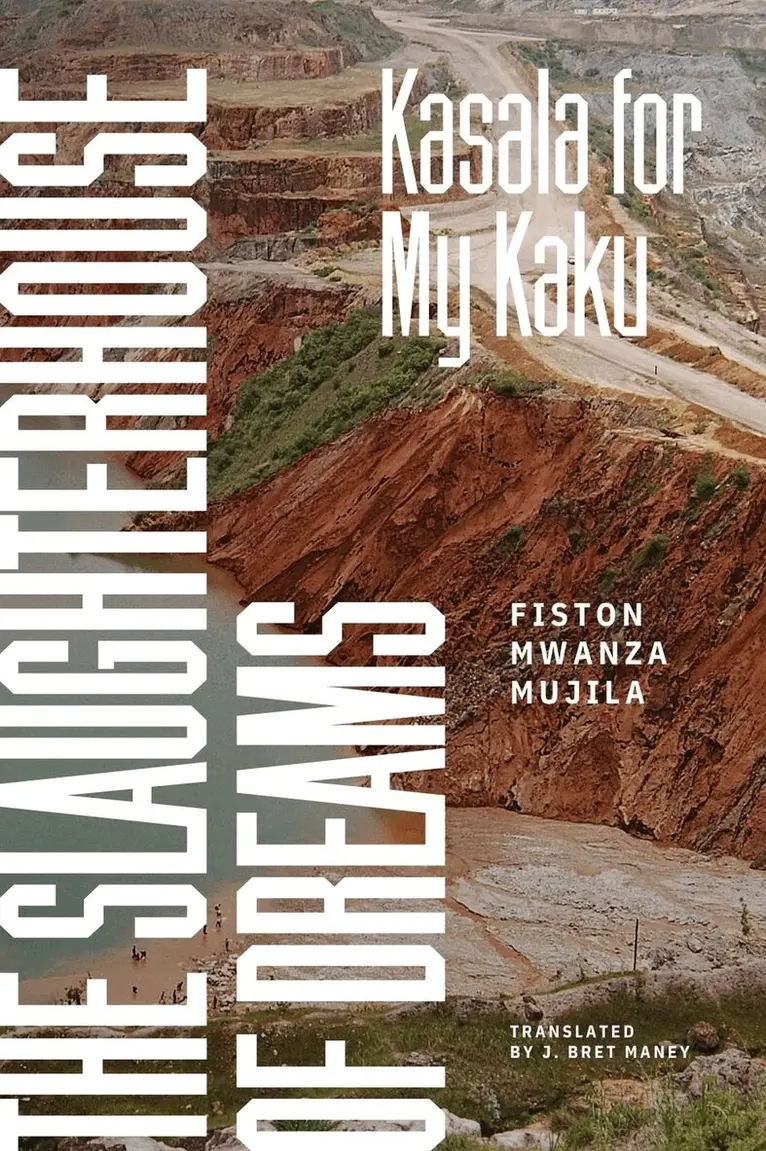
Slaughterhouse of Dreams
Kasala for My Kaku
279 kr
Beställningsvara. Skickas inom 3-6 vardagar. Fri frakt över 249 kr.
Du är på sajten för privatpersoner.
279 kr
Beställningsvara. Skickas inom 3-6 vardagar. Fri frakt över 249 kr.
Fiston Mwanza Mujila was born in the Democratic Republic of Congo in 1981 and lives today in Austria. His debut novel, Tram 83, published in English in 2015 by Deep Vellum, won the Etisalat Prize for Literature and the German International Literature Award and was longlisted for both the International Booker Prize and the Prix littéraire du Monde. His second novel, The Villain’s Dance (2024), also available from Deep Vellum, won the Prix Les Afriques and was a finalist for the National Book Award for Translated Literature. In addition to these novels translated by Roland Glasser, his poetry collection The River in the Belly (trans. J. Bret Maney, 2021) is also available in English from Deep Vellum. Dubbed “a new and provocative contribution to African Literature,” it was a finalist for the Luschei Prize for African Poetry and the Sarah Maguire Prize for Poetry in Translation.J. Bret Maney is a literary critic and translator from the French and Spanish. He is a recipient of several awards, including the 2020 Gulf Coast Translation Prize for his translations of Fiston Mwanza Mujila’s poetry and an International Latino Book Award and PEN/Heim Translation Fund Grant for his translation of Guillermo Cotto-Thorner’s novel, Manhattan Tropics (Arte Público, 2019), which he also coedited. He is Associate Professor of English and Digital Humanities at Lehman College and The Graduate Center, CUNY.
“In a state of turmoil, water—mayi!—gushes from its source. It springs up in beautifully unpredictable spurts, over which only the earth has final say. So it is with the poetry of Fiston Mwanza Mujila. So it is with the minerals scratched from the dirt. Whether in Kolwezi, Kipushi or Tenke-Fungurume, in this land saturated with cobalt, uranium and other things no less terrible, and which we end up jettisoning abroad at the border post of Kasumbalesa, in the region where the author of these sublime verses was born.” —In Koli Jean Bofane, author of Congo Inc.“The Slaughterhouse of Dreams in translation opens up a traditional African poetic performance to the world with charm and acuity. But make no mistake: it’s a poetic river deep in history, longing, family, anger, love, and a quest for a nation within the self, layer by layer.” —Kọ́lá Túbọ̀sún, author of Eṣù at the Library and co-editor of Best Literary Translations“In a style reminiscent of Walt Whitman’s celebratory self-invocation, the kasàlà positions the individual poet as a conduit between self, family, nation, humanity, and the cosmos. The imagery of great rivers—the Zambezi, the Zaire, and the Danube—underscores a vision of life as interconnected, resilient, and generative: a force that resists annihilation, even under conditions of displacement and exile. Mujila’s work stands as both a continuation and renewal of the Congolese tradition, reasserting the place of poetry in bearing witness to suffering and envisioning human possibility.” —Kasongo Mulenda Kapanga, author of The Writing of the Nation“In these praise songs, Fiston Mwanza Mujila weaves traditional oral poetics with a contemporary lens to make a series of poems that celebrate, satirize, complicate, and recognize the fundamental and ancient cores of the human condition. The Slaughterhouse of Dreams sets a clear vision for the continuation of human struggle and reminds us that in praise we can find the fullness of all things.” —Matthew Shenoda, author of The Way of the Earth“In The Slaughterhouse of Dreams, Fiston Mwanza Mujila reminds us how to feel the water of our bodies. These poems sing invocations to ancestors that “set the sun on fire.” They summon rivers, interrogate languages of the past, and ask us to “unspool dreams.” Here, there are bombs: “villages of mutilated buildings / villages nipped in the bud / starving villages / cholera-stricken villages.” Does Mujila speak of yesterday or of tomorrow? History breathes beneath fingernails. Try to look away and fail. The slaughterhouse holds rainbows dripping red. These kasàlàs are both protests and odes, inviting us to feel the full moon’s taking while dancing through love letters to those who came before. Float on waves of gorgeous hauntings.” —Fatima-Ayan Malika Hirsi, author of DREAMS FOR EARTH
Robert Woelfl, Katherine Soper, Jen Silverman, Ferdinand Schmalz, Roland Schimmelpfennig, Ewald Palmetshofer, Yade Yasemin Onder, Fiston Mwanza Mujila, Daniel Mezger, Tracy Letts, Stefan Hornbach, Friederike Emmerling, Bettina Walther, Barbara Neu, Stefanie von Lieven, Uwe B. Carstensen
147 kr
Olivia Wenzel, Lukas Rietzschel, Falk Richter, Yade Yasemin Onder, Fiston Mwanza Mujila, Caren Je, Bettina Walther, Barbara Neu, Stefanie von Lieven, Oliver Franke, Friederike Emmerling
193 kr
Sandrine Colard, Fiston Mwanza Mujila, Jean Bofane, Sandrine Colard
Inbunden, 2022
504 kr
Du är på sajten för privatpersoner.
279 kr
Beställningsvara. Skickas inom 3-6 vardagar. Fri frakt över 249 kr.
Fiston Mwanza Mujila was born in the Democratic Republic of Congo in 1981 and lives today in Austria. His debut novel, Tram 83, published in English in 2015 by Deep Vellum, won the Etisalat Prize for Literature and the German International Literature Award and was longlisted for both the International Booker Prize and the Prix littéraire du Monde. His second novel, The Villain’s Dance (2024), also available from Deep Vellum, won the Prix Les Afriques and was a finalist for the National Book Award for Translated Literature. In addition to these novels translated by Roland Glasser, his poetry collection The River in the Belly (trans. J. Bret Maney, 2021) is also available in English from Deep Vellum. Dubbed “a new and provocative contribution to African Literature,” it was a finalist for the Luschei Prize for African Poetry and the Sarah Maguire Prize for Poetry in Translation.J. Bret Maney is a literary critic and translator from the French and Spanish. He is a recipient of several awards, including the 2020 Gulf Coast Translation Prize for his translations of Fiston Mwanza Mujila’s poetry and an International Latino Book Award and PEN/Heim Translation Fund Grant for his translation of Guillermo Cotto-Thorner’s novel, Manhattan Tropics (Arte Público, 2019), which he also coedited. He is Associate Professor of English and Digital Humanities at Lehman College and The Graduate Center, CUNY.
“In a state of turmoil, water—mayi!—gushes from its source. It springs up in beautifully unpredictable spurts, over which only the earth has final say. So it is with the poetry of Fiston Mwanza Mujila. So it is with the minerals scratched from the dirt. Whether in Kolwezi, Kipushi or Tenke-Fungurume, in this land saturated with cobalt, uranium and other things no less terrible, and which we end up jettisoning abroad at the border post of Kasumbalesa, in the region where the author of these sublime verses was born.” —In Koli Jean Bofane, author of Congo Inc.“The Slaughterhouse of Dreams in translation opens up a traditional African poetic performance to the world with charm and acuity. But make no mistake: it’s a poetic river deep in history, longing, family, anger, love, and a quest for a nation within the self, layer by layer.” —Kọ́lá Túbọ̀sún, author of Eṣù at the Library and co-editor of Best Literary Translations“In a style reminiscent of Walt Whitman’s celebratory self-invocation, the kasàlà positions the individual poet as a conduit between self, family, nation, humanity, and the cosmos. The imagery of great rivers—the Zambezi, the Zaire, and the Danube—underscores a vision of life as interconnected, resilient, and generative: a force that resists annihilation, even under conditions of displacement and exile. Mujila’s work stands as both a continuation and renewal of the Congolese tradition, reasserting the place of poetry in bearing witness to suffering and envisioning human possibility.” —Kasongo Mulenda Kapanga, author of The Writing of the Nation“In these praise songs, Fiston Mwanza Mujila weaves traditional oral poetics with a contemporary lens to make a series of poems that celebrate, satirize, complicate, and recognize the fundamental and ancient cores of the human condition. The Slaughterhouse of Dreams sets a clear vision for the continuation of human struggle and reminds us that in praise we can find the fullness of all things.” —Matthew Shenoda, author of The Way of the Earth“In The Slaughterhouse of Dreams, Fiston Mwanza Mujila reminds us how to feel the water of our bodies. These poems sing invocations to ancestors that “set the sun on fire.” They summon rivers, interrogate languages of the past, and ask us to “unspool dreams.” Here, there are bombs: “villages of mutilated buildings / villages nipped in the bud / starving villages / cholera-stricken villages.” Does Mujila speak of yesterday or of tomorrow? History breathes beneath fingernails. Try to look away and fail. The slaughterhouse holds rainbows dripping red. These kasàlàs are both protests and odes, inviting us to feel the full moon’s taking while dancing through love letters to those who came before. Float on waves of gorgeous hauntings.” —Fatima-Ayan Malika Hirsi, author of DREAMS FOR EARTH
Robert Woelfl, Katherine Soper, Jen Silverman, Ferdinand Schmalz, Roland Schimmelpfennig, Ewald Palmetshofer, Yade Yasemin Onder, Fiston Mwanza Mujila, Daniel Mezger, Tracy Letts, Stefan Hornbach, Friederike Emmerling, Bettina Walther, Barbara Neu, Stefanie von Lieven, Uwe B. Carstensen
147 kr
Olivia Wenzel, Lukas Rietzschel, Falk Richter, Yade Yasemin Onder, Fiston Mwanza Mujila, Caren Je, Bettina Walther, Barbara Neu, Stefanie von Lieven, Oliver Franke, Friederike Emmerling
193 kr
Sandrine Colard, Fiston Mwanza Mujila, Jean Bofane, Sandrine Colard
Inbunden, 2022
504 kr
Du är på sajten för privatpersoner.
279 kr
Beställningsvara. Skickas inom 3-6 vardagar. Fri frakt över 249 kr.
Fiston Mwanza Mujila was born in the Democratic Republic of Congo in 1981 and lives today in Austria. His debut novel, Tram 83, published in English in 2015 by Deep Vellum, won the Etisalat Prize for Literature and the German International Literature Award and was longlisted for both the International Booker Prize and the Prix littéraire du Monde. His second novel, The Villain’s Dance (2024), also available from Deep Vellum, won the Prix Les Afriques and was a finalist for the National Book Award for Translated Literature. In addition to these novels translated by Roland Glasser, his poetry collection The River in the Belly (trans. J. Bret Maney, 2021) is also available in English from Deep Vellum. Dubbed “a new and provocative contribution to African Literature,” it was a finalist for the Luschei Prize for African Poetry and the Sarah Maguire Prize for Poetry in Translation.J. Bret Maney is a literary critic and translator from the French and Spanish. He is a recipient of several awards, including the 2020 Gulf Coast Translation Prize for his translations of Fiston Mwanza Mujila’s poetry and an International Latino Book Award and PEN/Heim Translation Fund Grant for his translation of Guillermo Cotto-Thorner’s novel, Manhattan Tropics (Arte Público, 2019), which he also coedited. He is Associate Professor of English and Digital Humanities at Lehman College and The Graduate Center, CUNY.
“In a state of turmoil, water—mayi!—gushes from its source. It springs up in beautifully unpredictable spurts, over which only the earth has final say. So it is with the poetry of Fiston Mwanza Mujila. So it is with the minerals scratched from the dirt. Whether in Kolwezi, Kipushi or Tenke-Fungurume, in this land saturated with cobalt, uranium and other things no less terrible, and which we end up jettisoning abroad at the border post of Kasumbalesa, in the region where the author of these sublime verses was born.” —In Koli Jean Bofane, author of Congo Inc.“The Slaughterhouse of Dreams in translation opens up a traditional African poetic performance to the world with charm and acuity. But make no mistake: it’s a poetic river deep in history, longing, family, anger, love, and a quest for a nation within the self, layer by layer.” —Kọ́lá Túbọ̀sún, author of Eṣù at the Library and co-editor of Best Literary Translations“In a style reminiscent of Walt Whitman’s celebratory self-invocation, the kasàlà positions the individual poet as a conduit between self, family, nation, humanity, and the cosmos. The imagery of great rivers—the Zambezi, the Zaire, and the Danube—underscores a vision of life as interconnected, resilient, and generative: a force that resists annihilation, even under conditions of displacement and exile. Mujila’s work stands as both a continuation and renewal of the Congolese tradition, reasserting the place of poetry in bearing witness to suffering and envisioning human possibility.” —Kasongo Mulenda Kapanga, author of The Writing of the Nation“In these praise songs, Fiston Mwanza Mujila weaves traditional oral poetics with a contemporary lens to make a series of poems that celebrate, satirize, complicate, and recognize the fundamental and ancient cores of the human condition. The Slaughterhouse of Dreams sets a clear vision for the continuation of human struggle and reminds us that in praise we can find the fullness of all things.” —Matthew Shenoda, author of The Way of the Earth“In The Slaughterhouse of Dreams, Fiston Mwanza Mujila reminds us how to feel the water of our bodies. These poems sing invocations to ancestors that “set the sun on fire.” They summon rivers, interrogate languages of the past, and ask us to “unspool dreams.” Here, there are bombs: “villages of mutilated buildings / villages nipped in the bud / starving villages / cholera-stricken villages.” Does Mujila speak of yesterday or of tomorrow? History breathes beneath fingernails. Try to look away and fail. The slaughterhouse holds rainbows dripping red. These kasàlàs are both protests and odes, inviting us to feel the full moon’s taking while dancing through love letters to those who came before. Float on waves of gorgeous hauntings.” —Fatima-Ayan Malika Hirsi, author of DREAMS FOR EARTH
Robert Woelfl, Katherine Soper, Jen Silverman, Ferdinand Schmalz, Roland Schimmelpfennig, Ewald Palmetshofer, Yade Yasemin Onder, Fiston Mwanza Mujila, Daniel Mezger, Tracy Letts, Stefan Hornbach, Friederike Emmerling, Bettina Walther, Barbara Neu, Stefanie von Lieven, Uwe B. Carstensen
147 kr
Olivia Wenzel, Lukas Rietzschel, Falk Richter, Yade Yasemin Onder, Fiston Mwanza Mujila, Caren Je, Bettina Walther, Barbara Neu, Stefanie von Lieven, Oliver Franke, Friederike Emmerling
193 kr
Sandrine Colard, Fiston Mwanza Mujila, Jean Bofane, Sandrine Colard
Inbunden, 2022
504 kr