• Fri frakt över 249 kr
  • •
  • Snabba leveranser
  • •
  • Billiga böcker
Kundservice

Du är på sajten för privatpersoner.

Företag, bibliotek eller offentlig verksamhet?

Du handlar på classic.bokus.com, där alla dina funktioner finns intakta.
Till classic.bokus.com
Bokus logotyp. Gå till startsidan.
  • Erbjudanden
  • Nyheter
  • Student
  • Topplistor
  • Barn & ungdom
  • Bokus Play
  • E-böcker
  • Pocketböcker
  • Spel & pussel

10% rabatt på allt med kod: NYSTART10 →

Sidfot

Mina sidor

    Hjälp

    • Kundservice
    • Vanliga frågor och svar
    • Frakt och leverans
    • Retur vid ångerrätt
    • Reklamera vara
    • Betalning
    • Köpvillkor
    • Allmänna villkor
    • Information om webbplatsens tillgänglighet

    Om Bokus

    • Om oss
    • Pressrum
    • För studenter
    • För företag
    • För bibliotek och offentlig verksamhet
    • För leverantörer
    • Hållbarhet

    Populärt

    • Aktuella erbjudanden
    • Presentkort
    • Studentlitteratur
    • Nya böcker
    • Topplistor
    • Signerade böcker
    • Engelska böcker

    Inspiration

    • Boktips
    • BookTok
    • Populära bokserier
    • Barnbokskaraktärer
    • Populära författare
    Logotyp för Bokus
    Följ oss på Facebook (extern länk)Följ oss på Instagram (extern länk)Följ oss på YouTube (extern länk)Följ oss på TikTok (extern länk)
    bokus @ CookiesAnpassa cookiesIntegritetspolicyKöpvillkor
    Till Citymail hemsida (extern länk)Till Budbee hemsida (extern länk)Till Postnord hemsida (extern länk)Till Schenker hemsida (extern länk)Till Early Bird hemsida (extern länk)Till Walleys hemsida (extern länk)
    1. Juridik
    2. Särskilda rättsområden
    3. Bolags-, handels- och konkurrensrätt
    4. Bolagsrätt

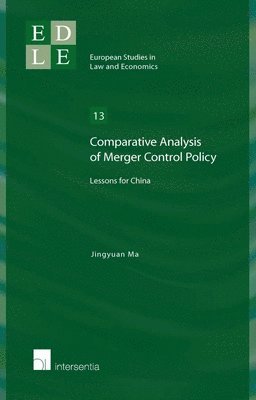
    Comparative Analysis of Merger Control Policy

    Lessons for China

    AvJingyuan Ma

    Häftad, Engelska, 2014

    Del 13 i serien European Studies in Law and Economics

    822 kr

    Tillfälligt slut

    Beskrivning

    After thirteen years of discussion, the Anti-Monopoly Law of the People's Republic of China was promulgated on 30 August 2007 and entered into force in August 2008. During the legislative process, a particular challenge was to determine the goal of competition law in China. This challenge can be best illustrated by the merger control policy under the Chinese Anti-Monopoly Law, which has been formulated by taking into account economic goals as well as various social and political considerations. Comparative Analysis of Merger Control Policy investigates to what extent competition goals may influence merger policy by taking a comparative perspective. To address this central research question, this book focuses on four major issues. First, in order to understand why competition law and policy in China incorporates a multitude of policy goals, the legislative history of the Anti-Monopoly Law and merger policy in China will be explored. Second, the evolution of the debate on competition goals in the US and the EU will put the developments in China in a comparative perspective. Third, emphasis will be placed on the evolution of incorporating the efficiency goal into merger policy.Finally, given the theoretical debate on competition goals, it must also be discussed whether competition goals may have an impact on the analysis of merger cases. Taking economic theories and modern economic techniques as the benchmark, this book concludes that the divergent competition goals in China, the United States and the European Union lead to a different outcome of merger cases. This book not only provides a comprehensive overview of the debate on competition goals, but also conducts a discussion of the impact of competition goals on merger cases by taking a comparative view. It also sets out policy implications for competition policy makers in China.

    Produktinformation

    • Utgivningsdatum:2014-08-10
    • Mått:160 x 240 x 17 mm
    • Vikt:500 g
    • Format:Häftad
    • Språk:Engelska
    • Serie:European Studies in Law and Economics
    • Förlag:Intersentia Ltd
    • ISBN:9781780682457

    Utforska kategorier

    • Bolagsrätt inom Juridik
    • Komparativ rätt inom Juridik

    Innehållsförteckning

    • CONTENTS Acknowledgements Table of Cases Table of Legislation List of Abbreviations List of Tables and Figures Chapter 1. Introduction 1. Introduction 2. Motivation 3. Research Question 4. Structure 5. Methodology 6. Limitations Chapter 2. The Development of Competition Law and Merger Control Policy in China 1. Introduction 2. The 1978 Market Reform 3. Merger and Acquisition between SOEs 3.1. Reform of SOEs 3.2. Merger Policy for SOEs 4. Merger and Acquisition by Foreign Investors 4.1. Foreign Direct Investment 4.2. Entry into the WTO 4.3. Merger Policy for Foreign Investors 5. An Overview of the Anti-Monopoly Law and the Merger Policy 5.1. Competition Policy before the AML 5.2. The Drafting Process of the AML 5.3. An Overview of the AML 5.4. Enforcement of the AML 5.4.1. Three Enforcement Agencies 5.4.2. MOFCOM: the Merger Enforcement Agency 5.5. Merger Guidelines after the AML 5.5.1. Notification Guidelines 5.5.2. Assessment Guidelines 6. Non-Economic Goals in the AML and Merger Policy 6.1. The Development of a Socialist Market Economy 6.2. Concerns of Protecting SOEs 6.3. Promoting Public Interest 6.4. National Security Review 7. Interpreting the Multiple Goals of the Chinese Anti-Monopoly Law 7.1. Academic Scholars 7.1.1. Non-Economic Goals versus Economic Goals 7.1.2. The Development of a Socialist Market Economy 7.1.3. Competition Policy versus Industrial Policy 7.1.4. The Considerations of Public Interests 7.1.5. Considerations of National Security 7.1.6. Efficiency and Welfare Standards 7.2. The Legislative Debate 7.3. Policy Makers 7.4. Conclusion 8. Conclusion Chapter 3. Goals of Competition Policy in the US and the EU: A Law and Economics Perspective 1. Introduction 2. Goals of Antitrust Law in the US 2.1. Introduction 2.2. Social and Political Goals of Antitrust 2.2.1. Populism 2.2.2. Influence of Populism in Court 2.2.3. Criticism from Academic Scholars 2.3. Harvard School 2.3.1. The Structure-Conduct-Performance Paradigm 2.3.2. Harvard School's View on the Goals of Antitrust Law 2.3.3. Influence of the Harvard School in Court 2.4. Chicago School 2.4.1. Chicago School's View on the Goals of Antitrust Law 2.4.1.1. Efficiency as the Sole Aim 2.4.1.2. Rejecting the Goal of 'Maximizing Competition' 2.4.1.3. Bork's Use of 'Consumer Welfare' 2.4.2. Influence of the Chicago School in Court 2.4.3. Criticism from Academic Scholars 2.4.3.1. Interpreting Legislative Intent 2.4.3.2. The Concerns of Distributive Effects 2.4.3.3. Protecting Competition as the Goal 2.5. The Debate on Welfare Standards in the Post-Chicago Era 2.5.1. Consumer Welfare Standard 2.5.1.1. Who is the Consumer? 2.5.1.2. What is Consumer Welfare? 2.5.1.3. Consumer Welfare or Consumer Surplus? 2.5.1.4. Consumer Welfare Maximization 2.5.1.5. Consumer Choice 2.5.2. Consumer Welfare versus Total Welfare 2.5.2.1. Distributive Issues 2.5.2.2. Implementation Issues 2.6. Conclusion 3. Goals of Competition Law in the EU 3.1. Introduction 3.2. The Market Integration Goal 3.3. The Consumer Protection Goal 3.3.1. Consumer Welfare versus Total Welfare 3.3.2. Defining 'Consumer Welfare' 3.4. The Total Welfare Goal and Industrial Policy 3.5. The Influence of Ordoliberalism 3.5.1. Ordoliberalism 3.5.2. The Influence of Ordoliberalism Competition Law 3.6. The Evolution of Legal Doctrine 3.6.1. Historical Backgrounds 3.6.2. The Market Integration Goal of the EEC 3.6.3. The Extension of the Policy Goal of the TEU 3.6.4. The Social Goals of the TFEU 3.7. A Viewpoint from the Competition Commissioners 3.7.1. Commissioner Karel Van Miert (1993 - 1999) 3.7.2. Commissioner Mario Monti (1999 - 2004) 3.7.3. Commissioner Neelie Kroes (2004 - 2010) 3.8. Conclusion 4. Conclusion Chapter 4. Integrating the Efficiency Goal in Merger Control Policy: A Comparative Perspective 1. Introduction 2. Economic Theories of Efficiency 2.1. Productive Efficiency 2.2. Allocative Efficiency 2.3. Dynamic Efficiency 2.4. Conflicts between Allocative, Dynamic and Productive Efficiencies 2.5. Unsolved Issues 3. Economic Analysis of Merger Effects 3.1. Economic Effects of Mergers 3.2. The Williamson Tradeoff 3.3. Impact on the Choice of Welfare Standards 4. Integrating Efficiency Goals in the US Merger Control Policy 4.1. Introduction 4.2. Academic Debate 4.2.1. Concerns of Legal Uncertainties 4.2.2. Economic Techniques to Measure Efficiencies 4.2.3. Efficiency Defense 4.3. Merger Guidelines 4.3.1. 1968 Horizontal Merger Guidelines 4.3.2. 1982 Horizontal Merger Guidelines 4.3.3. 1984 Horizontal Merger Guidelines 4.3.4. 1992 Horizontal Merger Guidelines 4.3.5. 1997 Horizontal Merger Guidelines 4.3.6. 2010 Horizontal Merger Guidelines 4.4. Judicial Treatment 4.4.1. Hostility toward Efficiency Claims 4.4.2. Cautiously Accepted Efficiency Claims 5. Integrating Efficiency Goal in the EU Competition Policy 5.1. Introduction 5.2. Merger Regulation 5.2.1. Merger Regulation 4064/89 5.2.2. 2004 EC Merger Regulation (ECMR) 5.3. Case Law 5.3.1. Negative View on Efficiency Claims 5.3.2. Cautiously Accepted Efficiency Claims 6. Conclusion Chapter 5. The Impact of Competition Goals on Merger Cases: A Comparative Perspective 1. Introduction 2. An Overview of Merger Cases in China 2.1. Merger Policy in China: Five Years' Implementation 2.2. A Brief Overview of MOFCOM's Merger Decisions 2.2.1. An Overview of the MOFCOM Published Cases 2.2.2. Observation: How Does the MOFCOM Investigate? 2.2.3. Observation: The High Use of Behavioral Remedies 2.2.4. Observation: The Focus on Market Share 2.2.5. Summary 3. The Economic Theories and Techniques for Horizontal Merger Analysis: A Brief Summary 3.1. Market Power 3.2. Indirect Assessment of Market Power 3.2.1. The Definition of the Relevant Market 3.2.2. Market Concentration 3.2.3. Market Share 3.2.4. The Consideration of Efficiency Gains 3.2.5. Entry 3.2.6. Buyers' Power 3.2.7. Remedies 3.3. Direct Assessment of Market Power 3.3.1. Introduction 3.3.2. Merger Simulation Techniques 4. Comparing Merger Policy in the US, the EU and China 4.1. Introduction 4.2. Comparing Merger Policy in the US and the EU: A Theoretical Debate 4.2.1. The Concepts of 'Monopolization' versus 'Dominance' 4.2.2. The Definition of Relevant Market 4.2.3. The Treatment of Econometric Techniques 4.3. Comparing Merger Policy in the US, the EU and China: Empirical Evidence 4.3.1. Comparing Merger Decisions in the US and the EU 4.3.2. Empirical Evidence on EU Merger Policy 4.3.3. Empirical Evidence on Merger Policy in China 4.3.4. Conclusion 4.4. Comparing Merger Policy in the US, EU and China: Two Case Studies 4.4.1. Panasonic/Sanyo Case 4.4.1.1. Case Summary 4.4.1.2. A Comparative Study on Economic Analysis of Merger Effects 4.4.1.3. Conclusion 4.4.2. Seagate/Samsung and Western Digital/Hitachi Case 4.4.2.1. Case Summary 4.4.2.2. A Comparative Study on Economic Analysis of Merger Effects 4.4.2.3. Conclusion 4.5. Summary: What Can the Evidence Tell? 5. Does Goal Matter? A Discussion on Competition Goals and Merger Policy 5.1. Different Goals, Different Results? 5.2. Moving Towards Economic Goals? 5.3. Implications for Chinese Policy Makers 6. Conclusion Chapter 6. Conclusions 1. Different Goals in the US, the EU and China 2. Competition Goals and Merger Analysis 3. Lessons for China 4. Future Research References