• Fri frakt över 249 kr
  • •
  • Snabba leveranser
  • •
  • Billiga böcker
Kundservice

Du är på sajten för privatpersoner.

Företag, bibliotek eller offentlig verksamhet?

Du handlar på classic.bokus.com, där alla dina funktioner finns intakta.
Till classic.bokus.com
Bokus logotyp. Gå till startsidan.
  • Erbjudanden
  • Nyheter
  • Student
  • Topplistor
  • Barn & ungdom
  • Bokus Play
  • E-böcker
  • Pocketböcker
  • Spel & pussel

10% rabatt på allt med kod NYSTART10 →

Sidfot

Mina sidor

    Hjälp

    • Kundservice
    • Vanliga frågor och svar
    • Frakt och leverans
    • Retur vid ångerrätt
    • Reklamera vara
    • Betalning
    • Köpvillkor
    • Allmänna villkor
    • Information om webbplatsens tillgänglighet

    Om Bokus

    • Om oss
    • Pressrum
    • För studenter
    • För företag
    • För bibliotek och offentlig verksamhet
    • För leverantörer
    • Hållbarhet

    Populärt

    • Aktuella erbjudanden
    • Presentkort
    • Studentlitteratur
    • Nya böcker
    • Topplistor
    • Signerade böcker
    • Engelska böcker

    Inspiration

    • Boktips
    • BookTok
    • Populära bokserier
    • Barnbokskaraktärer
    • Populära författare
    Logotyp för Bokus
    Följ oss på Facebook (extern länk)Följ oss på Instagram (extern länk)Följ oss på YouTube (extern länk)Följ oss på TikTok (extern länk)
    bokus @ CookiesAnpassa cookiesIntegritetspolicyKöpvillkor
    Till Citymail hemsida (extern länk)Till Budbee hemsida (extern länk)Till Postnord hemsida (extern länk)Till Schenker hemsida (extern länk)Till Early Bird hemsida (extern länk)Till Walleys hemsida (extern länk)
    1. Data och IT
    2. Nätverk och kommunikation

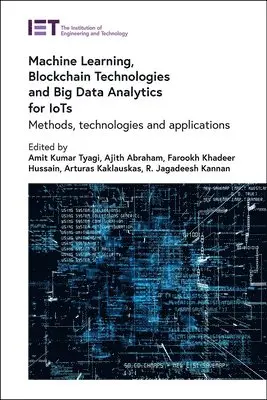
    Machine Learning, Blockchain Technologies and Big Data Analytics for IoTs

    Methods, technologies and applications

    AvAjith Abraham,Amit Kumar Tyagi

    Inbunden, Engelska, 2022

    Del i serien Security

    2 043 kr

    Beställningsvara. Skickas inom 3-6 vardagar. Fri frakt över 249 kr.

    Beskrivning

    Internet of Things (IoTs) are now being integrated at a large scale in fast-developing applications such as healthcare, transportation, education, finance, insurance and retail. The next generation of automated applications will command machines to do tasks better and more efficiently. Both industry and academic researchers are looking at transforming applications using machine learning and deep learning to build better models and by taking advantage of the decentralized nature of Blockchain. But the advent of these new technologies also brings very high expectations to industries, organisations and users. The decrease of computing costs, the improvement of data integrity in Blockchain, and the verification of transactions using Machine Learning are becoming essential goals.This edited book covers the challenges, opportunities, innovations, new concepts and emerging trends related to the use of machine learning, Blockchain and Big Data analytics for IoTs. The book is aimed at a broad audience of ICTs, data science, machine learning and cybersecurity researchers interested in the integration of these disruptive technologies and their applications for IoTs.

    Produktinformation

    • Utgivningsdatum:2022-10-14
    • Mått:156 x 234 x 36 mm
    • Vikt:1 270 g
    • Format:Inbunden
    • Språk:Engelska
    • Serie:Security
    • Antal sidor:679
    • Förlag:Institution of Engineering and Technology
    • ISBN:9781839533396

    Utforska kategorier

    • Nätverk och kommunikation inom Data och IT

    Mer om författaren

    Amit Kumar Tyagi is an assistant professor and senior researcher at the School of Computer Science and Engineering, Vellore Institute of Technology (VIT), Chennai Campus, Chennai, Tamil Nadu, India. His current research focuses on machine learning with big data, blockchain technology, data science, cyber physical systems, smart & secure computing and privacy. He has contributed to several projects such as "AARIN" and "P3-Block" to address some of the open issues related to the privacy breaches in vehicular applications (such as parking) and medical cyber physical systems. He is a member of the IEEE. He received his PhD from Pondicherry Central University, India.Ajith Abraham is the director of Machine Intelligence Research Labs (MIR Labs), Australia. MIR Labs are a not-for-profit scientific network for innovation and research excellence connecting industry and academia. His research focuses on real world problems in the fields of machine intelligence, cyber-physical systems, Internet of things, network security, sensor networks, Web intelligence, Web services, and data mining. He is the Chair of the IEEE Systems Man and Cybernetics Society Technical Committee on Soft Computing. He is editor-in-chief of Engineering Applications of Artificial Intelligence (EAAI) and serves on the editorial board of several international journals. He received his PhD in Computer Science from Monash University, Melbourne, Australia.Farookh Khadeer Hussain is an associate professor with the School of Software, University of Technology Sydney, Australia. He is also an associate member of the Advanced Analytics Institute and a core member of the Centre for Artificial Intelligence. His key research interests include trust-based computing, cloud of things, blockchains, and machine learning. He has published widely in these areas in top journals, such as FGCS, the Computer Journal, JCSS, IEEE Transactions on Industrial Informatics, and IEEE Transactions on Industrial Electronics. He holds a PhD from Curtin University, Perth, Australia.Arturas Kaklauskas is a professor at Vilnius Gediminas Technical University, Lithuania. His areas of interest include affective computing, Internet of Things, Big Data and text analytics, intelligent event prediction, opinion mining, intelligent decision support systems, neuro-marketing, intelligent tutoring systems, massive open online courses (MOOCS), smart built environment, energy and resilience management. He is editor-in-chief of the Journal of Civil Engineering and Management, editor of Engineering Applications of Artificial Intelligence, and associate editor of Ecological Indicators Journal. His publications include nine books. The Belarusian State Technological University (Minsk, Belarus) has awarded him an Honorary Doctorate.R. Jagadeesh Kannan is a professor at the School of Computer Science and Engineering, Vellore Institute of Technology, Chennai, Tamil Nadu, India. His research focuses on semantic web, network security, software engineering, and artificial intelligence. He is an active member of the Indian Society for Technical Education (ISTE), Computer Society of India (CSI), Software Process Improvement Network (SPIN), International Association of Engineers (IAENG), Association of Computer Electronics & Electrical & Engineers (ACEEE), International Association of Computer Science & Information Technology (IACSIT), Research GATE - Scientific Network, Society of Digital Information and Wireless Communications (SDIWC), Computer Science Teachers Association (CSTA), and the International forum of Researchers Students and Academician (IFRSA). He received a PhD from Anna University, Tamil Nadu, India in 2011.

    Innehållsförteckning

    • Chapter 1: Introduction to machine learning, blockchain technologies, and Big Data analytics for IoTs: concepts, open issues, and critical challengesChapter 2: Image enhancement on low-light and dark images for object detection using Artificial Intelligence for field practitionersChapter 3: Cache memory architecture for the convergence of machine learning, Internet of Things (IoT), and blockchain technologiesChapter 4: Machine learning algorithms for Big Data analytics including deep learningChapter 5: Machine learning-based blockchain technologies for data storage: challenges, and opportunitiesChapter 6: Clustering crowdsourced healthcare data from drones using Big Data analyticsChapter 7: Authentication and authorization in cloud computing using blockchainChapter 8: Fundamentals of machine learning and blockchain technologies for applications in cybersecurityChapter 9: Real-world applications of generative adversarial networks and their role in blockchain technologyChapter 10: Internet of Things (IoTs)-enabled security using artificial intelligence and blockchain technologiesChapter 11: Blockchain network with artificial intelligence - DeFi affair managementChapter 12: Vulnerabilities of smart contracts and solutionsChapter 13: Data analytics for socio-economic factors affecting crime ratesChapter 14: Deployment of automated teller machinery for e-pollingChapter 15: Machine learning-based blockchain technology for protection and privacy against intrusion attacks in intelligent transportation systemsChapter 16: Blockchain-enabled Internet of Things (IoTs) platforms for vehicle sensing and transportation monitoringChapter 17: Blockchain-enabled Internet of Things (IoTs) platforms for the healthcare sectorChapter 18: An integrated dimensionality reduction model for classifying IoT-enabled smart healthcare genomic dataChapter 19: Blockchain-based learning automated analytics platform in telemedicineChapter 20: A sensor-based architecture for telemedical and environmental air pollution monitoring system using 5G and blockchainChapter 21: Blockchain-enabled Internet of Things (IoT) platforms for financial servicesChapter 22: Blockchain and machine learning: an approach for predicting the commodity pricesChapter 23: Knowledge extraction from abnormal stock returns: evidence from Indian stock marketChapter 24: Impact of influence analysis of social media fake news - a machine learning perspectiveChapter 25: Application of machine learning techniques based on real-time images for site specific insect pest and disease management of cropsChapter 26: A prioritized potential framework for combined computing technologies: IoT, Machine Learning, and blockchainChapter 27: Conclusion to this book