• Fri frakt över 249 kr
  • •
  • Snabba leveranser
  • •
  • Billiga böcker
Kundservice

Du är på sajten för privatpersoner.

Företag, bibliotek eller offentlig verksamhet?

Du handlar på classic.bokus.com, där alla dina funktioner finns intakta.
Till classic.bokus.com
Bokus logotyp. Gå till startsidan.
  • Erbjudanden
  • Nyheter
  • Student
  • Topplistor
  • Barn & ungdom
  • Bokus Play
  • E-böcker
  • Pocketböcker
  • Spel & pussel

10% rabatt på allt med kod: NYSTART10 →

Sidfot

Mina sidor

    Hjälp

    • Kundservice
    • Vanliga frågor och svar
    • Frakt och leverans
    • Retur vid ångerrätt
    • Reklamera vara
    • Betalning
    • Köpvillkor
    • Allmänna villkor
    • Information om webbplatsens tillgänglighet

    Om Bokus

    • Om oss
    • Pressrum
    • För studenter
    • För företag
    • För bibliotek och offentlig verksamhet
    • För leverantörer
    • Hållbarhet

    Populärt

    • Aktuella erbjudanden
    • Presentkort
    • Studentlitteratur
    • Nya böcker
    • Topplistor
    • Signerade böcker
    • Engelska böcker

    Inspiration

    • Boktips
    • BookTok
    • Populära bokserier
    • Barnbokskaraktärer
    • Populära författare
    Logotyp för Bokus
    Följ oss på Facebook (extern länk)Följ oss på Instagram (extern länk)Följ oss på YouTube (extern länk)Följ oss på TikTok (extern länk)
    bokus @ CookiesAnpassa cookiesIntegritetspolicyKöpvillkor
    Till Citymail hemsida (extern länk)Till Budbee hemsida (extern länk)Till Postnord hemsida (extern länk)Till Schenker hemsida (extern länk)Till Early Bird hemsida (extern länk)Till Walleys hemsida (extern länk)
    1. Ekonomi och Ledarskap
    2. Nationalekonomi
    3. Makroekonomi

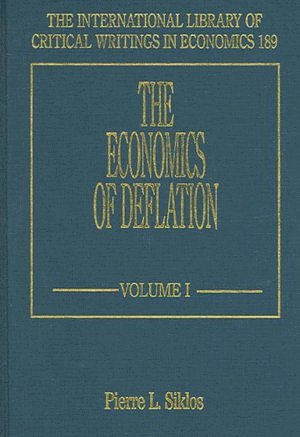
    Economics of Deflation

    AvPierre L. Siklos

    Inbunden, Engelska, 2005

    Del 189 i serien The International Library of Critical Writings in Economics series

    10 445 kr

    Beställningsvara. Skickas inom 5-8 vardagar. Fri frakt över 249 kr.

    Beskrivning

    This collection of seminal papers examines how economies behave under deflationary conditions. The volumes cover both theoretical and empirical aspects of this important subject. The editor presents articles exploring whether, and under what conditions, deflation can lead to beneficial economic outcomes, and also articles emphasizing that deflation should be avoided at all costs. Further sections examine specialized topics of the economics of deflation; including wage rigidities, the liquidity trap, and the zero lower bound of interest rates. A selection of important case studies of economies in deflation completes this comprehensive collection.

    Produktinformation

    • Utgivningsdatum:2005-09-28
    • Mått:169 x 244 x undefined mm
    • Format:Inbunden
    • Språk:Engelska
    • Serie:The International Library of Critical Writings in Economics series
    • Förlag:Edward Elgar Publishing Ltd
    • ISBN:9781843766346

    Utforska kategorier

    • Makroekonomi inom Ekonomi och Ledarskap

    Mer om författaren

    Edited by Pierre L. Siklos, Professor Emeritus, Department of Economics, Lazaridis School of Business and Economics, Wilfrid Laurier University and Balsillie School of International Affairs, Canada

    Recensioner i media

    'Deflation may be one of the most daunting policy challenges facing policymakers today. What makes deflation particularly challenging is its multifaceted nature and its newness for the current generation of economists and policymakers. With his extensive knowledge of history and the current debate, Pierre Siklos brings together an essential collection of readings that surveys the key aspects of deflation - from the microeconomic costs to the implications for monetary policy. This volume offers a concise, yet rich, overview of the economics of deflation and will be an indispensable reference for policy makers, their staffs, economists and all those grappling with the complexities of the phenomena called deflation.'

    Innehållsförteckning

    • Contents:Volume IAcknowledgementsIntroduction Pierre L. SiklosPART IMONETARY REGIMES AND DEFLATION 1. Milton Friedman (1969), ‘The Optimum Quantity of Money’2. R.G. Hawtrey (1919), ‘The Gold Standard’3. Lauchlin Currie (1933), ‘Treatment of Credit in Contemporary Monetary Theory’4. L.J. Hume (1963), ‘The Gold Standard and Deflation: Issues and Attitudes in the Nineteen-Twenties’5. Robert B. Barsky and J. Bradford De Long (1991), ‘Forecasting Pre-World War I Inflation: The Fisher Effect and the Gold Standard’6. J. Bradford DeLong (2000), ‘America’s Historical Experience with Low Inflation’7. David Reifschneider and John C. Williams (2000), ‘Three Lessons for Monetary Policy in a Low-Inflation Era’PART IIDEBT DEFLATION: CAUSES AND CONSEQUENCES 8. Irving Fisher (1933), ‘The Debt-Deflation Theory of Great Depressions’9. Ben S. Bernanke (1983), ‘Nonmonetary Effects of the Financial Crisis in the Propagation of the Great Depression’10. Mervyn King (1994), ‘Debt Deflation: Theory and Evidence’11. Charles W. Calomiris (1993), ‘Financial Factors in the Great Depression’12. Robert W. Dimand (2003), ‘Irving Fisher on the International Transmission of Booms and Depressions through Monetary Standards’PART IIIMONETARY POLICY UNDER DEFLATION 13. F.W. Pethick Lawrence (1918), ‘Deflation and Prices after the War’14. Lars Jonung (1979), ‘Knut Wicksell’s Norm of Price Stabilization and Swedish Monetary Policy in the 1930s’15. Gustav Cassel (1928), ‘The Rate of Interest, the Bank Rate, and the Stabilization of Prices’16. F.A. Hayek (1984), ‘The Monetary Policy of the United States After the Recovery from the 1920 Crisis’17. Bruce D. Smith (1985), ‘American Colonial Monetary Regimes: The Failure of the Quantity Theory and Some Evidence in Favour of an Alternate View’18. Scott Sumner (1993), ‘Colonial Currency and the Quantity Theory of Money: A Critique of Smith’s Interpretation’19. Milton Friedman (1992), ‘Franklin D. Roosevelt, Silver, and China’20. Marvin Goodfriend (2000), ‘Overcoming the Zero Bound on Interest Rate Policy’21. Charles W. Calomiris and R. Glenn Hubbard (1989), ‘Price Flexibility, Credit Availability, and Economic Fluctuations: Evidence from the United States, 1894–1909’PART IVTHE LIQUIDITY TRAP AND THE ZERO LOWER BOUND 22. Don Patinkin (1974), ‘The Role of the ‘Liquidity Trap’ in Keynesian Economics’23. Karl Brunner and Allan H. Meltzer (1968), ‘Liquidity Traps for Money, Bank Credit, and Interest Rates’24. Jean-Michel Grandmont and Guy Laroque (1976), ‘The Liquidity Trap’25. Paul R. Krugman (1998), ‘Its Baaack: Japan’s Slump and the Return of the Liquidity Trap’Name IndexVolume IIAcknowledgementsAn introduction by the editor to both volumes appears in Volume IPART IWAGE RIGIDITY AND DEFLATION 1. Robert E. Hall (1980), ‘Employment Fluctuations and Wage Rigidity’2. A.C. Pigou (1923), ‘Prices and Wages From 1896–1914’3. Barry Eichengreen and Jeffrey Sachs (1985), ‘Exchange Rates and Economic Recovery in the 1930s’4. Ben S. Bernanke and Kevin Carey (1996), ‘Nominal Wage Stickiness and Aggregate Supply in the Great Depression’5. Anthony Patrick O’Brien (1989), ‘A Behavioral Explanation for Nominal Wage Rigidity During the Great Depression’6. Christopher Hanes (1993), ‘The Development of Nominal Wage Rigidity in the Late 19th Century’7. Michael D. Bordo, Christopher J. Erceg and Charles L. Evans (2000), ‘Money, Sticky Wages, and the Great Depression’PART IISELECTED HISTORICAL STUDIES OF DEFLATIONARY EPISODES 8. Ben Bernanke and Harold James (1991), ‘The Gold Standard, Deflation, and Financial Crisis in the Great Depression: An International Comparison’9. Lauchlin Currie (1934), ‘The Failure of Monetary Policy to Prevent the Depression of 1929–32’10. Peter Temin and Barrie A. Wigmore (1990), ‘The End of One Big Deflation’11. Riccardo Faini and Gianni Toniolo (1992), ‘Reconsidering Japanese Deflation during the 1920s’12. Albert O. Hirschman (1948), ‘Inflation and Deflation in Italy’13. Stephen G. Cecchetti (1992), ‘Prices during the Great Depression: Was the Deflation of 1930–1932 Really Unanticipated?’14. James D. Hamilton (1992), ‘Was the Deflation During the Great Depression Anticipated? Evidence from the Commodities Futures Market’PART IIIA MODERN EPISODE OF ONGOING DEFLATION: JAPAN 15. Kenneth N. Kuttner and Adam S. Posen (2001), ‘The Great Recession: Lessons for Macroeconomic Policy from Japan’16. Robert L. Hetzel (2003), ‘Japanese Monetary Policy and Deflation’17. Thomas F. Cargill (2001), ‘Monetary Policy, Deflation, and Economic History: Lessons for the Bank of Japan’PART IVPOLICIES TO END DEFLATION 18.T. E. Gregory (1925), ‘What Can Central Banks Really Do?’19.John R. Commons (1925), ‘The Stabilization of Prices and Business’20. O.M.W. Sprague (1929), ‘Price Stabilization’21. John B. Taylor (2001), ‘Low Inflation, Deflation, and Policies for Future Price Stability’22. Thomas M. Humphrey (2001), ‘Monetary Policy Frameworks and Indicators for the Federal Reserve in the 1920s’23. Christina D. Romer (1992), ‘What Ended the Great Depression?’Name Index