• Fri frakt över 249 kr
  • •
  • Snabba leveranser
  • •
  • Billiga böcker
Kundservice

Du är på sajten för privatpersoner.

Företag, bibliotek eller offentlig verksamhet?

Du handlar på classic.bokus.com, där alla dina funktioner finns intakta.
Till classic.bokus.com
Bokus logotyp. Gå till startsidan.
  • Erbjudanden
  • Student
  • Topplistor
  • Barn & ungdom
  • Bokus Play
  • E-böcker
  • Ljudböcker
  • Pocketböcker
  • Spel och pussel

Skapa nya rutiner – hälsoböcker upp till 50% →

Sidfot

Mina sidor

    Hjälp

    • Kundservice
    • Vanliga frågor och svar
    • Frakt och leverans
    • Retur vid ångerrätt
    • Reklamera vara
    • Betalning
    • Köpvillkor
    • Allmänna villkor
    • Information om webbplatsens tillgänglighet

    Om Bokus

    • Om oss
    • Pressrum
    • För studenter
    • För företag
    • För bibliotek och offentlig verksamhet
    • För leverantörer
    • Hållbarhet

    Populärt

    • Aktuella erbjudanden
    • Presentkort
    • Studentlitteratur
    • Nya böcker
    • Topplistor
    • Signerade böcker
    • Engelska böcker

    Inspiration

    • Boktips
    • BookTok
    • Barnbokskaraktärer
    • Populära författare
    Logotyp för Bokus
    Följ oss på Facebook (extern länk)Följ oss på Instagram (extern länk)Följ oss på YouTube (extern länk)Följ oss på TikTok (extern länk)
    bokus @ CookiesAnpassa cookiesIntegritetspolicyKöpvillkor
    Till Citymail hemsida (extern länk)Till Budbee hemsida (extern länk)Till Postnord hemsida (extern länk)Till Schenker hemsida (extern länk)Till Early Bird hemsida (extern länk)Till Walleys hemsida (extern länk)
    1. Naturvetenskap och teknik
    2. Teknik och industri
    3. Elektronik och kommunikationer

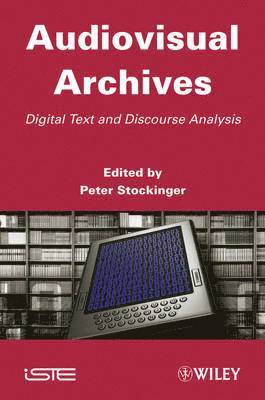
    Audiovisual Archives

    Digital Text and Discourse Analysis

    AvPeter Stockinger

    Inbunden, Engelska, 2012

    1 608 kr

    Tillfälligt slut

    Beskrivning

    Today, audiovisual archives and libraries have become very popular especially in the field of collecting, preserving and transmitting cultural heritage. However, the data in these archives or libraries - videos, images, soundtracks, etc. - constitute as such only potential cognitive resources for a given public (or “target community”). One of the most crucial issues of digital audiovisual libraries is indeed to enable users to actively appropriate audiovisual resources for their own concern (in research, education or any other professional or non-professional context). This means, an adaptation of the audiovisual data to the specific needs of a user or user group can be represented by small and closed "communities" as well as by networks of open communities around the globe."Active appropriation" is, basically speaking, the use of existing digital audiovisual resources by users or user communities according to their expectations, needs, interests or desires. This process presupposes: 1) the definition and development of models or "scenarios" of cognitive processing of videos by the user; 2) the availability of tools necessary for defining, developing, reusing and sharing meta-linguistic resources such as thesauruses, ontologies or description models by users or user communities.Both aspects are central to the so-called semiotic turn in dealing with digital (audiovisual) texts, corpora of texts or again entire (audiovisual) archives and libraries. They demonstrate practically and theoretically the well-known “from data to metadata” or “from (simple) information to (relevant) knowledge” problem, which obviously directly influences the effective use, social impact and relevancy, and therefore also the future, of digital knowledge archives. This book offers a systematic, comprehensive approach to these questions from a theoretical as well as practical point of view.ContentsPart 1. The Practical, Technical and Theoretical Context1. Analysis of an Audiovisual Resource.2. The Audiovisual Semiotic Workshop (ASW) Studio – A Brief Presentation.3. A Concrete Example of a Model for Describing Audiovisual Content.4. Model of Description and Task of Analysis.Part 2. Tasks in Analyzing an Audiovisual Corpus5. The Analytical Task of “Describing the Knowledge Object”.6. The Analytical Task of “Contextualizing the Domain of Knowledge”.7. The Analytical Task of “Analyzing the Discourse Production around a Subject”.Part 3. Procedures of Description8. Definition of the Domain of Knowledge and Configuration of the Topical Structure.9. The Procedure of Free Description of an Audiovisual Corpus.10. The Procedure of Controlled Description of an Audiovisual Corpus.Part 4. The ASW System of Metalinguistic Resources11. An Overview of the ASW Metalinguistic Resources.12. The Meta-lexicon Representing the ASW Universe of Discourse.

    Produktinformation

    • Utgivningsdatum:2012-05-11
    • Mått:160 x 241 x 27 mm
    • Vikt:699 g
    • Format:Inbunden
    • Språk:Engelska
    • Antal sidor:384
    • Förlag:ISTE Ltd and John Wiley & Sons Inc
    • ISBN:9781848213937

    Utforska kategorier

    • Elektronik och kommunikationer inom Naturvetenskap och teknik

    Mer om författaren

    Peter Stockinger is full Professor at the National Institute of Oriental Languages and Civilisations (INALCO) in Paris; and Research Director of ESCoM (Cognitive Semiotics and New Media Research Lab) of the Fondation Maison des Sciences de l'Homme (FMSH) in Paris, France.

    Innehållsförteckning

    • Preface xiPART 1. THE PRACTICAL, TECHNICAL AND THEORETICAL CONTEXT 1Chapter 1. Analysis of an Audiovisual Resource 31.1. Introduction 31.2. Functionally different corpora 41.3. Descriptive models 101.4. On the activity of analysis of audiovisual corpora 121.5. On the activity of indexation 141.6. Some reflections on the subject of the theoretical reference framework 15Chapter 2. The Audiovisual Semiotic Workshop (ASW) Studio – A Brief Presentation 232.1. A working environment for analyzing corpora of audiovisual texts 232.2. Brief presentation of the ASW Description Workshop 272.3 Four approaches to analyzing an audiovisual text 332.4. Models of description and interactive working forms 36Chapter 3. A Concrete Example of a Model for Describing Audiovisual Content 393.1. Introduction 393.2. Selecting the appropriate model from the library of descriptive models of description of audiovisual content 403.3. The sequences in a model of content description 433.4. Field of description and sequential organization of an analytical form 463.5. The level of schemas of definition and procedures of description 48Chapter 4. Model of Description and Task of Analysis 514.1. Introduction 514.2. The structural organization of a model of audiovisual content description 524.3. The canonic syntagmatic order of a form of description 544.4. Types of analysis, analytical tasks, procedures of description and activities of description 584.5. Particular tasks in analyzing the content of an audiovisual corpus 614.6. Concluding remarks 63PART 2. TASKS IN ANALYZING AN AUDIOVISUAL CORPUS 65Chapter 5. The Analytical Task of “Describing the Knowledge Object” 675.1. Introduction 675.2. A simple example of referential description 685.3. Thematic structure, topical structure and referential objects 705.4. A library of sequences for referential description 735.5. Alternative functional architectures to define sequences of referential description 76Chapter 6. The Analytical Task of “Contextualizing the Domain of Knowledge” 816.1. Introduction 816.2. Contextualization by spatial location 826.3. Location and contextualization by country 846.4. Geographical-physical location and contextualization 886.5. Contextualization by temporal location 936.6. Contextualization by historical era 966.7. Historical contextualization and periodization 1016.8. Thematic contextualization 102Chapter 7. The Analytical Task of “Analyzing the Discourse Production around a Subject” 1077.1. Introduction 1077.2. Procedures of discourse production 1087.3. Anatomy of the description of discourse production around a subject 1137.4. Examples illustrating analysis of discourse production 1167.5. Textual and discursive assessment 120PART 3. PROCEDURES OF DESCRIPTION 123Chapter 8. Definition of the Domain of Knowledge and Configuration of the Topical Structure 1258.1. Introduction 1258.2. Some reminders and specifications 1268.3. (Re-) configuring and adapting an existing topical structure 1308.4. (Re-) configuring more complex topical structures 133Chapter 9. The Procedure of Free Description of an Audiovisual Corpus 139 9.1. Introduction 1399.2. Organization of the so-called “free description” procedure 1409.3. The descriptive activity [Minimal designation] 1439.4. The descriptive activity [Contextualized designation] 1469.5. The activities of [Drafting of a summary presentation] and [Designation of the referent in the original language] 1499.6. The descriptive activity [Designation of the referent by keywords] 1509.7. Pragmatic and onomasiological variants of the activity of [Minimal designation] 153Chapter 10. The Procedure of Controlled Description of an Audiovisual Corpus 15510.1. Introduction 15510.2. Organization of the procedure called controlled description 15610.3. Working with several micro-thesauruses 15910.4. Selecting, classifying and ranking terms using a micro-thesaurus 16110.5. An approach combining controlled and free description 163PART 4. THE ASW SYSTEM OF METALINGUISTIC RESOURCES 167Chapter 11. An Overview of the ASW Metalinguistic Resources 16911.1. Introduction 16911.2. General overview of the ASW system of metalinguistic resources 17011.3. The ASW meta-lexicon of conceptual terms 17411.4. The ASW thesaurus 17711.5. The schemas of definition 18011.6. The sequences of description 18411.7. Resources external to the ASW system 18711.8. ASW Modeling Workshop 190Chapter 12. The Meta-lexicon Representing the ASW Universe of Discourse 19712.1. Introduction 19712.2. “Conceptual term” and “theme” – a few explanations 19812.3. The definitional structure of a topic 20012.4. The ASW universe of discourse 20212.5. The general organization of the vocabulary relating to analytical objects in the ASW universe of discourse 20612.6. Questions relating to the organization of the ASW vocabulary of conceptual terms representing analytical objects 21012.7. The process of developing the ASW vocabulary of conceptual terms defining analytical objects 214Chapter 13. Detailed Presentation of the Conceptual Vocabulary [Object of analysis] 21713.1. Introduction 21713.2. The two branches [Natural object] and [Object of value] 21813.3. Questions of organization of the ASW meta-lexicon 22113.4. How are we to take account of different classifications? 22613.5. The conceptual domain represented by the term [Functional material object] 22913.6. The conceptual domain represented by the term [Social object] 23313.7. The conceptual domain represented by the term [Cultural object] 23513.8. Taxonomic domains belonging to the branch [Primary symbolic object] 23813.9. Taxonomic domains belonging to the branch [Secondary symbolic object] 24213.10. The taxonomic domains of the branch [Object “Perdurant”] 24513.11. The taxonomic domains of the branch [Object “Region”] 248Chapter 14. The Meta-lexicon of Activities Involved in Analyzing the Textual Object 25114.1 Introduction 25114.2. Four categories of textual analysis activities 25214.3. The class of activities [Procedure of structural analysis of the textual object] 25514.4. The class of activities [Procedure of analysis of the textual object using the ASW thesaurus] 25914.5. The class of activities [Procedure of analysis using an ASW external reference] 26014.6. The class of activities [Procedure of pragmatic analysis of the textual object] 26414.7. Activity of analysis and schemas of indexation 26514.8. The library of schemas of indexing 268Chapter 15. The ASW Thesaurus 27315.1. Introduction 27315.2. General presentation of the ASW thesaurus 27415.3. Facets and lists of standardized expressions 277Chapter 16. The Configurational Building Blocks of Models of Description 28116.1. Introduction 28116.2. Analysis of an audiovisual text and models of description 28216.3. The library of sequences making up the model of thematic description 28416.4. Definition and insertion of a sequence into a model of description 28916.5. Summary presentation of a library of schemas of definition 292Conclusion and Perspectives 297Bibliography 301Glossary of Specialized Terms 307Glossary of Acronyms 337Index 349
    Hoppa över listan

    Du kanske också är intresserad av

    Peter Stockinger - German Stargazers Book of Astrology, Häftad

    German Stargazers Book of Astrology

    Peter Stockinger

    Häftad, 2014

    336 kr

    Peter Stockinger - Introduction to Audiovisual Archives, Inbunden

    Introduction to Audiovisual Archives

    Peter Stockinger

    Inbunden, 2011

    1 939 kr

    Peter Stockinger - Stars and Stones, Häftad

    Stars and Stones

    Peter Stockinger

    Häftad, 2016

    222 kr

    Peter Stockinger - Introduction to Audiovisual Archives, E-bok

    Introduction to Audiovisual Archives

    Peter Stockinger

    E-bok
    2013

    2 215 kr

    Peter Stockinger - Audiovisual Archives, E-bok

    Audiovisual Archives

    Peter Stockinger

    E-bok
    2013

    2 414 kr

    Peter Stockinger - Art of Communication, E-bok

    Art of Communication

    Peter Stockinger

    E-bok
    2025

    1 988 kr

    Peter Stockinger - L'Art de la Communication: Fondements Sã(c)Miotiques Et Applications Stratã(c)Giques, Häftad

    L'Art de la Communication: Fondements Sã(c)Miotiques Et Applications Stratã(c)Giques

    Peter Stockinger

    Häftad, 2025

    2 338 kr

    Peter Stockinger - Digital Audiovisual Archives, E-bok

    Digital Audiovisual Archives

    Peter Stockinger

    E-bok
    2013

    2 323 kr

    Peter Stockinger - Manazil, Häftad

    Manazil

    Peter Stockinger

    Häftad, 2025

    360 kr

    Peter Stockinger - Art of Communication, E-bok

    Art of Communication

    Peter Stockinger

    E-bok
    2025

    1 988 kr