• Fri frakt över 249 kr
  • •
  • Snabba leveranser
  • •
  • Billiga böcker
Kundservice

Du är på sajten för privatpersoner.

Företag, bibliotek eller offentlig verksamhet?

Du handlar på classic.bokus.com, där alla dina funktioner finns intakta.
Till classic.bokus.com
Bokus logotyp. Gå till startsidan.
  • Erbjudanden
  • Nyheter
  • Student
  • Topplistor
  • Barn & ungdom
  • Bokus Play
  • E-böcker
  • Pocketböcker
  • Spel & pussel

10% rabatt på allt med kod: NYSTART10 →

Sidfot

Mina sidor

    Hjälp

    • Kundservice
    • Vanliga frågor och svar
    • Frakt och leverans
    • Retur vid ångerrätt
    • Reklamera vara
    • Betalning
    • Köpvillkor
    • Allmänna villkor
    • Information om webbplatsens tillgänglighet

    Om Bokus

    • Om oss
    • Pressrum
    • För studenter
    • För företag
    • För bibliotek och offentlig verksamhet
    • För leverantörer
    • Hållbarhet

    Populärt

    • Aktuella erbjudanden
    • Presentkort
    • Studentlitteratur
    • Nya böcker
    • Topplistor
    • Signerade böcker
    • Engelska böcker

    Inspiration

    • Boktips
    • BookTok
    • Populära bokserier
    • Barnbokskaraktärer
    • Populära författare
    Logotyp för Bokus
    Följ oss på Facebook (extern länk)Följ oss på Instagram (extern länk)Följ oss på YouTube (extern länk)Följ oss på TikTok (extern länk)
    bokus @ CookiesAnpassa cookiesIntegritetspolicyKöpvillkor
    Till Citymail hemsida (extern länk)Till Budbee hemsida (extern länk)Till Postnord hemsida (extern länk)Till Schenker hemsida (extern länk)Till Early Bird hemsida (extern länk)Till Walleys hemsida (extern länk)
    1. Naturvetenskap och teknik
    2. Teknik och industri
    3. Elektronik och kommunikationer

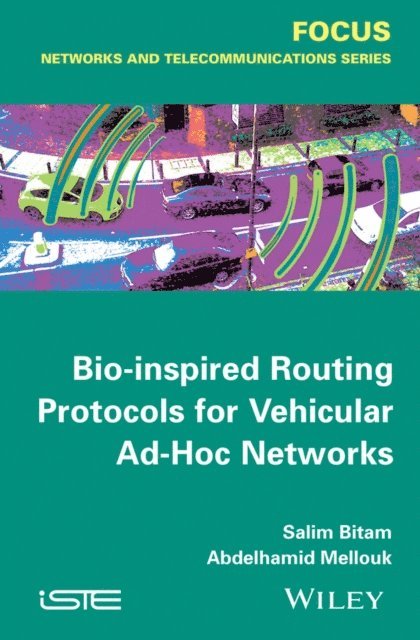
    Bio-inspired Routing Protocols for Vehicular Ad-Hoc Networks

    AvSalim Bitam,Abdelhamid Mellouk

    Inbunden, Engelska, 2014

    1 805 kr

    Beställningsvara. Skickas inom 5-8 vardagar. Fri frakt över 249 kr.

    Beskrivning

    Vehicular Ad-Hoc Networks (VANETs) play a key role to develop Intelligent Transportation Systems (ITS) aiming to achieve road safety and to guaranty needs of drivers and passengers, in addition to improve the transportation productivity. One of the most important challenges of this kind of networks is the data routing between VANET nodes which should be routed with high level of Quality of Service (QoS) to ensure receiving messages in the time. Then, the driver can take the appropriate decision to improve the road safety. In the literature, there are several routing protocols for VANETs which are more or less reliable to reach safety requirements. In this book, we start by describing all VANET basic concepts such as VANET definition, VANET versus Mobile ad-Hoc Network (MANET), architectures, routing definition and steps, Quality of Service (QoS) for VANET Routing, Metrics of evaluation, Experimentation, and simulation of VANETs, mobility patterns of VANET etc. Moreover, different routing protocols for routing in VANETs will be described. We propose two main categories to be presented: classical routing and bio-inspired routing. Concerning classical VANET, main principles and all phases will be overviewed, as well as, their two sub-categories which are topological and geographical protocols. After that, we propose a new category called bio-inspired routing which is inspired by natural phenomenon such as Ant colony, Bee life, Genetic operators etc. We present also, some referential protocols as example of each category.In this book, we focus on the idea of how to apply bio-inspired principle into VANET routing to improve road safety, and to ensure QoS of vehicular applications.

    Produktinformation

    • Utgivningsdatum:2014-09-19
    • Mått:165 x 244 x 16 mm
    • Vikt:390 g
    • Format:Inbunden
    • Språk:Engelska
    • Antal sidor:160
    • Förlag:ISTE Ltd and John Wiley & Sons Inc
    • ISBN:9781848216631

    Utforska kategorier

    • Elektronik och kommunikationer inom Naturvetenskap och teknik
    • Byggnadsteknik inom Naturvetenskap och teknik

    Mer om författaren

    Salim BITAM is an Associate Professor, Head (2003-2009) of Computer Science for Management Department of Biskra University, Algeria, he is senior member of LESIA Laboratory (University of Biskra, Algeria), and Associate Member of LiSSi Laboratory (Paris-Est University -UPEC-, France). He received the Ing. Diploma in Computer Science from Mentouri University, Constantine, Algeria, in 1999 and the Magister and PhD diplomas in Computer Science from University of Biskra, Algeria, in 2002 and 2011, respectively. In December 2002, he has been an assistant professor and since January 2011 he is an associate professor in Computer Science Department in University of Biskra. Dr. Bitam main research interests are vehicular ad-hoc networks, mobile ad-hoc networks, wireless sensor networks, cloud computing, and bio-inspired methods for routing and optimization. Dr. Salim Bitam has served as a reviewer of several journals such as IEEE, Elsevier and Springer and on the program committees of several international conferences.Abdelhamid MELLOUK (IEEE Senior Member) is a full professor at University of Paris-Est (UPEC), Networks & Telecommunications (N&T) Department and LiSSi Laboratory, France. He graduated in computer network engineering from the Computer Science High Eng. School, University of Paris Sud XI Orsay, received his Ph.D. in informatics from the same university, and a Doctorate of Sciences (Habilitation) diploma from  UPEC. Founder of the Network Control Research activity with extensive international academic and industrial collaborations, his general area of research is in adaptive real-time control for high-speed new generation dynamic wired/wireless networking in order to maintain acceptable quality of service/experience for added value services. He is an active member of the IEEE Communications Society and held several offices including leadership positions in IEEE Communications Society Technical Committees (Chair of The Technical Committee on Communications Software, Leader Officer of The Technical Committee on Switching and Routing). He has published/coordinated five books and several refereed international publications in journals, conferences, and books, in addition to numerous keynotes and plenary talks in flagship venues. He serves on the Editorial Boards or as Associate Editor for several journals, and he is chairing or has chaired (or co-chaired) some of the top international conferences and symposia (includling IEEE ICC and IEEE GlobeCom).

    Innehållsförteckning

    • PREFACE ixINTRODUCTION xiACRONYMS AND NOTATIONS xvCHAPTER 1. VEHICULAR AD HOC NETWORKS 11.1. VANET definition, characteristics and applications11.1.1. Definition of vehicular ad hoc network11.1.2. Characteristics of vehicular ad hoc networks 21.1.3. Applications of vehicular ad hoc networks 51.2. VANET architectures 71.2.1. Vehicular WLAN/cellular architecture 71.2.2. Pure ad hoc architecture 81.2.3. Hybrid architecture 91.3. Mobility models 91.3.1. Random-based mobility models 101.3.2. Geographic map-based mobility models 121.3.3. Group-based mobility 141.3.4. Prediction-based mobility models 171.3.5. Software-tools-based mobility models 201.4. VANET challenges and issues 211.4.1. VANET routing 211.4.2. Vehicular network scalability 221.4.3. Computational complexity in VANET networking 221.4.4. Routing robustness and self-organization in vehicular networks 231.4.5. Vehicular network security 231.5. Bibliography 23CHAPTER 2. ROUTING FOR VEHICULAR AD HOC NETWORKS 292.1. Basic concepts 292.1.1. Single-hop versus multi-hop beaconing in VANETs 292.1.2. Routing classification of VANETs 312.2. Quality-of-service of VANET routing 352.2.1. Quality-of-service definition 352.2.2. Quality-of-service criteria 362.3. VANET routing standards 372.3.1. Dedicated short range communication 382.3.2. Standards for wireless access in vehicular environments (WAVE) 402.3.3. VANET standards related to routing layers 422.3.4. Other VANET routing standards 442.4. VANET routing challenges and issues 452.4.1. Dynamics nature of VANETs (mobility pattern and vehicles’ velocity) 452.4.2. Vehicular network density and scalability 462.4.3. Safety improvement and quality-of-service 462.5. Bibliography 47CHAPTER 3. CONVENTIONAL ROUTING PROTOCOLS FOR VANETS 513.1. Topology-based routing 513.1.1. Reactive routing protocols 523.1.2. Proactive routing protocols 553.1.3. Hybrid routing protocols 573.1.4. Critics of topology-based routing 583.2. Geography-based routing 593.2.1. Geography-based routing principle 593.2.2. Geography-based routing protocols 593.2.3. Critics of geography-based routing 673.3. Cluster-based routing 683.3.1. Cluster-based routing principle 683.3.2. Cluster-based routing protocols 693.3.3. Critics of cluster-based routing 733.4. Bibliography 73CHAPTER 4. BIO-INSPIRED ROUTING PROTOCOLS FOR VANETS 794.1. Motivations for using bio-inspired approaches in VANET routing 804.1.1. Network scalability 804.1.2. Computational complexity 804.1.3. Self-organization and adaptability 814.1.4. Routing robustness 814.2. Fundamental concepts and operations of bio-inspired VANET routing 824.2.1. Optimization problem definition 824.2.2. Search space (SSp) 834.2.3. Objective function 834.2.4. Population 844.2.5. Individual encoding 844.2.6. Initialization 844.2.7. Stopping criterion 854.3. Basic bio-inspired algorithms used in VANET routing literature 854.3.1. Genetic algorithm 864.3.2. Ant colony optimization 894.3.3. Particle swarm optimization 904.3.4. Bees life algorithm 924.3.5. Bacterial foraging optimization 934.4. Evolutionary algorithms for VANET routing 954.4.1. Sequential genetic algorithms for VANET routing 954.4.2. Parallel genetic algorithms for VANET routing 1004.5. Swarm intelligence for VANET routing 1014.5.1. Ant colony optimization for VANET routing 1024.5.2. Particle swarm optimization for VANET routing 1064.5.3. Bee colony optimization for VANET routing 1084.5.4. Bacterial foraging optimization for VANET routing 1104.6. Another bio-inspired approach for VANET routing 1124.7. Bibliography 113CONCLUSION 121INDEX 125