• Fri frakt över 249 kr
  • •
  • Snabba leveranser
  • •
  • Billiga böcker
Kundservice

Du är på sajten för privatpersoner.

Företag, bibliotek eller offentlig verksamhet?

Du handlar på classic.bokus.com, där alla dina funktioner finns intakta.
Till classic.bokus.com
Bokus logotyp. Gå till startsidan.
  • Erbjudanden
  • Nyheter
  • Student
  • Topplistor
  • Barn & ungdom
  • Bokus Play
  • E-böcker
  • Pocketböcker
  • Spel & pussel

10% rabatt på allt med kod: NYSTART10 →

Sidfot

Mina sidor

    Hjälp

    • Kundservice
    • Vanliga frågor och svar
    • Frakt och leverans
    • Retur vid ångerrätt
    • Reklamera vara
    • Betalning
    • Köpvillkor
    • Allmänna villkor
    • Information om webbplatsens tillgänglighet

    Om Bokus

    • Om oss
    • Pressrum
    • För studenter
    • För företag
    • För bibliotek och offentlig verksamhet
    • För leverantörer
    • Hållbarhet

    Populärt

    • Aktuella erbjudanden
    • Presentkort
    • Studentlitteratur
    • Nya böcker
    • Topplistor
    • Signerade böcker
    • Engelska böcker

    Inspiration

    • Boktips
    • BookTok
    • Populära bokserier
    • Barnbokskaraktärer
    • Populära författare
    Logotyp för Bokus
    Följ oss på Facebook (extern länk)Följ oss på Instagram (extern länk)Följ oss på YouTube (extern länk)Följ oss på TikTok (extern länk)
    bokus @ CookiesAnpassa cookiesIntegritetspolicyKöpvillkor
    Till Citymail hemsida (extern länk)Till Budbee hemsida (extern länk)Till Postnord hemsida (extern länk)Till Schenker hemsida (extern länk)Till Early Bird hemsida (extern länk)Till Walleys hemsida (extern länk)
    1. Naturvetenskap och teknik
    2. Teknik och industri
    3. Energiteknik

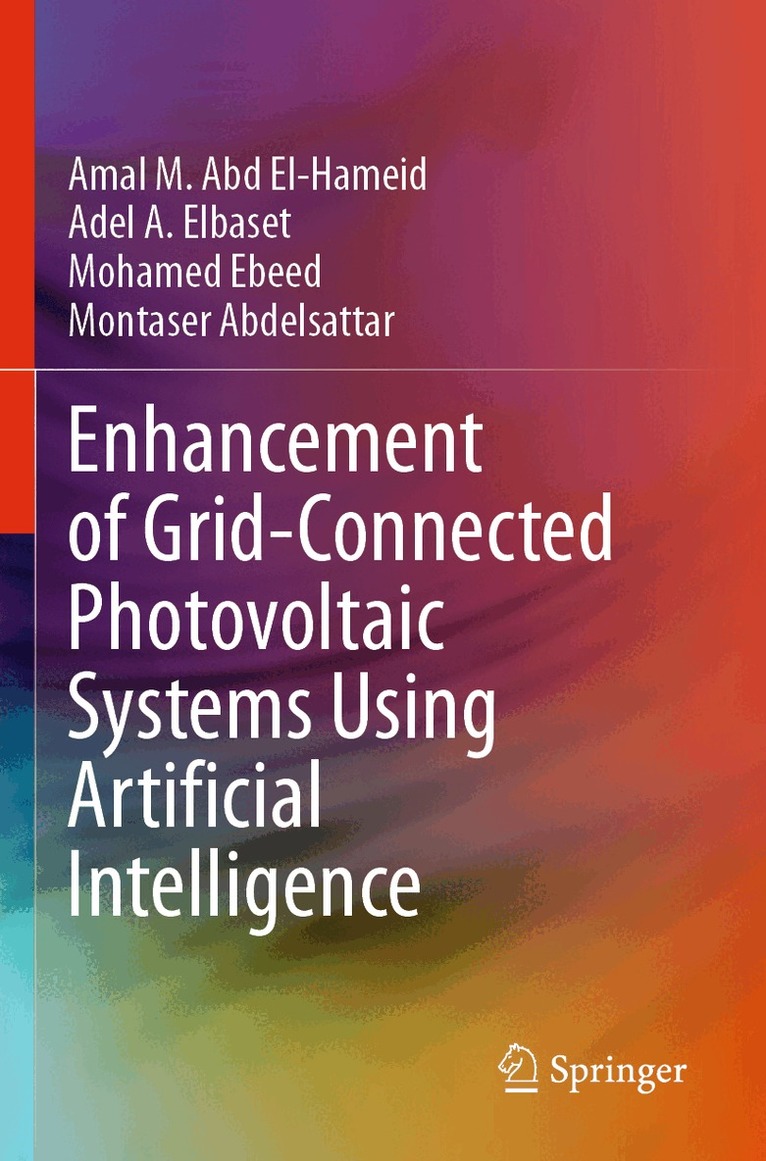
    Enhancement of Grid-Connected Photovoltaic Systems Using Artificial Intelligence

    AvAmal M. Abd El- Hameid,Adel A. Elbaset

    Häftad, Engelska, 2024

    1 409 kr

    Beställningsvara. Skickas inom 10-15 vardagar. Fri frakt över 249 kr.

    Fler format och utgåvor

    Inbunden

    1 409 kr

    Övrigt

    646 kr

    Beskrivning

    ​Enhancement of Grid-Connected Photovoltaic Systems Using Artificial Intelligence presents methods for monitoring transmission systems and enhancing distribution system performance using modern optimization techniques considering different multi-objective functions such as voltage loss sensitivity indexes, reducing total annual cost, and voltage deviation. The authors offer a comprehensive survey of distributed energy resources (DERs), explain the backward/forward sweep (BFS) power flow algorithm, and present simulation results on the optimal integration of photovoltaic-based distributed generators (PV-DG) and distribution static synchronous compensators (DSTATCOM) in different transmission and distribution systems. This book will be a valuable academic and industry resource for electrical engineers, students, and researchers working on optimization techniques, photovoltaic systems, energy engineering, and artificial intelligence.

    Produktinformation

    • Utgivningsdatum:2024-05-12
    • Mått:155 x 235 x 14 mm
    • Vikt:388 g
    • Format:Häftad
    • Språk:Engelska
    • Antal sidor:226
    • Förlag:Springer International Publishing AG
    • ISBN:9783031296949

    Utforska kategorier

    • Energiteknik inom Naturvetenskap och teknik

    Mer om författaren

    Amal Mohamed Abd El-Hameid, Ph.D., received her B.Sc. and M.Sc. degrees from the Electrical Engineering Department at Sohag University, Egypt, in 2012 and 2016, respectively. She is currently pursuing a Ph.D. Since May 2016, she has worked as an Assistant Lecturer in the Electrical Engineering Department for the Faculty of Industrial Education at Sohag University. Her research interests include renewable energy, power quality, photovoltaics, and optimization techniques.Adel A Elbaset, Ph.D., is a Full Professor with the Faculty of Engineering at Minia University, Egypt. He received his B.S., M.Sc., and Ph.D. from University in 1995, 2000, and 2006, respectively. Dr. Elbaset is a Full Professor with the Faculty of Engineering at Heliopolis University, where he is also Vice-Dean for Student Affairs and Head of the Department of Electromechanics. He has published over 120 technical papers in international journals and conferences and has supervised and examined more than 50 M.Sc. and Ph.D. theses at Minia and other Egyptian universities. His research interests are wind energy systems, photovoltaics, renewable energy systems, power electronics, power system protection and control, power quality and harmonics, and applications of neural networks and fuzzy systems. He has published 14 international books in the field of renewable energy.Mohamed Ebeed Hussein, Ph.D., received a B.S. from Aswan University in 2005 and an M.Sc. in electrical engineering from South Valley University in 2013. He received the jointly-supervised Ph.D. From the Department of Electrical Engineering, Faculty of Engineering, Aswan University, and University of Jaen, Spain, in 2018. Currently, he is a Lecturer in the Department of Electrical Engineering, Faculty of Engineering at Sohag University, Egypt. From 2008 to 2009, he was a lecturer at the Aswan Technical Institute. From 2009 to 2017, he was a maintenance engineer with EFACO Company. Montaser Abd El Sattar Mohammed, Ph.D., received a B.Sc. from the Faculty of Engineering, Department of Electrical Engineering at Al-Azhar University, Egypt, in 2006 and an M.Sc., and Ph.D. from the Department of Electrical Engineering, Faculty of Engineering at Minia University, Egypt, in 2011 and 2015, respectively. Dr, Mohammed has been working as a Lecturer at the El-Minia High Institute of Engineering and Technology, El-Minia, Egypt, since 2015. His research interests are renewable energy sources, power electronics, power quality, and harmonics.

    Innehållsförteckning

    • Introduction.- Power Quality Issues.- Stochastic Optimal Planning of Distribution System Considering Integrated Photovoltaic-Based DG and D-STATCOM.- Optimal Allocation of Distributed Energy Resources Using Modern Optimization Techniques.- Results and Discussion.- Conclusions and Future Work.