• Fri frakt över 249 kr
  • •
  • Snabba leveranser
  • •
  • Billiga böcker
Kundservice

Du är på sajten för privatpersoner.

Företag, bibliotek eller offentlig verksamhet?

Du handlar på classic.bokus.com, där alla dina funktioner finns intakta.
Till classic.bokus.com
Bokus logotyp. Gå till startsidan.
  • Erbjudanden
  • Nyheter
  • Student
  • Topplistor
  • Barn & ungdom
  • Bokus Play
  • E-böcker
  • Pocketböcker
  • Spel & pussel

10% rabatt på allt med kod: NYSTART10 →

Sidfot

Mina sidor

    Hjälp

    • Kundservice
    • Vanliga frågor och svar
    • Frakt och leverans
    • Retur vid ångerrätt
    • Reklamera vara
    • Betalning
    • Köpvillkor
    • Allmänna villkor
    • Information om webbplatsens tillgänglighet

    Om Bokus

    • Om oss
    • Pressrum
    • För studenter
    • För företag
    • För bibliotek och offentlig verksamhet
    • För leverantörer
    • Hållbarhet

    Populärt

    • Aktuella erbjudanden
    • Presentkort
    • Studentlitteratur
    • Nya böcker
    • Topplistor
    • Signerade böcker
    • Engelska böcker

    Inspiration

    • Boktips
    • BookTok
    • Populära bokserier
    • Barnbokskaraktärer
    • Populära författare
    Logotyp för Bokus
    Följ oss på Facebook (extern länk)Följ oss på Instagram (extern länk)Följ oss på YouTube (extern länk)Följ oss på TikTok (extern länk)
    bokus @ CookiesAnpassa cookiesIntegritetspolicyKöpvillkor
    Till Citymail hemsida (extern länk)Till Budbee hemsida (extern länk)Till Postnord hemsida (extern länk)Till Schenker hemsida (extern länk)Till Early Bird hemsida (extern länk)Till Walleys hemsida (extern länk)
    1. Psykologi och pedagogik
    2. Pedagogik

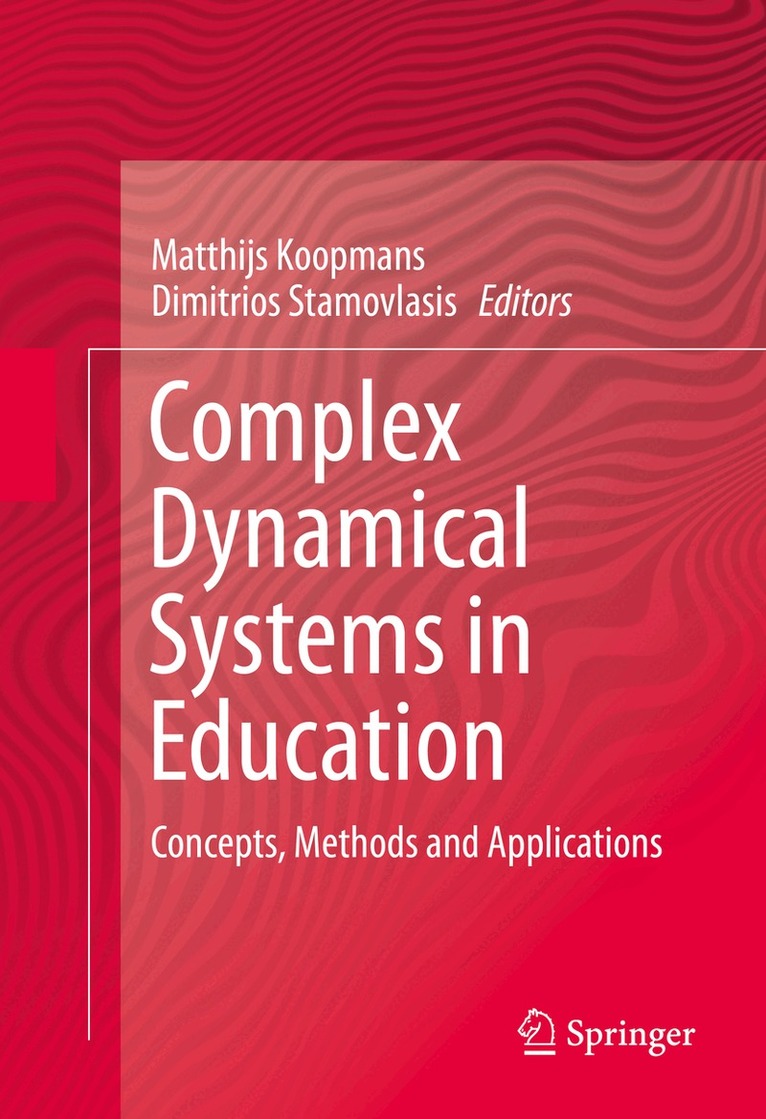
    Complex Dynamical Systems in Education

    Concepts, Methods and Applications

    AvMatthijs Koopmans,Dimitrios Stamovlasis

    Inbunden, Engelska, 2016

    1 055 kr

    Beställningsvara. Skickas inom 10-15 vardagar. Fri frakt över 249 kr.

    Beskrivning

    This book capitalizes on the developments in dynamical systems and education by presenting some of the most recent advances in this area in seventeen non-overlapping chapters. The first half of the book discusses the conceptual framework of complex dynamical systems and its applicability to educational processes. The second half presents a set of empirical studies that that illustrate the use of various research methodologies to investigate complex dynamical processes in education, and help the reader appreciate what we learn about dynamical processes in education from using these approaches.

    Produktinformation

    • Utgivningsdatum:2016-03-04
    • Mått:155 x 235 x 29 mm
    • Vikt:798 g
    • Format:Inbunden
    • Språk:Engelska
    • Antal sidor:412
    • Upplaga:16001
    • Förlag:Springer International Publishing AG
    • ISBN:9783319275758

    Utforska kategorier

    • Pedagogik inom Psykologi och pedagogik

    Mer om författaren

    Matthijs Koopmans is Associate Professor and Assessment Coordinator at the School of Education at Mercy College. His professional interests include the application of complex dynamical systems approaches in education, cause and effect relationships and nonlinear time series. He published numerous research articles and book reviews in peer-reviewed journals including Evaluation and Program Planning; Nonlinear, Dynamics, Psychology and Life Sciences, and Complicity: An International Journal of Complexity in Education. He is one of the editors of Chaos and Complexity in Psychology: The Theory of Nonlinear Dynamics, published by Cambridge University Press in 2009. He earned his Doctorate in 1988 at Harvard Graduate School of Education.Dimitrios Stamovlasis is Assistant Professor of Research Methodology and Applied Statistics in Social Science at the Aristotle University, Department of Philosophy and Education. His research interests are interdisciplinary and they focus: on methodologicaland epistemological issues of contemporary social sciences that improve theory building; on nonlinear dynamics (complexity, catastrophe theory, entropy, and related fields) and their application to social, behavioral and life sciences; on specific research endeavors in the area of educational research concerning neo-Piagetian theories, learning, science education, problem solving, creativity and group dynamics. He published numerous research articles in peer-reviewed journals, and he served as a guest editor in the Special Issue of Nonlinear Dynamics, Psychology and Life Science (2014) focused on Nonlinear Dynamics in Education. He earned his PhD at the University of Ioannina (2001) and he also holds a M.Sc. in Physical Chemistry from University of Hawaii, an MBA, and a M. Sc. in Statistics from University of Athens.

    Innehållsförteckning

    • Introduction to Education as a ComplexDynamical System​.- Complexity of School Environments and Educational Contexts.- A BatesonianPerspective on Qualitative Research and Complex Human Systems.- Emergence Self-Transcending and Education.- Opening the Wondrous World of the Possible for Education.- Towards the teaching ofmotor skills as a system of growing complexity.- The Fractal Dynamics ofEarly Childhood Play Development and Nonlinear Teaching and Learning.- Ergodicityand Merits of the Single Case.- Catastrophe Theory:Methodology, Epistemology and Applications in Learning Science.- Evaluating Complex Educational Systems withQuadratic Assignment Processes and Exponential Random Graph Model Methods.- Looking at’ EducationalInterventions Surplus Value of aComplex Dynamic Systems Approach to Study the Effectiveness of a Science andTechnology Educational Intervention.- Analyzing teacher-student interactions withState Space Grids.- Nonlinear Dynamical Interaction Patterns inCollaborative Groups: Discourse Analysis with OrbitalDecomposition.- Investigating the Long Memory Process in DailyHigh School Attendance Data.- Educational Systems andthe Intergenerational Transmission of Inequality: A Complex Dynamical SystemsPerspective.- The Symbolic Dynamics of Visual Attention DuringLearning: Exploring the Application of Orbital Decomposition.- A catastrophe model formotivation and emotions: Highlighting theSynergistic Role of Performance-Approach and Performance-Avoidance GoalOrientations.