• Fri frakt över 249 kr
  • •
  • Snabba leveranser
  • •
  • Billiga böcker
Kundservice

Du är på sajten för privatpersoner.

Företag, bibliotek eller offentlig verksamhet?

Du handlar på classic.bokus.com, där alla dina funktioner finns intakta.
Till classic.bokus.com
Bokus logotyp. Gå till startsidan.
  • Erbjudanden
  • Student
  • Topplistor
  • Barn & ungdom
  • Bokus Play
  • E-böcker
  • Ljudböcker
  • Pocketböcker
  • Spel och pussel

Pocketfynda! Hundratals böcker för 49 kr/st →

Sidfot

Mina sidor

    Hjälp

    • Kundservice
    • Vanliga frågor och svar
    • Frakt och leverans
    • Retur vid ångerrätt
    • Reklamera vara
    • Betalning
    • Köpvillkor
    • Allmänna villkor
    • Information om webbplatsens tillgänglighet

    Om Bokus

    • Om oss
    • Pressrum
    • För studenter
    • För företag
    • För bibliotek och offentlig verksamhet
    • För leverantörer
    • Hållbarhet

    Populärt

    • Aktuella erbjudanden
    • Presentkort
    • Studentlitteratur
    • Nya böcker
    • Topplistor
    • Signerade böcker
    • Engelska böcker

    Inspiration

    • Boktips
    • BookTok
    • Barnbokskaraktärer
    • Populära författare
    Logotyp för Bokus
    Följ oss på Facebook (extern länk)Följ oss på Instagram (extern länk)Följ oss på YouTube (extern länk)Följ oss på TikTok (extern länk)
    bokus @ CookiesAnpassa cookiesIntegritetspolicyKöpvillkor
    Till Citymail hemsida (extern länk)Till Budbee hemsida (extern länk)Till Postnord hemsida (extern länk)Till Schenker hemsida (extern länk)Till Early Bird hemsida (extern länk)Till Walleys hemsida (extern länk)
    1. Ekonomi och Ledarskap
    2. Nationalekonomi

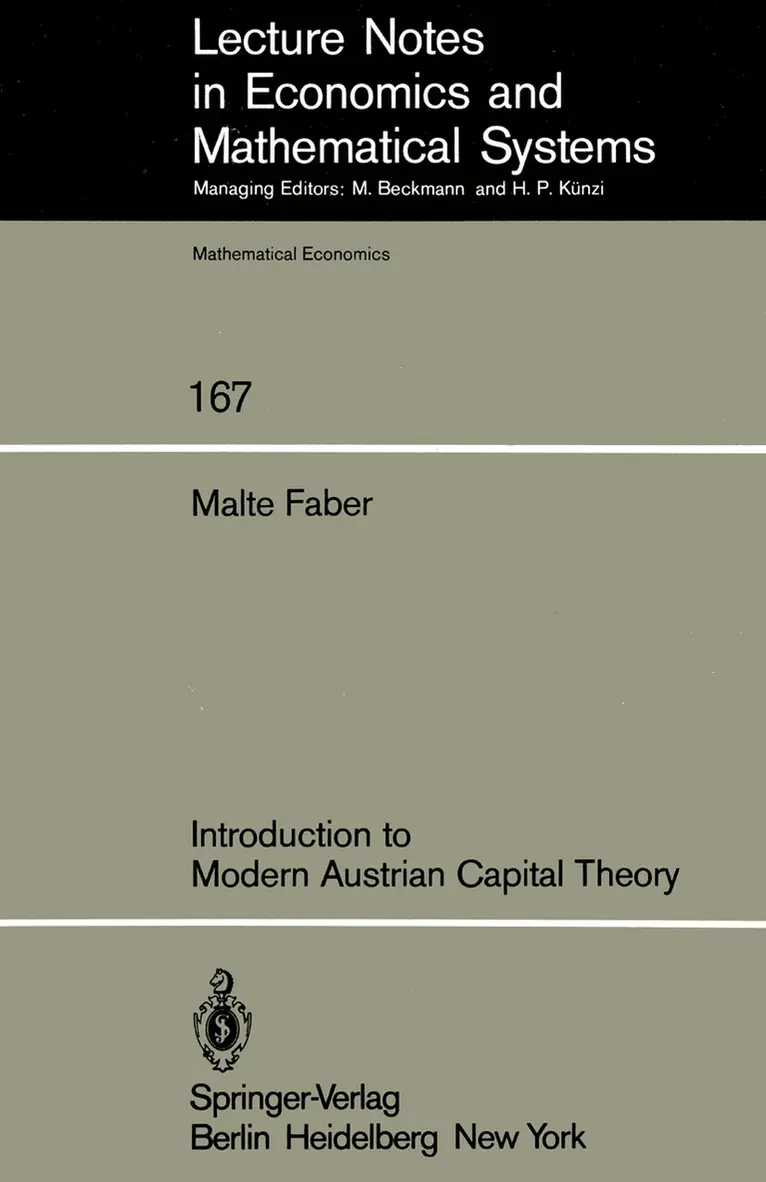
    Introduction to Modern Austrian Capital Theory

    AvMalte Faber

    Häftad, Engelska, 1979

    Del 167 i serien Lecture Notes in Economics and Mathematical Systems

    559 kr

    Beställningsvara. Skickas inom 10-15 vardagar. Fri frakt över 249 kr.

    Fler format och utgåvor

    E-bok

    732 kr

    Beskrivning

    During the fifties and the sixties the neoclassical concept of the production function was criticized in numerous papers. In particular, the aggregation of different capital goods into a single number was reprehended. A second essential disadvantage, namely the neglect of the time structure of the production process, found, however, rela­ tively little attention. While up to the thirties the Austrian capital theory which stressed the time aspect of production was an important school, it fell into oblivion after the great capital controversies of the thirties. It took over thirty years, i. e. till the beginning of the seventies be­ fore it came to a renaissance of the Austrian capital theory by var­ ious writers. We may roughly classify the different attempts of Hits rebirth in modern economics" into three groups: 1. The approach of ~ [1970, 1973, 1973a] has received most of the attention in the literature (Burmeister [1974], Faber [1975], Fehl [1975], ~[1975], Hagemann and ~ [1976]). It will be shown in Chapter 9 that ~ is only in so far a Neo-Austrian as he does explicitly take into consideration the vertical time structure of the production process. But he does not use the Austrian concepts of superiority of roundabout methods, of time preference and of the period of production. 2. The latter concept has been revived by the second group, to which Tintner [1970], von Weizs~cker [1971a, 1971b, 1974], ~ [1971, 1976 and ~ [1973, 1975, 1976] belong.

    Produktinformation

    • Utgivningsdatum:1979-03-05
    • Mått:170 x 244 x 12 mm
    • Vikt:375 g
    • Format:Häftad
    • Språk:Engelska
    • Serie:Lecture Notes in Economics and Mathematical Systems
    • Antal sidor:201
    • Förlag:Springer-Verlag Berlin and Heidelberg GmbH & Co. KG
    • ISBN:9783540091219

    Utforska kategorier

    • Nationalekonomi inom Ekonomi och Ledarskap

    Innehållsförteckning

    • I: Austrian Capital Theory and the von Neumann-Model.- 1. Introduction.- 2. The Austrian Theory of Interest.- 3. The von Neumann-Model and its Relations to Austrian Capital and Interest Theory.- II: Modern Austrian Capital Theory.- 4. A Two-Period Two-Sector Neo-Austrian Model.- 5. A Multiperiod Two-Sector Model.- 6. A Multisector Model.- 7. The Schumpeter-von Böhm-Bawerk Controversy on the Rate of Interest in the Stationary State.- III: Relationship to other Approaches to Capital Theory.- 8. A Comparison with Results of Neoclassical Capital and Growth Theory.- 9. Hicks’ Neo-Austrian Theory of Capital.- References.- Author Index.