• Fri frakt över 249 kr
  • •
  • Snabba leveranser
  • •
  • Billiga böcker
Kundservice

Du är på sajten för privatpersoner.

Företag, bibliotek eller offentlig verksamhet?

Du handlar på classic.bokus.com, där alla dina funktioner finns intakta.
Till classic.bokus.com
Bokus logotyp. Gå till startsidan.
  • Erbjudanden
  • Nyheter
  • Student
  • Topplistor
  • Barn & ungdom
  • Bokus Play
  • E-böcker
  • Pocketböcker
  • Spel & pussel

10% rabatt på allt med kod: NYSTART10 →

Sidfot

Mina sidor

    Hjälp

    • Kundservice
    • Vanliga frågor och svar
    • Frakt och leverans
    • Retur vid ångerrätt
    • Reklamera vara
    • Betalning
    • Köpvillkor
    • Allmänna villkor
    • Information om webbplatsens tillgänglighet

    Om Bokus

    • Om oss
    • Pressrum
    • För studenter
    • För företag
    • För bibliotek och offentlig verksamhet
    • För leverantörer
    • Hållbarhet

    Populärt

    • Aktuella erbjudanden
    • Presentkort
    • Studentlitteratur
    • Nya böcker
    • Topplistor
    • Signerade böcker
    • Engelska böcker

    Inspiration

    • Boktips
    • BookTok
    • Populära bokserier
    • Barnbokskaraktärer
    • Populära författare
    Logotyp för Bokus
    Följ oss på Facebook (extern länk)Följ oss på Instagram (extern länk)Följ oss på YouTube (extern länk)Följ oss på TikTok (extern länk)
    bokus @ CookiesAnpassa cookiesIntegritetspolicyKöpvillkor
    Till Citymail hemsida (extern länk)Till Budbee hemsida (extern länk)Till Postnord hemsida (extern länk)Till Schenker hemsida (extern länk)Till Early Bird hemsida (extern länk)Till Walleys hemsida (extern länk)
    1. Ekonomi och Ledarskap
    2. Nationalekonomi
    3. Internationell ekonomi

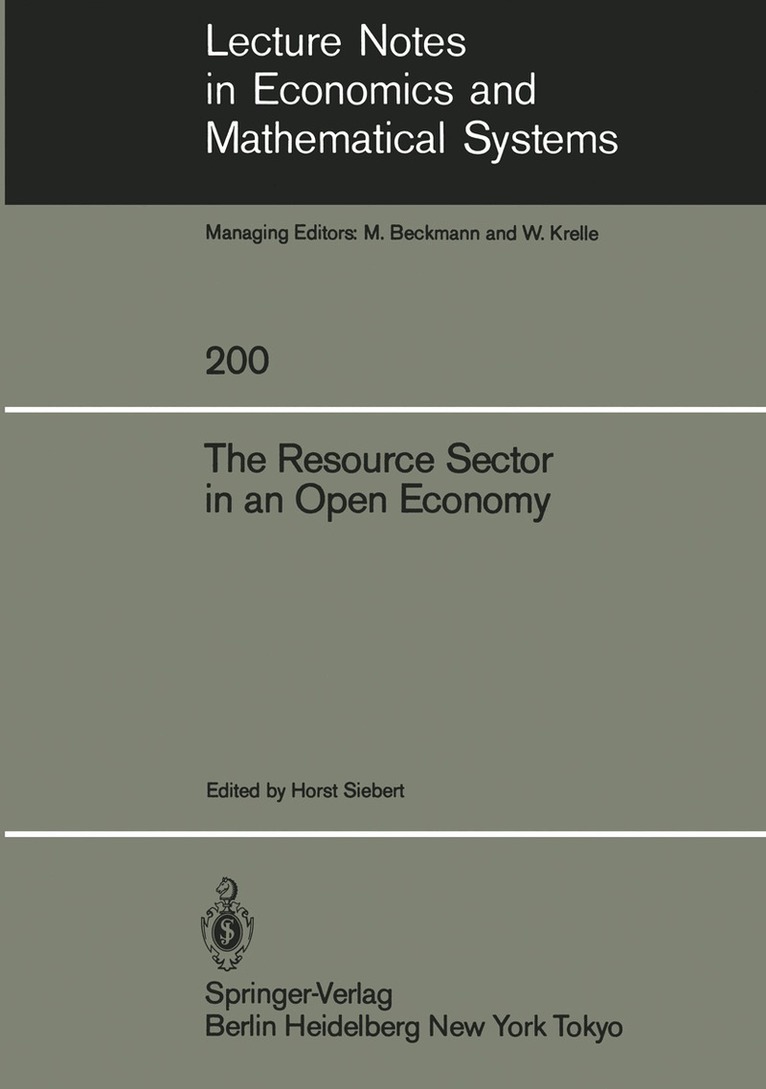
    Resource Sector in an Open Economy

    AvH. Siebert

    Häftad, Engelska, 1983

    Del 200 i serien Lecture Notes in Economics and Mathematical Systems

    1 119 kr

    Beställningsvara. Skickas inom 10-15 vardagar. Fri frakt över 249 kr.

    Beskrivning

    the economics of exhaustible " assets presents a whole forest of intriguing problems." 1 Harald Hotelling ) The two energy price shocks in 1973/74 and 1979/80 have arosed interest in the new area of resource economics. The affluent societies of Europe, North America and Japan were confronted with the new scarcity paradigm of the "space ship earth" with only a limited supply of natural resources aboard whereas population is growing and the environment can­ not accomodate the increasing volume of pollutants. The problem of natural resource scarcity gives rise to the question how resource-dependent economies like European coun­ tries and Japan are affected by an increase in resource prices and how they can adjust to rising energy prices. The new para­ digm also has focused new interest on the problem of the re­ source-extracting firm and of the resource-exporting country. The Hotelling revival of resource economics has given new im­ portance to the behavior and to the policy issues of resource­ exporting countries.

    Produktinformation

    • Utgivningsdatum:1983-11-01
    • Mått:170 x 244 x 11 mm
    • Vikt:322 g
    • Format:Häftad
    • Språk:Engelska
    • Serie:Lecture Notes in Economics and Mathematical Systems
    • Antal sidor:164
    • Förlag:Springer-Verlag Berlin and Heidelberg GmbH & Co. KG
    • ISBN:9783540127000

    Utforska kategorier

    • Internationell ekonomi inom Ekonomi och Ledarskap
    • Miljöekonomi inom Ekonomi och Ledarskap

    Innehållsförteckning

    • I. Allocation Policy in a Resource-Exporting Country.- 1. The Role of Resource Exports.- 2. The Impact of the Resource Sector on the Economy.- 3. Intertemporal Allocation.- 4. Some Policy Issues.- II. On the Short-Run and Long-Run Effects of a Resource Boom.- 1. Introduction.- 2. Possible Causes of a Resource Boom.- 3. Short-Run Effects of a Resource Boom.- 4. Some Long-Run Considerations.- 5. Concluding Remarks.- III. More on the Consequences of a Resource Boom and the Cures of the Dutch Disease.- 1. Introduction.- 2. The Model.- 3. Consequences of a Resource Boom.- 4. Policies Against Adverse Boom Effects.- 5. Extensions and General Conclusions.- IV. Taxation of the Australian Resource Sector.- 1. Some Institutional Background.- 2. Mineral Profits, Taxation and Riskiness.- 3. Mineral Exports — Impact on other Sectors.- 4. Taxation and the Sale of Mineral Leases.- 5. The Objectives of Taxation Policy.- 6. Auctioning of Leases versus Resource Taxation.- 7. Exhaustability and Taxation.- 8. Bonanzas.- 9. The Northern Territory — The Proposed Mineral Royalty Bill.- 10. Conclusion.- V. Diversification and Stabilization in a Resource-Exporting Country.- 1. Introduction.- 2. Disturbances in a Small Commodity Exporting Country.- 3. Analytical Framework.- 4. Results.- 5. Summary and Conclusions.- Author Index.