• Fri frakt över 249 kr
  • •
  • Snabba leveranser
  • •
  • Billiga böcker
Kundservice

Du är på sajten för privatpersoner.

Företag, bibliotek eller offentlig verksamhet?

Du handlar på classic.bokus.com, där alla dina funktioner finns intakta.
Till classic.bokus.com
Bokus logotyp. Gå till startsidan.
  • Erbjudanden
  • Nyheter
  • Student
  • Topplistor
  • Barn & ungdom
  • Bokus Play
  • E-böcker
  • Pocketböcker
  • Spel & pussel

10% rabatt på allt med kod NYSTART10 →

Sidfot

Mina sidor

    Hjälp

    • Kundservice
    • Vanliga frågor och svar
    • Frakt och leverans
    • Retur vid ångerrätt
    • Reklamera vara
    • Betalning
    • Köpvillkor
    • Allmänna villkor
    • Information om webbplatsens tillgänglighet

    Om Bokus

    • Om oss
    • Pressrum
    • För studenter
    • För företag
    • För bibliotek och offentlig verksamhet
    • För leverantörer
    • Hållbarhet

    Populärt

    • Aktuella erbjudanden
    • Presentkort
    • Studentlitteratur
    • Nya böcker
    • Topplistor
    • Signerade böcker
    • Engelska böcker

    Inspiration

    • Boktips
    • BookTok
    • Populära bokserier
    • Barnbokskaraktärer
    • Populära författare
    Logotyp för Bokus
    Följ oss på Facebook (extern länk)Följ oss på Instagram (extern länk)Följ oss på YouTube (extern länk)Följ oss på TikTok (extern länk)
    bokus @ CookiesAnpassa cookiesIntegritetspolicyKöpvillkor
    Till Citymail hemsida (extern länk)Till Budbee hemsida (extern länk)Till Postnord hemsida (extern länk)Till Schenker hemsida (extern länk)Till Early Bird hemsida (extern länk)Till Walleys hemsida (extern länk)
    1. Data och IT
    2. Systemvetenskap och AI

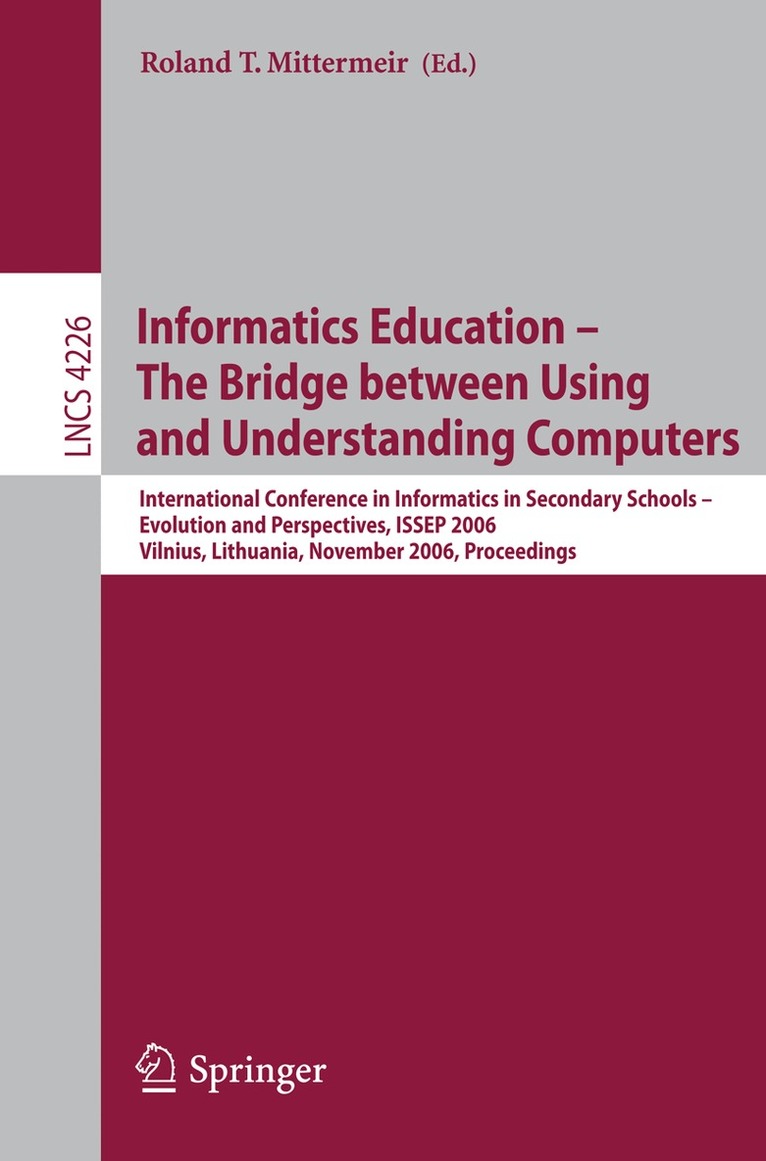
    Informatics Education - The Bridge between Using and Understanding Computers

    International Conference on Informatics in Secondary Schools - Evolution and Perspectives, ISSEP 2006, Vilnius, Lithuania, November 7-11, 2006, Proceedings

    AvRoland Mittermeir

    Häftad, Engelska, 2006

    Del i serien Lecture Notes in Computer Science

    562 kr

    Beställningsvara. Skickas inom 10-15 vardagar. Fri frakt över 249 kr.

    Beskrivning

    Although the school system is subject to specific national regulations, didactical issues warrant discussion on an international level. This applies specifically to informatics didactics. In contrast to most other scientific disciplines, informatics undergoes substantial technical and scientific changes and shifts of paradigms even at the basic level taught in secondary school. Moreover, informatics education is under more stringent observation from parents, potential employers, and policy makers than other disciplines. It is considered to be a modern discipline. Hence, being well-educated in informatics seemingly ensures good job perspectives. Further, policy makers pay attention to informatics education, hoping that a young population well-educated in this modern technology will contribute to the future wealth of the nation. But are such high aspirations justified? What should school aim at in order to live up to such expectations? ISSEP 2005, the 1st International Conference on Informatics in Secondary Schools – Evolution and Perspectives already showed that informatics teachers have to bridge a wide gap [1, 2]. On one hand, they have to show the inherent properties that informatics (or computer science) can contribute to general education. On the other hand, they are to make pupils computer literate. Under the constraint of limited time available for instruction, these different educational aims come into conflict. Computer-supported teaching or eLearning is to be considered distinct from informatics education. However, in many countries, informatics teachers still have to support the eTeaching activities of their colleagues.

    Produktinformation

    • Utgivningsdatum:2006-10-30
    • Mått:155 x 235 x 19 mm
    • Vikt:522 g
    • Format:Häftad
    • Språk:Engelska
    • Serie:Lecture Notes in Computer Science
    • Antal sidor:322
    • Förlag:Springer-Verlag Berlin and Heidelberg GmbH & Co. KG
    • ISBN:9783540482185

    Utforska kategorier

    • Systemvetenskap och AI inom Data och IT

    Innehållsförteckning

    • The Spectrum of Informatics Education.- Evolution of the Cultural-Based Paradigm for Informatics Education in Secondary Schools – Two Decades of Lithuanian Experience.- Discovering Informatics Fundamentals Through Interactive Interfaces for Learning.- Contributing to General Education by Teaching Informatics.- Bridging the Gap Between School Computing and the “Real World”.- Programming Versus Application.- Databases as a Tool of General Education.- Handling the Diversity of Learners’ Interests by Putting Informatics Content in Various Contexts.- Computer Science in English High Schools: We Lost the S, Now the C Is Going.- Teaching Computing in Secondary Schools in a Dynamic World: Challenges and Directions.- Teaching Algorithmics and Programming.- Functions, Objects and States: Teaching Informatics in Secondary Schools.- From Intuition to Programme.- On Novices’ Local Views of Algorithmic Characteristics.- Learning Computer Programming with Autonomous Robots.- A Master Class Software Engineering for Secondary Education.- Algorithmic Thinking: The Key for Understanding Computer Science.- Issues of Selecting a Programming Environment for a Programming Curriculum in General Education.- Object-Oriented Programming at Upper Secondary School for Advanced Students.- The Role of ICT-Education.- Informatics Education at Austria’s Lower Secondary Schools Between Autonomy and Standards.- Development of an Integrated Informatics Curriculum for K-12 in Korea.- Contribution of Informatics Education to Mathematics Education in Schools.- Exams and Competitions.- Evolution of Informatics Maturity Exams and Challenge for Learning Programming.- Objective Scoring for Computing Competition Tasks.- Teacher Education and School Development.- Modelling and Evaluating ICT Coursesfor Pre-service Teachers: What Works and How It Works?.- Sustaining Local Identity, Control and Ownership While Integrating Technology into School Learning.- eLearning.- Designing Digital Technologies for Layered Learning.- ePortfolios in Australian Schools: Supporting Learners’ Self-esteem, Multiliteracies and Reflection on Learning.- Metacognition in Web-Based Learning Activities.- Development of Modern e-Learning Services for Lithuanian Distance Education Network LieDM.- Localization and Internationalization of Web-Based Learning Environment.