• Fri frakt över 249 kr
  • •
  • Snabba leveranser
  • •
  • Billiga böcker
Kundservice

Du är på sajten för privatpersoner.

Företag, bibliotek eller offentlig verksamhet?

Du handlar på classic.bokus.com, där alla dina funktioner finns intakta.
Till classic.bokus.com
Bokus logotyp. Gå till startsidan.
  • Erbjudanden
  • Nyheter
  • Student
  • Topplistor
  • Barn & ungdom
  • Bokus Play
  • E-böcker
  • Pocketböcker
  • Spel & pussel

10% rabatt på allt med kod: NYSTART10 →

Sidfot

Mina sidor

    Hjälp

    • Kundservice
    • Vanliga frågor och svar
    • Frakt och leverans
    • Retur vid ångerrätt
    • Reklamera vara
    • Betalning
    • Köpvillkor
    • Allmänna villkor
    • Information om webbplatsens tillgänglighet

    Om Bokus

    • Om oss
    • Pressrum
    • För studenter
    • För företag
    • För bibliotek och offentlig verksamhet
    • För leverantörer
    • Hållbarhet

    Populärt

    • Aktuella erbjudanden
    • Presentkort
    • Studentlitteratur
    • Nya böcker
    • Topplistor
    • Signerade böcker
    • Engelska böcker

    Inspiration

    • Boktips
    • BookTok
    • Populära bokserier
    • Barnbokskaraktärer
    • Populära författare
    Logotyp för Bokus
    Följ oss på Facebook (extern länk)Följ oss på Instagram (extern länk)Följ oss på YouTube (extern länk)Följ oss på TikTok (extern länk)
    bokus @ CookiesAnpassa cookiesIntegritetspolicyKöpvillkor
    Till Citymail hemsida (extern länk)Till Budbee hemsida (extern länk)Till Postnord hemsida (extern länk)Till Schenker hemsida (extern länk)Till Early Bird hemsida (extern länk)Till Walleys hemsida (extern länk)
    1. Naturvetenskap och teknik
    2. Matematik och naturvetenskap
    3. Astronomi

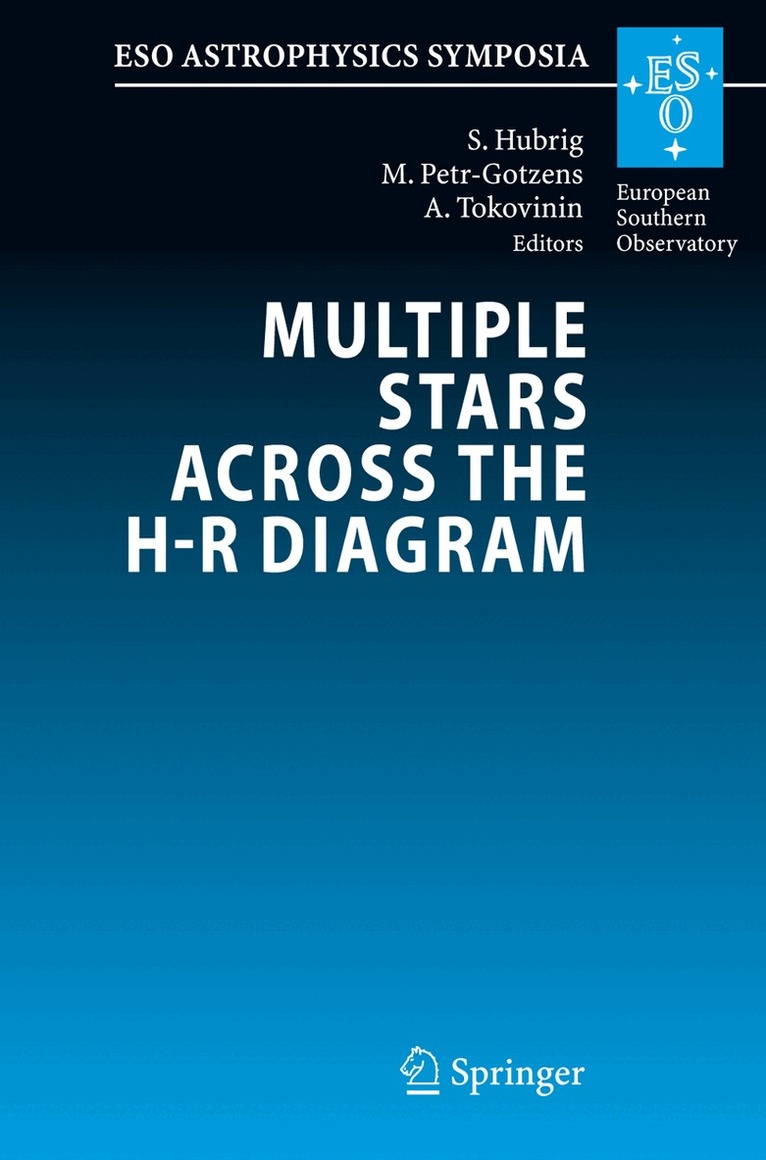
    Multiple Stars across the H-R Diagram

    Proceedings of the ESO Workshop held in Garching, Germany, 12-15 July 2005

    AvSwetlana Hubrig,Monika Petr-Gotzens

    Inbunden, Engelska, 2007

    Del i serien ESO Astrophysics Symposia

    1 086 kr

    Beställningsvara. Skickas inom 10-15 vardagar. Fri frakt över 249 kr.

    Beskrivning

    The ESO workshop “Multiple Stars across the H-R Diagram” was held in Garching on 12–15, July 2005. The topics included observations of multiple stars from ground and space, dynamical and stellar evolution in multiple systems, e?ects of the environment on multiplicity, formation and early e- lution of multiple stars, and special components of multiple stars (chemically peculiar stars, blue stragglers, brown dwarfs, etc.). Stars show a marked tendency to be in systems of di?erent multiplicity, 7 ranging from simple binaries and triples to globular clusters with N?10 . Modern observations give a frequency of binary and multiple stars in the Galactic ?eld of up to 70%, and between 5% and 20% of these systems are at least triple. There is evidence that the degree of multiplicity increases with primary mass. Many known multiple systems are too wide to have s- ni?cant physical interaction between their components. However, tidal and N-body dynamical interactions are important even in relatively wide s- tems and probably lead to the shrinkage of inner orbits. This sets the stage for spectacular evolutionary processes such as Roche-lobe over?ow, me- ers, supernovae, formation of special components, etc. Only recently did we realize that some of these processes require at least three stars. Theformationofmultiplesystemsremainsadi?cultandchallengingpart of astrophysics, although it has been addressed at the Workshop only brie?y.

    Produktinformation

    • Utgivningsdatum:2007-10-30
    • Mått:155 x 235 x 23 mm
    • Vikt:647 g
    • Format:Inbunden
    • Språk:Engelska
    • Serie:ESO Astrophysics Symposia
    • Antal sidor:305
    • Upplaga:2008
    • Förlag:Springer-Verlag Berlin and Heidelberg GmbH & Co. KG
    • ISBN:9783540747444

    Utforska kategorier

    • Astronomi inom Naturvetenskap och teknik

    Innehållsförteckning

    • Evolutionary Processes in Multiple Systems.- Dynamics and Stability of Triple Stars.- Multiple Stars: Physics vs. Dynamics.- Gliese 225.2: An Old (Stable?) Quadruplet.- Multiple Stars: Designation, Catalogues, Statistics.- Radial-velocity Studies of Certain Multiple Systems.- Spectral Disentangling Applied to Triple Systems: RV Crt.- Evidence for Rapid Variability in the Multiple System 68 u Her.- DG Leo: A Triple System with a Surprising Variety of Physical Phenomena.- A Spectroscopic Study of HD 208905.- The Suspected Binarity of the Nearby Flare Star Gl 424.- The Ecology of Dense Star Clusters with Binaries.- The Formation of Multiple Stars.- Population of Dynamically Formed Triples in Dense Stellar Systems.- Interferometric Studies of Multiple Stars.- Interferometric Orbits of New Hipparcos Binaries.- New Facts about ? Velorum: Fewer but Larger Components.- Speckle Interferometry of Two Low-mass Triple Systems in the Solar Neighbourhood.- Tertiary Companions to Close Spectroscopic Binaries.- Spectroscopic Subcomponents in Visual Double Stars: The Most Probable Values of their Physical and Orbital Parameters.Application to the System WDS 14404+2159.- Multiple Stars in the Field.- Multiplicity of Chemically Peculiar Stars.- Multiplicity of Contact Binary Stars.- Extrasolar Planets in Double and Multiple Stellar Systems.- Homogeneous Comparison of Directly Detected Planet Candidates: GQ Lup, 2M1207, AB Pic.- Searching for Planets Around Stars in Wide Binaries.- Multiplicity at the Very Low Mass End of the H-R Diagram.- Spectroscopic Companions of Very Young Brown Dwarfs.- The Observed Multiplicity of Low-mass Stars: From Embedded Protostars to Open Clusters.- High-order Multiplicity of PMS Stars: Results from a VLT/NACO Survey.- Accretion onto Binary YSOs Through Gapfrom Their Circum-binary Disk.- The Nearest Pre-Main Sequence Multiple Stars.- A Study of the Young Quadruple System AO Vel with a ZAMS Eclipsing BpSi Primary and PMS Companions.- Multiplicity of Massive Stars.- The Triple System ?1 Orionis A in the Heart of the Orion Trapezium Cluster.- The Primordial Binary Population in OB Associations.- Multiplicity of Early-type Stars in the Field: Progress Report.- Search for Low-mass Companions to X-ray Emitting A-type Stars.