• Fri frakt över 249 kr
  • •
  • Snabba leveranser
  • •
  • Billiga böcker
Kundservice

Du är på sajten för privatpersoner.

Företag, bibliotek eller offentlig verksamhet?

Du handlar på classic.bokus.com, där alla dina funktioner finns intakta.
Till classic.bokus.com
Bokus logotyp. Gå till startsidan.
  • Erbjudanden
  • Nyheter
  • Student
  • Topplistor
  • Barn & ungdom
  • Bokus Play
  • E-böcker
  • Pocketböcker
  • Spel & pussel

10% studentrabatt med kod TERM26

Sidfot

Mina sidor

    Hjälp

    • Kundservice
    • Vanliga frågor och svar
    • Frakt och leverans
    • Retur vid ångerrätt
    • Reklamera vara
    • Betalning
    • Köpvillkor
    • Allmänna villkor
    • Information om webbplatsens tillgänglighet

    Om Bokus

    • Om oss
    • Pressrum
    • För studenter
    • För företag
    • För bibliotek och offentlig verksamhet
    • För leverantörer
    • Hållbarhet

    Populärt

    • Aktuella erbjudanden
    • Presentkort
    • Studentlitteratur
    • Nya böcker
    • Topplistor
    • Signerade böcker
    • Engelska böcker

    Inspiration

    • Boktips
    • BookTok
    • Populära bokserier
    • Barnbokskaraktärer
    • Populära författare
    Logotyp för Bokus
    Följ oss på Facebook (extern länk)Följ oss på Instagram (extern länk)Följ oss på YouTube (extern länk)Följ oss på TikTok (extern länk)
    bokus @ CookiesAnpassa cookiesIntegritetspolicyKöpvillkor
    Till Citymail hemsida (extern länk)Till Budbee hemsida (extern länk)Till Postnord hemsida (extern länk)Till Schenker hemsida (extern länk)Till Early Bird hemsida (extern länk)Till Walleys hemsida (extern länk)
    1. Skönlitteratur
    2. Dramatik

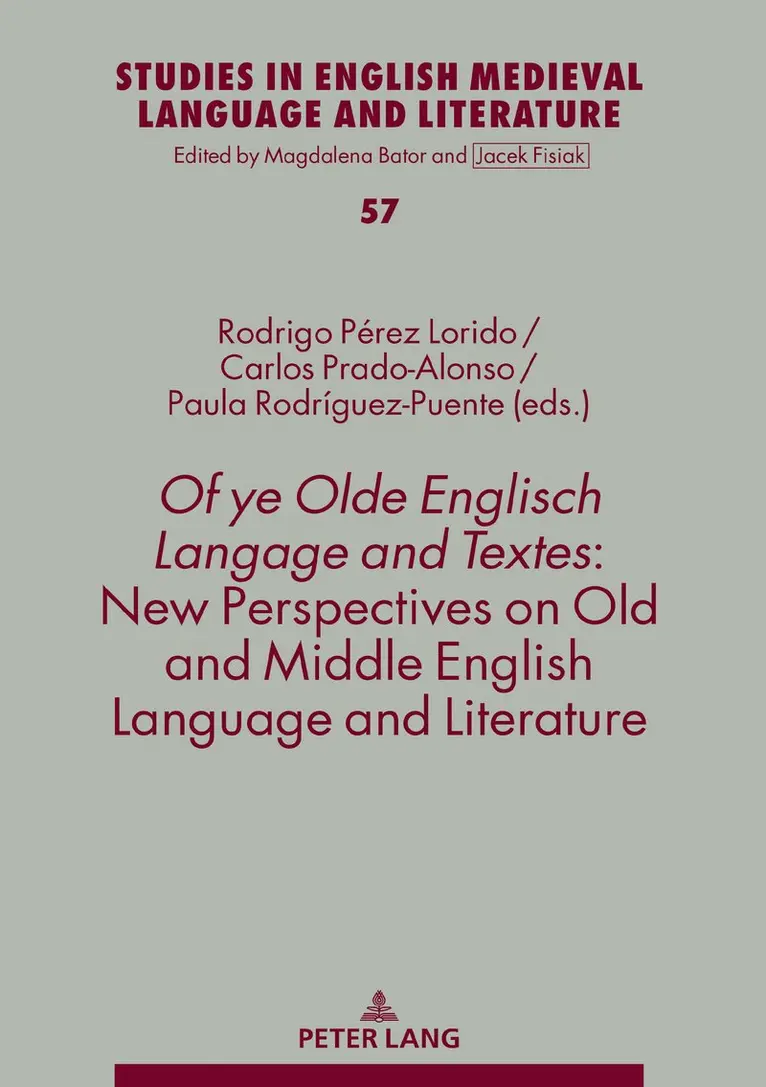
    Of ye Olde Englisch Langage and Textes: New Perspectives on Old and Middle English Language and Literature

    AvRodrigo Pérez Lorido,Carlos Prado Alonso

    Inbunden, Engelska, 2020

    Del 57 i serien Studies in English Medieval Language and Literature

    843 kr

    Beställningsvara. Skickas inom 5-8 vardagar. Fri frakt över 249 kr.

    Beskrivning

    This book provides new insights on different aspects of Old and Middle Eng-lish language and literature, presenting state-of-the-art analyses of linguistic phenomena and literary developments in those periods and opening up new directions for future work in the field. The volume tackles aspects of English diachronic linguistics such as the development of binominals and collective nouns in Old and Middle English, the early history of the intensifiers ‘deadly’ and ‘mortally’, the articulatory-acoustic characteristics of approximants in English, Old English metrics, some aspects of the methodology of corpus research with paleography in focus, studies of the interplay language-register, and a chapter discussing the periodology of Older Scots. The last section of the book ad-dresses literary and translatorial issues such as the impact of Latin ‘quis’ on the Middle English interrogative ‘who of’, the problems that may arise when trans-lating Beowulf into Galician, a reinterpretation of Chaucer’s Knight’s Tale, and a discussion of the structure of medieval manuscripts containing miscellanea.

    Produktinformation

    • Utgivningsdatum:2020-06-29
    • Mått:148 x 210 x 27 mm
    • Vikt:514 g
    • Format:Inbunden
    • Språk:Engelska
    • Serie:Studies in English Medieval Language and Literature
    • Antal sidor:344
    • Förlag:Peter Lang AG
    • ISBN:9783631817957

    Utforska kategorier

    • Dramatik inom Skönlitteratur
    • Språk: referensverk och allmänt inom Språk och ordböcker

    Mer om författaren

    Rodrigo Pérez Lorido is Associate Professor at the University of Oviedo (Spain), where he teaches English historical linguistics and sociolinguistics. His main fields of research are English diachronic syntax, psycholinguistics and different theories of language change. Carlos Prado-Alonso works as Associate professor at the University of Oviedo (Spain), where he teaches English syntax and pragmatic analysis. His research interests include the analysis of present-day English syntactic constructions and corpus research. Paula Rodríguez-Puente is Associate professor at the University of Oviedo (Spain), where she teaches history of the English language and English syntax. Her main research interests include English Historical Linguistics and corpus research.

    Innehållsförteckning

    • Table of Contents List of Contributors ................... 11 1.Introduction ................... 13 PART I. Language analysis and variation I.A Lexis and semanticsOxana Kharlamenko 2.The Expression of non-individual in some Old English nouns ................... 25 Olga Timofeeva 3.The lexicalisation of a Middle English binominal ................... 51 Zeltia Blanco-Suárez 4.Tracking down deadly and mortal(ly): The early history ................... 81I.B. Spelling and phonology Gjertrud F. Stenbrenden 5. Coda approximants in British English: A diachronic and synchronic account ................... 109Nelson Goering 6.Eduard Sievers’ Altgermanisch Metrik 125 years on ................... 139Jacob Thaisen 7. Classifying scripts, with particular reference to Anglicana and Secretary ................... 163I.C Register Jesús Romero-Barranco/Paula Rodríguez-Abruñeiras 8. Coordination and subordination in Middle English scientific prose: Textual variation in focus ................... 187Magdalena Bator/Elżbieta Pawlikowska-Asendrych 9. Germanic culinary recipes in the Middle Ages - a comparative typological study ................... 213 Sergio López-Martínez 10.The periodisation of Older Scots ................... 231 PART II. Textual analysis and translation II.A Translation Ayumi Miura 11. Revisiting the Latin influence on Middle English interrogative who of. ................... 259Jorge Luis Bueno-Alonso 12. “Are the in-laws swearing?”: Editing Old English manuscripts for translation through Beowulf’s Galician aliterative rendering ................... 281 II.B Text transmissionRichard North 13. “In hethenesse”: Chaucer’s Knight and Sultan Muḥammad V of Granada .................... 301María José Esteve Ramos 14. “For to understand that much work the leech shall have”: The context of the Agnus Castus herbal in MS Sloane 7 .................... 323