• Fri frakt över 249 kr
  • •
  • Snabba leveranser
  • •
  • Billiga böcker
Kundservice

Du är på sajten för privatpersoner.

Företag, bibliotek eller offentlig verksamhet?

Du handlar på classic.bokus.com, där alla dina funktioner finns intakta.
Till classic.bokus.com
Bokus logotyp. Gå till startsidan.
  • Erbjudanden
  • Nyheter
  • Student
  • Topplistor
  • Barn & ungdom
  • Bokus Play
  • E-böcker
  • Pocketböcker
  • Spel & pussel

10% rabatt på allt med kod: NYSTART10 →

Sidfot

Mina sidor

    Hjälp

    • Kundservice
    • Vanliga frågor och svar
    • Frakt och leverans
    • Retur vid ångerrätt
    • Reklamera vara
    • Betalning
    • Köpvillkor
    • Allmänna villkor
    • Information om webbplatsens tillgänglighet

    Om Bokus

    • Om oss
    • Pressrum
    • För studenter
    • För företag
    • För bibliotek och offentlig verksamhet
    • För leverantörer
    • Hållbarhet

    Populärt

    • Aktuella erbjudanden
    • Presentkort
    • Studentlitteratur
    • Nya böcker
    • Topplistor
    • Signerade böcker
    • Engelska böcker

    Inspiration

    • Boktips
    • BookTok
    • Populära bokserier
    • Barnbokskaraktärer
    • Populära författare
    Logotyp för Bokus
    Följ oss på Facebook (extern länk)Följ oss på Instagram (extern länk)Följ oss på YouTube (extern länk)Följ oss på TikTok (extern länk)
    bokus @ CookiesAnpassa cookiesIntegritetspolicyKöpvillkor
    Till Citymail hemsida (extern länk)Till Budbee hemsida (extern länk)Till Postnord hemsida (extern länk)Till Schenker hemsida (extern länk)Till Early Bird hemsida (extern länk)Till Walleys hemsida (extern länk)
    1. Naturvetenskap och teknik
    2. Matematik och naturvetenskap
    3. Kemi
    4. Organisk kemi

    Carbosilanes

    Syntheses and Reactions

    AvGerhard Fritz,Eberhard Matern

    Häftad, Engelska, 2011

    546 kr

    Beställningsvara. Skickas inom 10-15 vardagar. Fri frakt över 249 kr.

    Beskrivning

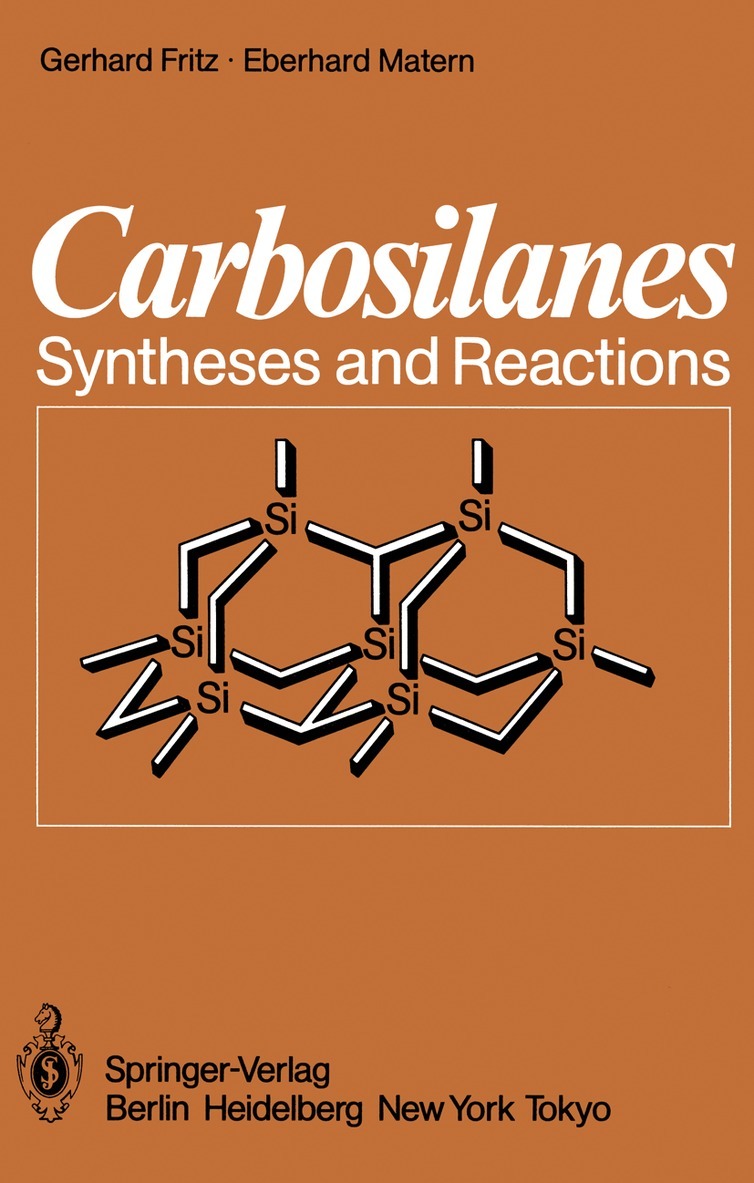
    Carbosilanes are compounds in which the elements silicon and carbon alternate in the molecular skeleton [1]. Just as the alkanes are formally derived from the diamond lattice and the aromatics from the graphite lattice, the carbosilanes are structurally derived from silicon carbide. Because of the tetravalent nature of silicon and carbon we can expect stable linear, cyclic and polycyclic compounds to occur. However, carbosilanes do not exist in nature. This book is an attempt to give a summarized presentation. Carbosilanes are, of course, part" of organosilicon chemistry, but their behavior differentiates them distinctly from other organosilicon compounds. The differences result primarily from the alternating Si-C-Si arrangements in the molecular skeleton, and especially the various methylene bridges (CH , CHX, CX ; X = halogen) cause changes in z z Si-C bond polarization and hence influence the reaction possibilities. It is convenient to regard carbosilanes as similar to silicones except that the oxygen bridges of silicones are replaced by methylene units. However, this does not accurately account for all the chemical properties of these compounds. Carbosilanes are related more directly to silicon carbide, as shown occasionally by the reactive behavior of polycyclic car­ bosilanes. Therefore, in view of the present interest shown for thermally stable cera­ mics of unusual character, interesting possibilities arise for further development. Most cyclic carbosilanes can be classified in two groups: the carborundanes and the Si-scaphanes. Compounds belonging to the carborundane class maintain Si-C six-membered rings in the boat conformation.

    Produktinformation

    • Utgivningsdatum:2011-12-22
    • Mått:170 x 244 x 16 mm
    • Vikt:482 g
    • Format:Häftad
    • Språk:Engelska
    • Antal sidor:258
    • Förlag:Springer-Verlag Berlin and Heidelberg GmbH & Co. KG
    • ISBN:9783642708022

    Utforska kategorier

    • Organisk kemi inom Naturvetenskap och teknik
    • Oorganisk kemi inom Naturvetenskap och teknik

    Innehållsförteckning

    • I. Introduction.- 1. Characteristic Differences between the Elements Silicon and Carbon.- 2. Functional Groups in the Chemistry of Silicon.- II. The Formation of Carbosilanes.- 1. The Formation of Carbosilanes by Thermal Decomposition of Methylsilanes.- 2. Formation of Carbosilanes by Direct Reaction of Halogenomethanes with Silicon.- 3. Formation of Polycyclic Molecular Skeletons through Rearrangement of Carbosilanes with AlBr3 or AlCl3.- 4. Organometallic Syntheses of Carbosilanes.- III. Reactions of Carbosilanes.- 1. Introduction.- 2. The Introduction of New Functional Groups on the Carbosilane Molecular Skeleton.- 3. Reactions with MeMgCl and MeLi.- 4. Metallation of Carbosilanes.- 5. Reactions of C-Chlorinated Carbosilanes with Silylphosphanes.- 6. The Reactive Behavior of Further Cyclic Carbosilanes.- 7. Investigations into the Cleavage of Si —Me Bonds in Carbosilanes.- 8. Substituent Effects in Carbosilanes.- 9. Hydrosilylation in Carbosilane Chemistry.- IV. Results of Structural Investigations of Carbosilanes.- 1. X-Ray Investigations of Crystal Structures.- 2. Electron Diffraction Studies.- V. References.