• Fri frakt över 249 kr
  • •
  • Snabba leveranser
  • •
  • Billiga böcker
Kundservice

Du är på sajten för privatpersoner.

Företag, bibliotek eller offentlig verksamhet?

Du handlar på classic.bokus.com, där alla dina funktioner finns intakta.
Till classic.bokus.com
Bokus logotyp. Gå till startsidan.
  • Erbjudanden
  • Nyheter
  • Student
  • Topplistor
  • Barn & ungdom
  • Bokus Play
  • E-böcker
  • Pocketböcker
  • Spel & pussel

10% rabatt på allt med kod: NYSTART10 →

Sidfot

Mina sidor

    Hjälp

    • Kundservice
    • Vanliga frågor och svar
    • Frakt och leverans
    • Retur vid ångerrätt
    • Reklamera vara
    • Betalning
    • Köpvillkor
    • Allmänna villkor
    • Information om webbplatsens tillgänglighet

    Om Bokus

    • Om oss
    • Pressrum
    • För studenter
    • För företag
    • För bibliotek och offentlig verksamhet
    • För leverantörer
    • Hållbarhet

    Populärt

    • Aktuella erbjudanden
    • Presentkort
    • Studentlitteratur
    • Nya böcker
    • Topplistor
    • Signerade böcker
    • Engelska böcker

    Inspiration

    • Boktips
    • BookTok
    • Populära bokserier
    • Barnbokskaraktärer
    • Populära författare
    Logotyp för Bokus
    Följ oss på Facebook (extern länk)Följ oss på Instagram (extern länk)Följ oss på YouTube (extern länk)Följ oss på TikTok (extern länk)
    bokus @ CookiesAnpassa cookiesIntegritetspolicyKöpvillkor
    Till Citymail hemsida (extern länk)Till Budbee hemsida (extern länk)Till Postnord hemsida (extern länk)Till Schenker hemsida (extern länk)Till Early Bird hemsida (extern länk)Till Walleys hemsida (extern länk)
    1. Naturvetenskap och teknik
    2. Teknik och industri
    3. Elektronik och kommunikationer

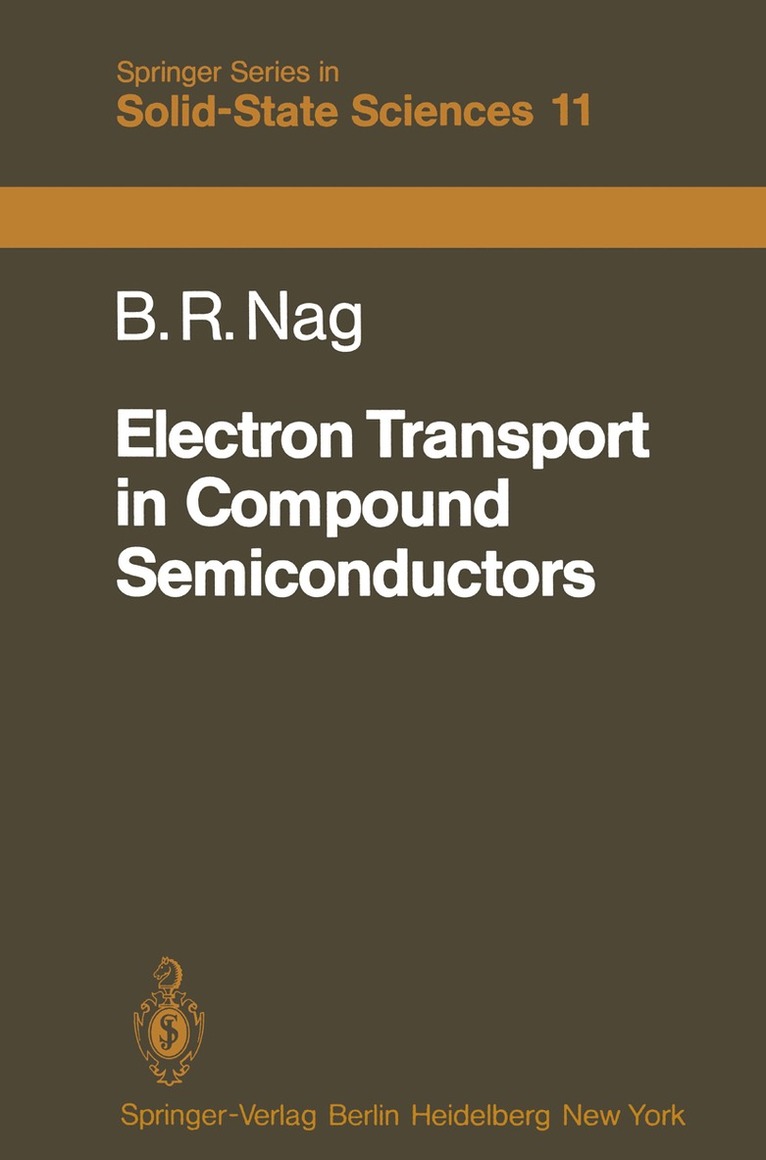
    Electron Transport in Compound Semiconductors

    AvB.R. Nag

    Häftad, Engelska, 2011

    Del 11 i serien Springer Series in Solid-State Sciences

    1 086 kr

    Beställningsvara. Skickas inom 10-15 vardagar. Fri frakt över 249 kr.

    Fler format och utgåvor

    E-bok

    1 416 kr

    Beskrivning

    Discovery of new transport phenomena and invention of electron devices through exploitation of these phenomena have caused a great deal of interest in the properties of compound semiconductors in recent years. Extensive re­ search has been devoted to the accumulation of experimental results, par­ ticularly about the artificially synthesised compounds. Significant ad­ vances have also been made in the improvement of the related theory so that the values of the various transport coefficients may be calculated with suf­ ficient accuracy by taking into account all the complexities of energy band structure and electron scattering mechanisms. Knowledge about these deve­ lopments may, however, be gathered only from original research contributions, scattered in scientific journals and conference proceedings. Review articles have been published from time to time, but they deal with one particular material or a particular phenomenon and are written at an advanced level. Available text books on semiconductor physics, do not cover the subject in any detail since many of them were written decades ago. There is, there­ fore, a definite need for a book, giving a comprehensive account of electron transport in compound semiconductors and covering the introductory material as well as the current work. The present book is an attempt to fill this gap in the literature. The first chapter briefly reviews the history of the developement of compound semiconductors and their applications. It is also an introduction to the contents of the book.

    Produktinformation

    • Utgivningsdatum:2011-12-15
    • Mått:155 x 235 x 27 mm
    • Vikt:727 g
    • Format:Häftad
    • Språk:Engelska
    • Serie:Springer Series in Solid-State Sciences
    • Antal sidor:464
    • Förlag:Springer-Verlag Berlin and Heidelberg GmbH & Co. KG
    • ISBN:9783642814181

    Utforska kategorier

    • Elektronik och kommunikationer inom Naturvetenskap och teknik
    • Materietillstånd inom Naturvetenskap och teknik

    Innehållsförteckning

    • 1. Introduction.- 1.1 Historical Note.- 1.2 Applications.- 1.3 Transport Coefficients of Interest.- 1.4 Scope of the Book.- 2. Crystal Structure.- 2.1 Zinc-Blende Structure.- 2.2 Wurtzite Structure.- 2.3 Rock-Salt Structure.- 2.4 Chalcopyrite Structure.- 3. Energy Band Structure.- 3.1 Electron Wave Vector and Brillouin Zone.- 3.2 Brillouin Zone for the Sphalerite and Rock-Salt Crystal Structure.- 3.3 Brillouin Zone for the Wurtzite Structure.- 3.4 Brillouin Zone for the Chalcopyrite Structure.- 3.5 E-k Diagrams.- 3.6 Conclusion.- 4. Theory of Efiergy Band Structure.- 4.1 Models of Band Structure.- 4.2 Free-Electron Approximation Model.- 4.3 Tight-Binding Approximation Model.- 4.4 Energy Bands in Semiconductor Super!attices.- 4.5 The k-p Perturbation Method for Derivating E-k Relation.- 4.6 External Effects on Energy Bands.- 5. Electron Statistics.- 5.1 Fermi Energy for Parabolic Bands.- 5.2 Fermi Energy for Nonparabolic Bands.- 5.3 Fermi Energy in the Presence of a Quantising Magnetic Field.- 5.4 Fermi Energy and Impurity Density.- 5.5 Conclusions.- 6. Scattering Theory.- 6.1 Collision Processes.- 6.2 Transition Probability.- 6.3 Matrix Elements.- 6.4 Free-Carrier Screening.- 6.5 Overlap Integrals.- 6.6 Scattering Probability S(k).- 6.7 Scattering Probabilities for Anisotropic Bands.- 6.8 S(k) for Neutral Impurity, Alloy, and Crystal-Defect Scattering.- 6.9 Conclusions.- 7. The Boltzmann Transport Equation and Its Solution.- 7.1 The Liouville Equation and the Boltzmann Equation.- 7.2 The Boltzmann Transport Equation.- 7.3 The Collision Integral.- 7.4 Linearised Boltzmann Equation.- 7.5 Simplified Form of the Collision Terms.- 7.6 Solution of the Boltzmann Equation.- 7.7 Method of Solution for Anisotropic Coupling Constants and Anisotropic Electron Effective Mass.- 7.8 Conclusions.- 8. Low-Field DC Transport Coefficients.- 8.1 Evaluation of Drift Mobility.- 8.2 Drift Mobility for Anisotropic Bands.- 8.3 Galvanomagnetic Transport Coefficients.- 8.4 Transport Coefficients for Nonuniform conditions.- 8.5 Conclusions.- 9. Low-Field AC Transport Coefficients.- 9.1 Classical Theory of AC Transport Coefficients.- 9.2 AC Galvanomagnetic Coefficients.- 9.3 Cyclotron Resonance and Faraday Rotation.- 9.4 Free-Carrier Absorption (FCA).- 9.5 Concluding Remarks.- 10. Electron Transport in a Strong Magnetic Field.- 10.1 Scattering Probabilities.- 10.2 Mobility in Strong Magnetic Fields.- 10.3 Electron Mobility in the Extreme Quantum Limit (EQL).- 10.4 Oscillatory Effects in the Magnetoresistance.- 10.5 Experimental Results on Magnetophonon Resonance.- 10.6 Conclusions.- 11. Hot-Electron Transport.- 11.1 Phenomenon of Hot Electrons.- 11.2 Experimental Characteristics.- 11.3 Negative Differential Mobility and Electron Transfer Effect.- 11.4 Analytic Theories.- 11.5 Numerical Methods.- 11.6 Hot-Electron AC Conductivity.- 11.7 Hot-Electron Diffusion.- 11.8 Conclusion.- 12. Review of Experimental Results.- 12.1 Transport Coefficients of III-V Compounds.- 12.2 II-VI Compounds.- 12.3 IV-VI Compounds.- 12.4 Mixed Compounds.- 12.5 Chalcopyrites.- 12.6 Conclusion.- 13. Conclusions.- 13.1 Problems of Current Interest.- 13.2 Scope of Further Studies.- Appendix A: Table of Fermi Integrals.- Appendix B: Computer Program for the Evaluation of Transport Coefficients by the Iteration Method.- Appendix C: Values of a. and b. for Gaussian Quadrature Integration. 417 Appendix D: Computer Program for the Monte Carlo Calculation of Hot-Electron Conductivity and Diffusivity.- List of Symbols.- References.