• Fri frakt över 249 kr
  • •
  • Snabba leveranser
  • •
  • Billiga böcker
Kundservice

Du är på sajten för privatpersoner.

Företag, bibliotek eller offentlig verksamhet?

Du handlar på classic.bokus.com, där alla dina funktioner finns intakta.
Till classic.bokus.com
Bokus logotyp. Gå till startsidan.
  • Erbjudanden
  • Nyheter
  • Student
  • Topplistor
  • Barn & ungdom
  • Bokus Play
  • E-böcker
  • Pocketböcker
  • Spel & pussel

10% rabatt på allt med kod: NYSTART10 →

Sidfot

Mina sidor

    Hjälp

    • Kundservice
    • Vanliga frågor och svar
    • Frakt och leverans
    • Retur vid ångerrätt
    • Reklamera vara
    • Betalning
    • Köpvillkor
    • Allmänna villkor
    • Information om webbplatsens tillgänglighet

    Om Bokus

    • Om oss
    • Pressrum
    • För studenter
    • För företag
    • För bibliotek och offentlig verksamhet
    • För leverantörer
    • Hållbarhet

    Populärt

    • Aktuella erbjudanden
    • Presentkort
    • Studentlitteratur
    • Nya böcker
    • Topplistor
    • Signerade böcker
    • Engelska böcker

    Inspiration

    • Boktips
    • BookTok
    • Populära bokserier
    • Barnbokskaraktärer
    • Populära författare
    Logotyp för Bokus
    Följ oss på Facebook (extern länk)Följ oss på Instagram (extern länk)Följ oss på YouTube (extern länk)Följ oss på TikTok (extern länk)
    bokus @ CookiesAnpassa cookiesIntegritetspolicyKöpvillkor
    Till Citymail hemsida (extern länk)Till Budbee hemsida (extern länk)Till Postnord hemsida (extern länk)Till Schenker hemsida (extern länk)Till Early Bird hemsida (extern länk)Till Walleys hemsida (extern länk)
    1. Juridik
    2. Internationell rätt

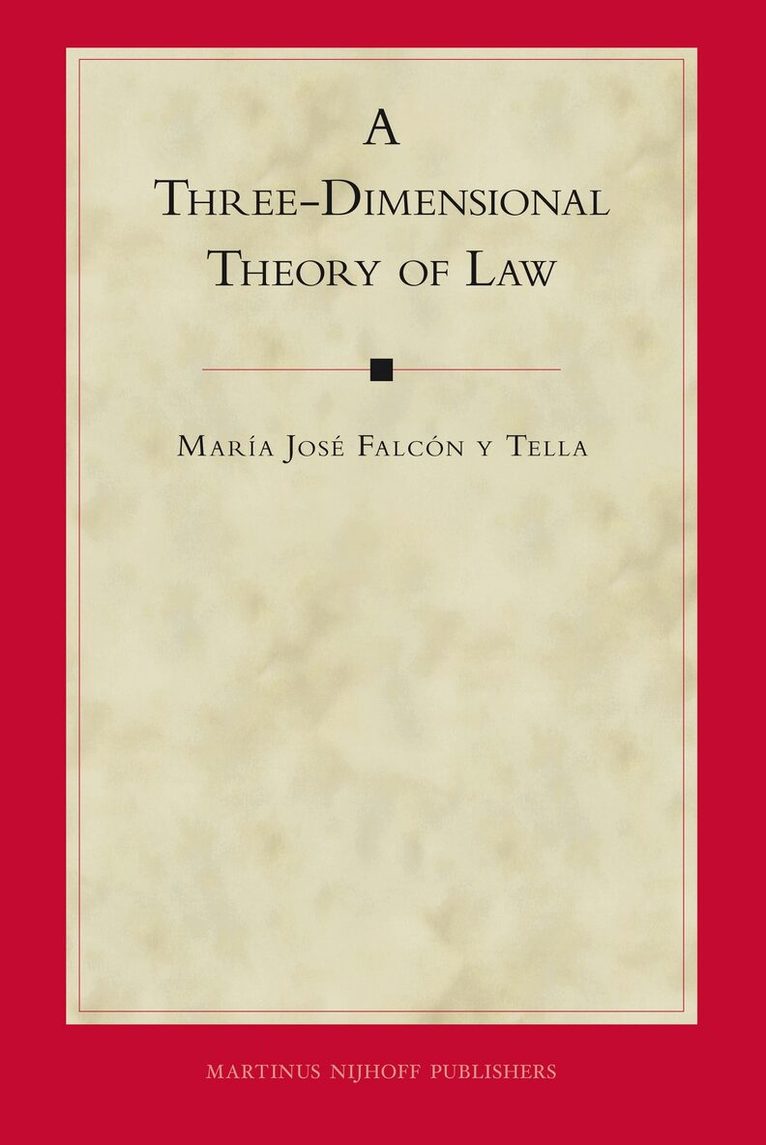
    Three-Dimensional Theory of Law

    AvMaría José Falcon y Tella

    Inbunden, Engelska, 2010

    Del i serien Brill | Nijhoff

    2 603 kr

    Beställningsvara. Skickas inom 5-8 vardagar. Fri frakt över 249 kr.

    Beskrivning

    What this book intends to do is to study three-dimensionalism (the distinction values-norms-facts) not in what could be called its historical dimension, but in its substantive aspect, as a “form” that, when applied to different legal themes, would add a “material content” to the three-dimensional theory. We can point out, as a study plan, the distinction between “three” perspectives: Those of the legal norm, of the legal order, and the legal relationship. Three-dimensionalism also appears in this work when one analyzes the “three” phases of the life of the law: The formation, the interpretation, and the application; and in the distinction between the “three” characteristics of the legal order: Fullness, coherence, and unity—the theory of legal validity, intended as legitimacy, as validity strictly speaking, or as effectiveness.

    Produktinformation

    • Utgivningsdatum:2010-04-27
    • Mått:160 x 240 x 27 mm
    • Vikt:820 g
    • Format:Inbunden
    • Språk:Engelska
    • Serie:Brill | Nijhoff
    • Antal sidor:376
    • Förlag:Brill
    • ISBN:9789004179325

    Utforska kategorier

    • Internationell rätt inom Juridik

    Mer om författaren

    María José Falcón y Tella is Professor of Legal Philosophy (1991) and Director of the Institute of Human Rights (1998) at the Complutense University of Madrid. She is the author of 20 books, many of them translated into different languages, such as Civil Disobedience (Nijhoff, 2004), Punishment and Culture (Nijhoff, 2006), and Equity and Law (Nijhoff, 2008). She was awarded 'The National Prize of Studies in Law' in 1987.

    Innehållsförteckning

    • I. INTRODUCTIONChapter 1 Different Perspectives from which to Approach the Concept of Law1. The Diff erence between Formal and Material Perspectives2. Formal Perspective: The Three-dimensional Method in the Study of Law3. Material PerspectiveII. THEORY OF THE LEGAL NORMChapter 2 Concept of the Legal Norm1. Defining the Legal Norm as Compared with Other Types of Norms2. Structure of the Legal NormChapter 3 Analytical-Linguistic Consideration of the Legal Norm, as a Prescriptive Proposition1. Initial Considerations Regarding this Process of Analysis2. The Concept of Proposition and how it Diff ers from Other Concepts3. Types of Propositions. The Traditional Approach and Enrico Pattaro’s ApproachChapter 4 Classifi cations of the Legal Norms1. Primary and Secondary Norms. Historical Criteria for Differentiation2. Other Classifi cation Criteria for Legal NormsIII. THEORY OF THE LEGAL ORDERA) Moments or Phases in the Life of the Legal Order: The Formation, the Interpretation, and the ApplicationChapter 5 Formation of the Legal Order: Theory of the Sources of Law1. The Sources of Law2. Communitarian Law3. Written Law as the Principal Source in the Roman-Germanic System4. Custom as a Spontaneous Reiteration of the Acts of the People5. General Principles of Law6. Case Law7. Contracts8. JurisprudenceChapter 6 Interpretation of the Legal Order1. Interconnection between the Processes of Application and Interpretation of Law2. The concept of Interpretation. Elements3. Types of InterpretationChapter 7 Application of the Legal Order1. Analogy2. Equity3. Other Types of Legal ArgumentsChapter 8 The Completeness of the Legal Order. Gaps in the Law1. Principal Theories Utilized by the Legal Order’s Dogma of Completeness2. The Problem of Gaps in the LawChapter 9 The Coherence of the Legal Order. Legal Antinomies1. The Concept of System2. The Problem of AntinomiesChapter 10 The Unity of the Legal Order. The Validity of the Law1. The Suitability of the Three-dimensional Approach with Regards to the Topic of Validity2. The Concept of ValidityChapter 11 The Deontological or Naturalist Foundation of Validity1. Relations Existing in the Matter of Validity2. Some Natural Law TheoriesChapter 12 Positivist Foundation of Validity1. Relations Existing on the Subject of Validity2. Main Positivist TheoriesChapter 13 Realist Basis of Validity1. Relations Existing on the Subject of Validity2. Principal Realist TheoriesChapter 14 Problems Resolved by Considering Law From the Perspective of the Legal Order1. The Term “Legal Order”2. Problems Resolved by Considering Law from the Perspective of the Legal OrderIV. THEORY OF THE LEGAL RELATIONSHIPChapter 15 The Legal Relationship1. Historical Formulation of the Concept of the Legal RelationshipF. C. von Savigny’s Elaboration of the Concept in his Work System desHeutingen römischen Rechts2. Defi nition of The Legal Relationship: The Concepts of Legal Situation, Legal Act, and Legal Transaction3. Structure of the Legal Relationship: Elements4. Content of the Legal Relationship5. Types of Legal RelationshipsChapter 16 Right as a Part of the Legal Relationship1. The Law (“Norma Agendi”) – Right (“Facultas Agendi”) Comparison2. The Doctrinal Development of the Idea of Right3. Limits on the Exercise of RightsBibliography; Index.