• Fri frakt över 249 kr
  • •
  • Snabba leveranser
  • •
  • Billiga böcker
Kundservice

Du är på sajten för privatpersoner.

Företag, bibliotek eller offentlig verksamhet?

Du handlar på classic.bokus.com, där alla dina funktioner finns intakta.
Till classic.bokus.com
Bokus logotyp. Gå till startsidan.
  • Erbjudanden
  • Nyheter
  • Student
  • Topplistor
  • Barn & ungdom
  • Bokus Play
  • E-böcker
  • Pocketböcker
  • Spel & pussel

10% rabatt på allt med kod: NYSTART10 →

Sidfot

Mina sidor

    Hjälp

    • Kundservice
    • Vanliga frågor och svar
    • Frakt och leverans
    • Retur vid ångerrätt
    • Reklamera vara
    • Betalning
    • Köpvillkor
    • Allmänna villkor
    • Information om webbplatsens tillgänglighet

    Om Bokus

    • Om oss
    • Pressrum
    • För studenter
    • För företag
    • För bibliotek och offentlig verksamhet
    • För leverantörer
    • Hållbarhet

    Populärt

    • Aktuella erbjudanden
    • Presentkort
    • Studentlitteratur
    • Nya böcker
    • Topplistor
    • Signerade böcker
    • Engelska böcker

    Inspiration

    • Boktips
    • BookTok
    • Populära bokserier
    • Barnbokskaraktärer
    • Populära författare
    Logotyp för Bokus
    Följ oss på Facebook (extern länk)Följ oss på Instagram (extern länk)Följ oss på YouTube (extern länk)Följ oss på TikTok (extern länk)
    bokus @ CookiesAnpassa cookiesIntegritetspolicyKöpvillkor
    Till Citymail hemsida (extern länk)Till Budbee hemsida (extern länk)Till Postnord hemsida (extern länk)Till Schenker hemsida (extern länk)Till Early Bird hemsida (extern länk)Till Walleys hemsida (extern länk)
    1. Språk och ordböcker
    2. Språk: referensverk och allmänt
    3. Språk: historia och allmänt

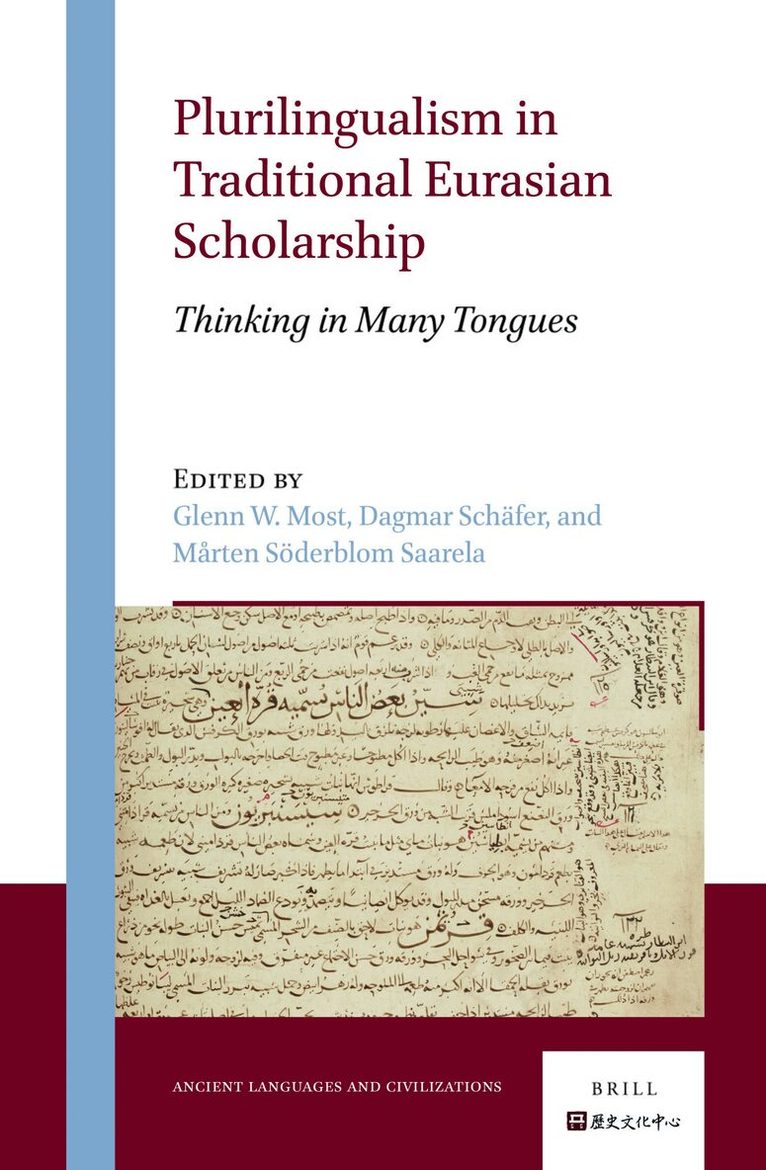
    Plurilingualism in Traditional Eurasian Scholarship

    Thinking in Many Tongues

    AvGlenn W. Most

    Inbunden, Engelska, 2023

    Del 3 i serien Ancient Languages and Civilizations

    2 576 kr

    Beställningsvara. Skickas inom 5-8 vardagar. Fri frakt över 249 kr.

    Beskrivning

    Was plurilingualism the exception or the norm in traditional Eurasian scholarship? This volume presents a selection of primary sources—in many cases translated into English for the first time—with introductions that provide fascinating historical materials for challenging notions of the ways in which traditional Eurasian scholars dealt with plurilingualism and monolingualism. Comparative in approach, global in scope, and historical in orientation, it engages with the growing discussion of plurilingualism and focuses on fundamental scholarly practices in various premodern and early modern societies—Chinese, Indian, Mesopotamian, Jewish, Islamic, Ancient Greek, and Roman—asking how these were conceived by the agents themselves. The volume will be an indispensable resource for courses on these subjects and on the history of scholarship and reflection on language throughout the world.

    Produktinformation

    • Utgivningsdatum:2023-04-20
    • Mått:155 x 235 x 37 mm
    • Vikt:956 g
    • Format:Inbunden
    • Språk:Engelska
    • Serie:Ancient Languages and Civilizations
    • Antal sidor:484
    • Förlag:Brill
    • ISBN:9789004464667

    Utforska kategorier

    • Språk: historia och allmänt inom Språk och ordböcker
    • Språkvetenskap och lingvistik inom Språk och ordböcker

    Mer om författaren

    Glenn W. Most, PhD (Yale/Tübingen, 1980) is a classicist and comparatist. He retired in November 2020 as Professor of Greek Philology at the Scuola Normale Superiore di Pisa and remains a regular Visiting Professor on the Committee on Social Thought (University of Chicago) and External Scientific Member of the MPIGW, Berlin. He has published numerous articles and books on Classics, philosophy, the history of religion, and comparative literature, among other fields.Dagmar Schäfer, PhD (University of Würzburg, 1996) is a sinologist and historian of science. She is Director of Department 3 (Artifacts, Action, Knowledge) at the MPIWG, Berlin, and Honorary Professor at Freie Universität Berlin. Author of The Crafting of the 10,000 Things (University of Chicago Press, 2011), she has published widely on the premodern history of China (Song–Ming) and the changing role of artifacts in the creation, diffusion, and use of scientific and technological knowledge.Mårten Söderblom Saarela, PhD (Princeton University, 2015) is a historian of the Qing empire and Associate Research Fellow at the Institute of Modern History, Academia Sinica, Taipei. He is the author of The Early Modern Travels of Manchu: A Script and Its Study in East Asia and Europe (Penn, 2020), and co-editor of Saksaha: A Journal of Manchu Studies.

    Innehållsförteckning

    • List of IllustrationsNotes on ContributorsIntroductionGlenn W. Most, Dagmar Schäfer and Michele LoporcaroPart 1 Language Diversity1.1 IntroductionGlenn W. Most1.2 The Tower of Babel (Genesis 11:1–9)Joel S. Baden1.3 A 5th-Century BCE Greek Historian Discusses the Pelasgians and the Origins of the Greek LanguageHerodotus, HistoriesFilippomaria Pontani1.4 Language Arose from Spontaneous Feelings and Reactions to NatureThe Doctrine of Epicurus (4th Century BCE) and Lucretius (1st Century BCE)Filippomaria Pontani1.5 Language Diversity Is a Result of Social InteractionXunzi’s View on Plurilingualism in 3rd-Century BCE ChinaDagmar Schäfer1.6 Language Is a Collective Product of MankindDiodorus of Sicily, Library of History (1st Century BCE)Filippomaria Pontani1.7 A 1st-Century BCE/CE Greek Geographer Discusses What a “Barbarian” Language Is in Terms of Homer and the CariansStrabo, GeographyFilippomaria Pontani1.8 Plurilingualism in China and Inner Asia in the 12th Century CE“Khitan Reciting Poetry”Mårten Söderblom SaarelaPart 2 Etymology2.1 IntroductionGlenn W. Most, Dagmar Schäfer and Michele Loporcaro2.2 An Early Post-Vedic Treatise on the Etymological Explanation of WordsYāska, EtymologyJohannes Bronkhorst2.3 A 4th-Century BCE Greek Philosophical Analysis of the Methods and Limits of EtymologyPlato, CratylusGlenn W. Most2.4 A 1st-Century BCE Roman Polymath’s Explanation of the Mysteries of LatinVarro, On the Latin LanguageGlenn W. Most and Michele Loporcaro2.5 A 1st-Century CE Stoic Etymological and Allegorical Explanation of Greek GodsCornutus, Compendium of Greek TheologyGlenn W. Most2.6 Zheng Xuan and Commentarial Etymology (2nd Century CE)Dagmar Schäfer2.7 Etymology in the Most Important Reference Encyclopedia of Late Antiquity (ca. 600 CE)Isidore of Seville, EtymologiesMichele Loporcaro and Glenn W. Most2.8 Buddhist Etymologies from First-Millennium India and ChinaWorks by Vasubandhu, Sthiramati and ParamārthaRoy Tzohar2.9 An Influential Latin Dictionary and Its Etymologies (12th Century CE) in the Linguistic Landscape of Medieval EuropeHugutio of Pisa’s DerivationesMichele LoporcaroPart 3 Lexicography3.1 IntroductionMårten Söderblom Saarela3.2 Lexicality and Lexicons from MesopotamiaMarkham J. Geller3.3 Translating Oriental Words into GreekA Papyrus Glossary from the 1st Century CEFilippomaria Pontani3.4 The Making of Monolingual DictionariesThe Prefaces to the Lexica of Hesychius (6th Century CE) and Photius (9th Century CE)Filippomaria Pontani3.5 A 10th-Century CE Byzantine Encyclopedia and LexiconSuda, Letter SigmaGlenn W. Most3.6 A Dictionary of the Imperial CapitalShen Qiliang’s Da Qing quanshu (1683)Mårten Söderblom SaarelaPart 4 Translation4.1 IntroductionDagmar Schäfer and Markham J. Geller4.2 Translators of SumerianThe Unsung Heroes of Babylonian ScholarshipMarkham J. Geller4.3 The Earliest and Most Complete Story of the Translation of the Pentateuch into Greek (2nd Century BCE)The Letter of AristeasBenjamin G. Wright III4.4 “Faithful” and “Unfaithful” TranslationsThe Greco-Latin Tradition in Jerome’s Letter to Pammachius (395/396 CE)Filippomaria Pontani4.5 A 4th-Century CE Buddhist Note on Sanskrit-Chinese TranslationDao’an’s Preface to the Abridgement of the Mahāprajñāpāramitā SūtraBill M. Mak4.6 An 8th-Century CE Indian Astronomical Treatise in ChineseThe Nine Seizers Canon by Qutan XidaBill M. Mak4.7 Two 8th-Century CE Recensions of Amoghavajra’s Buddhist Astral Compendium, Treatise on Lunar Mansions and PlanetsBill M. Mak4.8 Arabic and Arabo-Latin Translations of Euclid’s ElementsSonja BrentjesPart 5 Writing Systems5.1 IntroductionDagmar Schäfer, Markham J. Geller and Glenn W. Most5.2 A 4th-Century BCE Greek Philosophical Myth about the Egyptian Origins of WritingPlato, PhaedrusGlenn W. Most5.3 A Buddhist Mahāyāna Account of the Coming into Being of LanguageThe Descent into Laṅkā Scripture (Laṅkāvatārasūtra)Roy Tzohar5.4 Stories of OriginIbn al-Nadīm, Kitāb al-FihristSonja Brentjes5.5 Inventing or Adapting Scripts in Inner AsiaThe Jin and Yuan Histories and the Early Manchu Veritable Records Juxtaposed (1340s–1630s)Mårten Söderblom Saarela5.6 An Essay on the Use of Chinese and Korean Language in Late 18th-Century CE ChosŏnYu Tŭkkong, “Hyang’ŏ pan, Hwaŏ pan”Mårten Söderblom SaarelaIndex