• Fri frakt över 249 kr
  • •
  • Snabba leveranser
  • •
  • Billiga böcker
Kundservice

Du är på sajten för privatpersoner.

Företag, bibliotek eller offentlig verksamhet?

Du handlar på classic.bokus.com, där alla dina funktioner finns intakta.
Till classic.bokus.com
Bokus logotyp. Gå till startsidan.
  • Erbjudanden
  • Nyheter
  • Student
  • Topplistor
  • Barn & ungdom
  • Bokus Play
  • E-böcker
  • Pocketböcker
  • Spel & pussel

Må bättre, för mindre! Upp till 50% rabatt på hälsoböcker

Sidfot

Mina sidor

    Hjälp

    • Kundservice
    • Vanliga frågor och svar
    • Frakt och leverans
    • Retur vid ångerrätt
    • Reklamera vara
    • Betalning
    • Köpvillkor
    • Allmänna villkor
    • Information om webbplatsens tillgänglighet

    Om Bokus

    • Om oss
    • Pressrum
    • För studenter
    • För företag
    • För bibliotek och offentlig verksamhet
    • För leverantörer
    • Hållbarhet

    Populärt

    • Aktuella erbjudanden
    • Presentkort
    • Studentlitteratur
    • Nya böcker
    • Topplistor
    • Signerade böcker
    • Engelska böcker

    Inspiration

    • Boktips
    • BookTok
    • Populära bokserier
    • Barnbokskaraktärer
    • Populära författare
    Logotyp för Bokus
    Följ oss på Facebook (extern länk)Följ oss på Instagram (extern länk)Följ oss på YouTube (extern länk)Följ oss på TikTok (extern länk)
    bokus @ CookiesAnpassa cookiesIntegritetspolicyKöpvillkor
    Till Citymail hemsida (extern länk)Till Budbee hemsida (extern länk)Till Postnord hemsida (extern länk)Till Schenker hemsida (extern länk)Till Early Bird hemsida (extern länk)Till Walleys hemsida (extern länk)
    1. Historia och arkeologi
    2. Historia
    3. Forntidens historia

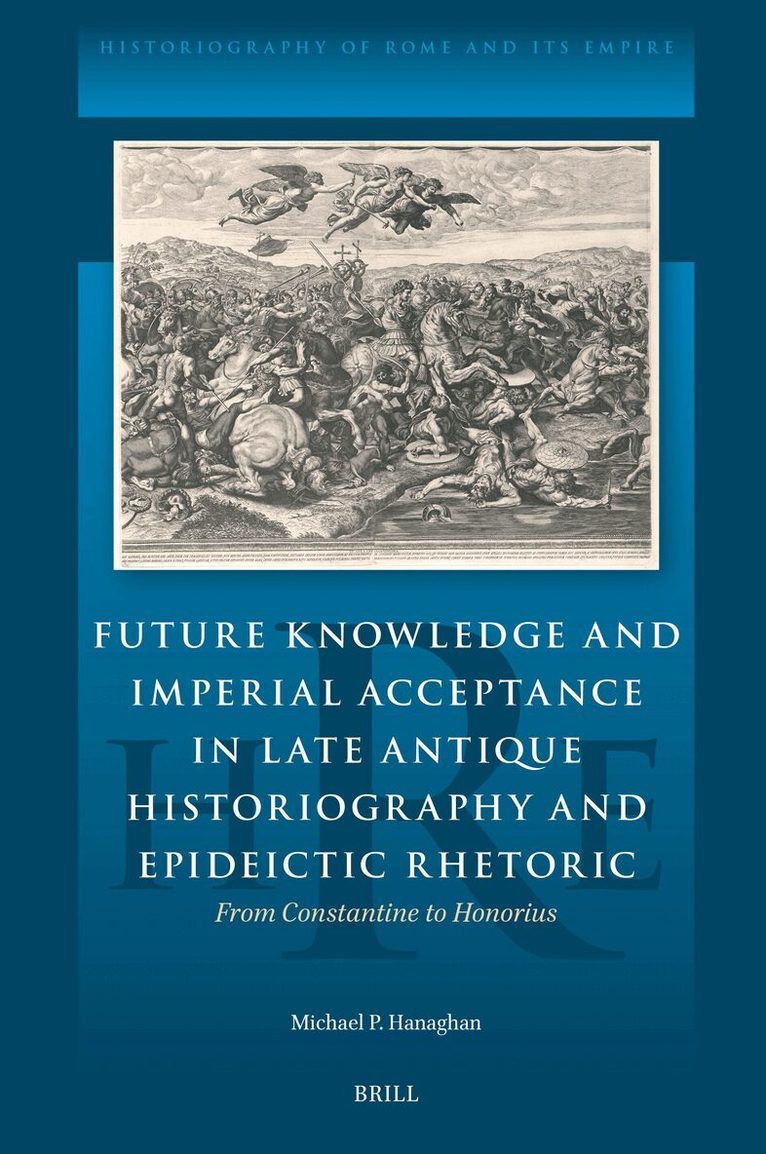
    Future Knowledge and Imperial Acceptance in Late Antique Historiography and Epideictic Rhetoric

    From Constantine to Honorius

    AvMichael Hanaghan

    Inbunden, Engelska, 2024

    Del 20 i serien Historiography of Rome and Its Empire

    1 912 kr

    Beställningsvara. Skickas inom 3-6 vardagar. Fri frakt över 249 kr.

    Beskrivning

    This book analyses late antique historiography and epideictic texts, focusing on how divine knowledge of imperial futures safeguarded the legitimacy of Roman emperors. It begins with Constantine and his tetrarchic colleagues (A), before moving to Constantius II and Julian (B), then Valens (C), and ending with Theodosius and Honorius (D).The impact of future knowledge in these texts could be felt both in the present circumstances of their composition and in perpetuity, as visions of the future reflect either the confidence or boastful arrogance of history’s protagonists, their divine inspiration or doom, and ultimately, their place in imperial memory.

    Produktinformation

    • Utgivningsdatum:2024-12-19
    • Mått:155 x 235 x 25 mm
    • Vikt:623 g
    • Format:Inbunden
    • Språk:Engelska
    • Serie:Historiography of Rome and Its Empire
    • Antal sidor:288
    • Förlag:Brill
    • ISBN:9789004714786

    Utforska kategorier

    • Forntidens historia inom Historia och arkeologi

    Mer om författaren

    Michael P. Hanaghan, Ph.D.(2015), Sydney, is Senior Research Fellow at the Institute for Religion and Critical Inquiry, Australian Catholic University, Melbourne. He has published predominantly on Late Antique literature, including numerous articles and the monograph Reading Sidonius’ Epistles (CUP, 2019).

    Innehållsförteckning

    • Historiography of Rome and Its Empire SeriesPrefaceAcknowledgmentsIntroduction1 Forms of Future Knowledge in Late Antiquity2 The Politicisation of Future Knowledge3 Late Antique Historiography and Epideictic Rhetoric4 Divine, Future Knowledge and Imperial Representation5 The Acceptance Model and Divine, Future Knowledge in Late Antiquity6 ScopePart 1: Constantine and the Tetrarchy1 A Metamorphosis from Pan. Lat.7(6) to 4(10)1 Introduction2 Pan. Lat. 7(6) Constantine’s Marriage to Fausta3 Pan. Lat. 6(7) and Constantine’s Vision of Apollo4 Pan. Lat. 12(9) and Constantine’s Victory at the Milvian Bridge5 Conclusion2 Divine Acceptance in Lactantius’ De mort. pers.1 Introduction2 Diocletian, Galerius, and the Beginning of the Great Persecution3 Constantine, Maxentius, and the Battle of the Milvian Bridge4 Licinius, Maximin Daza and the Battle of Tzirallum5 Conclusion3 Divine Acceptance in Eusebius’ Historia Ecclesiastica1 Introduction2 Dating Books 8–103 Eusebius’ Introduction of Maxentius and Maximin Daza in Book 84 Parallel Defeats and the Failure of Pagan Divine Knowledge in Book 95 Licinius: the Final Tyrant, a First Attempt in Book 106 Conclusion4 Imperial Memory in Eusebius’ Epideixeis (De laud. Const. and Vit. Const)1 Introduction2 Constantine, Christ, and Future Knowledge in Eusebius’ De laudibus Constantini3 The Great Persecution and Constantine’s Escape4 Maxentius, Licinius, and Eusebius’ Historical Revisionism5 ConclusionPart 2: Constantius II and Julian5 Julian’s Divination in Libanius’ Contemporary Discourse (Or. 13, 12, 15)1 Introduction2 Julian’s Rise and the Announcement of Constantius’ Death (Or. 13)3 Constantius vs Julian, Augustus and Sacrificial Priest (Or. 12)4 Philanthropia and the Friendship of the Gods (Or. 15)5 Conclusion6 Gregory Nazianzus’ Creation of a Discourse against Julian (Or. 4–5)1 Introduction2 Paideia, Rhetoric and Gregory’s Historicising Ambition (Or. 4)3 Julian’s Katabasis, Mock Epic and the Making of Imperial Memory4 The Destruction of the Temple in Jerusalem in Or. 55 Julian’s Death and the Failure of Divine Knowledge in Or. 56 Conclusion7 Remembering Julian in Libanius’ Retrospection (Or. 18)1 Introduction2 The Date of Or. 18 and Its Relationship to Gregory Nazianzus’ Or. 4 and 53 Julian’s Success in Gaul4 Julian’s Acclamation5 The Death of Constantius6 Julian’s Persian Campaign7 Conclusion8 Ammianus’ Constantius II and Julian; Divine Acceptance and the Politics of Rome1 Introduction2 Constantius’ Anxious Paranoia (Amm. Marc. 14–19)3 Julian vs Constantius (Amm. Marc. 20–21)4 Constantius’ Legislation against Divination and His Legacy5 Constantius and the Altar of Victory6 Conclusion9 Ecclesiastical Historiography and the Denial of Julian’s Divine Acceptance1 Introduction2 The Martyrion of St. Babylas and the Temple of Apollo3 The Martyrion of St. Mammas4 The Destruction of the Temple in Jerusalem5 Julian’s Body, Christ’s Coffin, and the Embodiment of Imperial Memory6 Julian’s Funerary Procession and the Display of Imperial Unacceptance7 ConclusionPart 3: Valens10 Ammianus’ Valens: Antioch, Thrace, and the Barbarian Future of Rome1 Introduction2 Valentinian I and the Treason Trials at Rome3 The Magic Trials at Antioch and Valens’ Failure to Obtain Elite Acceptance4 Barbarians in Thrace and the Shades of Valens’ Victims5 Conclusion11 Antioch to Adrianople in the Nicene Criticism of Valens’ Acceptance1 Introduction2 Socrates Scholasticus, Sozomen, and the Denial of Valens’ Divine Acceptance3 Christian Predictions and the Battle of Adrianople4 ConclusionPart 4: Theodosius and Honorius12 Theodosius and the Battle of the Frigidus in Ecclesiastical Historiography1 Introduction2 Eugenius and Flavianus’ Divinatory Knowledge3 John of Thebes, a Christian Counter-Prediction4 Eugenius’ Death5 Conclusion13 The Antitheses of Honorius’ Court: Rufinus, Gildo, and Eutropius in Claudian’s Epic-Epideixeis1 Introduction2 Rufinus, Magic, and the Forbidden Divine Knowledge of the Gods3 Rome’s Recent Past and Gildo’s Future4 Eutropius: Omen, Seer, Sacrifice, and a Political and Divine Anathema5 Conclusion14 Honorius, Stilicho, and Divine Acceptance in Claudian’s Panegyrics1 Introduction2 Stilicho’s First Consulship and the Shadow of Eutropius3 Stilicho and the Gothic War4 Claudian’s Panegyrics for Honorius’ Fourth and Sixth Consulships5 ConclusionEpilogueAppendix: TimelineBibliographyIndex