• Fri frakt över 249 kr
  • •
  • Snabba leveranser
  • •
  • Billiga böcker
Kundservice

Du är på sajten för privatpersoner.

Företag, bibliotek eller offentlig verksamhet?

Du handlar på classic.bokus.com, där alla dina funktioner finns intakta.
Till classic.bokus.com
Bokus logotyp. Gå till startsidan.
  • Erbjudanden
  • Nyheter
  • Student
  • Topplistor
  • Barn & ungdom
  • Bokus Play
  • E-böcker
  • Pocketböcker
  • Spel & pussel

10% rabatt på allt med kod: NYSTART10 →

Sidfot

Mina sidor

    Hjälp

    • Kundservice
    • Vanliga frågor och svar
    • Frakt och leverans
    • Retur vid ångerrätt
    • Reklamera vara
    • Betalning
    • Köpvillkor
    • Allmänna villkor
    • Information om webbplatsens tillgänglighet

    Om Bokus

    • Om oss
    • Pressrum
    • För studenter
    • För företag
    • För bibliotek och offentlig verksamhet
    • För leverantörer
    • Hållbarhet

    Populärt

    • Aktuella erbjudanden
    • Presentkort
    • Studentlitteratur
    • Nya böcker
    • Topplistor
    • Signerade böcker
    • Engelska böcker

    Inspiration

    • Boktips
    • BookTok
    • Populära bokserier
    • Barnbokskaraktärer
    • Populära författare
    Logotyp för Bokus
    Följ oss på Facebook (extern länk)Följ oss på Instagram (extern länk)Följ oss på YouTube (extern länk)Följ oss på TikTok (extern länk)
    bokus @ CookiesAnpassa cookiesIntegritetspolicyKöpvillkor
    Till Citymail hemsida (extern länk)Till Budbee hemsida (extern länk)Till Postnord hemsida (extern länk)Till Schenker hemsida (extern länk)Till Early Bird hemsida (extern länk)Till Walleys hemsida (extern länk)
    1. Naturvetenskap och teknik
    2. Teknik och industri
    3. Elektronik och kommunikationer

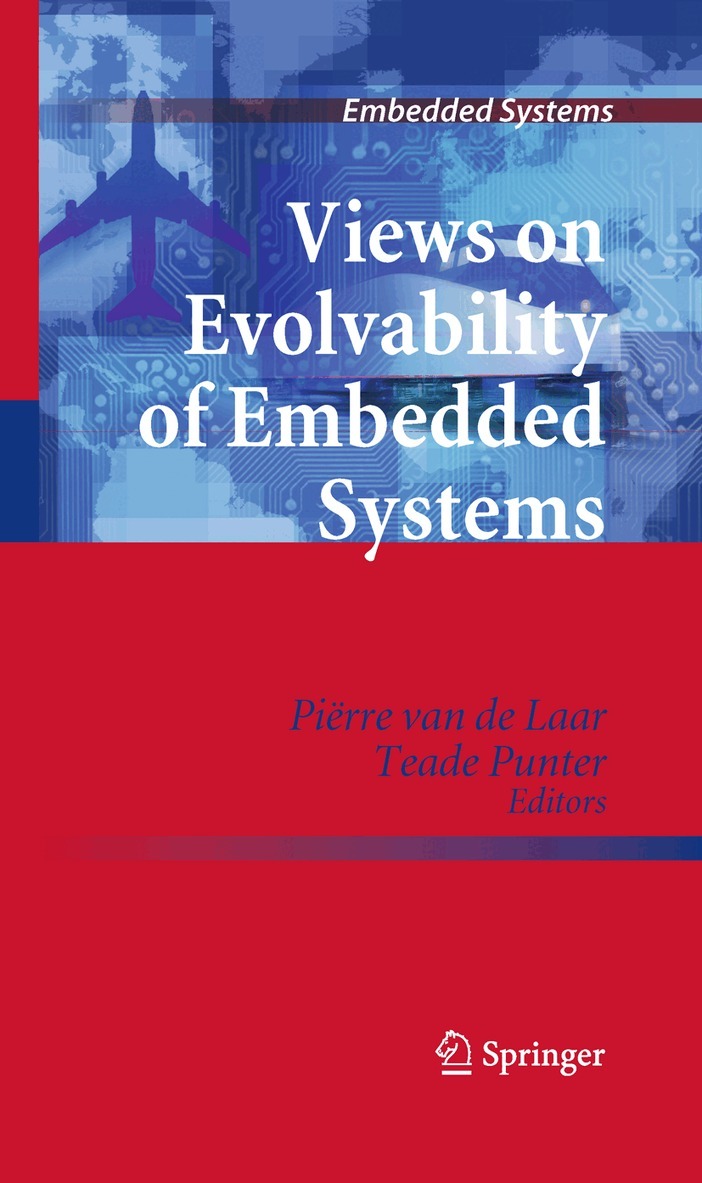
    Views on Evolvability of Embedded Systems

    AvPierre Van de Laar,Teade Punter

    Inbunden, Engelska, 2010

    Del i serien Embedded Systems

    1 625 kr

    Beställningsvara. Skickas inom 10-15 vardagar. Fri frakt över 249 kr.

    Beskrivning

    Evolvability, the ability to respond effectively to change, represents a major challenge to today's high-end embedded systems, such as those developed in the medical domain by Philips Healthcare. These systems are typically developed by multi-disciplinary teams, located around the world, and are in constant need of upgrading to provide new advanced features, to deal with obsolescence, and to exploit emerging enabling technologies. Despite the importance of evolvability for these types of systems, the field has received scant attention from the scientific and engineering communities.Views on Evolvability of Embedded Systems focuses on the topic of evolvability of embedded systems from an applied scientific perspective. In particular, the book describes results from the Darwin project that researched evolvability in the context of Magnetic Resonance Imaging (MRI) systems. This project applied the Industry-as-Laboratory paradigm, in which industry and academia join forces to ensure continuous knowledge and technology transfer during the project’s lifetime. The Darwin project was a collaboration between the Embedded Systems Institute, the MRI business unit of Philips Healthcare, Philips Research, and five Dutch universities.Evolvability was addressed from a system engineering perspective by a number of researchers from different disciplines such as software-, electrical- and mechanical engineering, with a clear focus on economic decision making. The research focused on four areas: data mining, reference architectures, mechanisms and patterns for evolvability, in particular visualization & modelling, and economic decision making. Views on Evolvability of Embedded Systems is targeted at both researchers and practitioners; they will not only find a state-of-the-art overview on evolvability research, but also guidelines to make systems more evolvable and new industrially-validated techniques to improve the evolvability of embeddedsystems.

    Produktinformation

    • Utgivningsdatum:2010-10-29
    • Mått:155 x 235 x 25 mm
    • Vikt:636 g
    • Format:Inbunden
    • Språk:Engelska
    • Serie:Embedded Systems
    • Antal sidor:316
    • Förlag:Springer
    • ISBN:9789048198481

    Utforska kategorier

    • Elektronik och kommunikationer inom Naturvetenskap och teknik
    • Nätverk och kommunikation inom Data och IT

    Mer om författaren

    Pierre van de Laar studied at the Catholic University of Nijmegen and was awarded his master degree (cum laude) in both theoretical and computational physics in 1994 and his PhD on 'Selection in Neural Information Processing' in 1999. He was a senior researcher at Philips Research in Eindhoven. Since 2006, he is a Research Fellow of the Embedded Systems Institute. After performing a study for DaimlerChrysler, he joined the Darwin project. Teade Punter received a M.Sc (Ir.) from University of Twente in 1991 and a Ph.D. from Eindhoven University of Technology in 2001. He worked at the Open University of the Netherlands, Kema Nederland B.V., Fraunhofer IESE and Eindhoven University of Technology. He has dealt with a variety of topics in software and systems engineering, e.g., software measurement and assessment. Teade is a Knowledge Manager at ESI for multiple projects, including the Darwin project. Teade's interests are in model driven engineering, integration & test and technology transfer.

    Recensioner i media

    'We were shown the benefits of modeling and visualization and how these could be actively used to move us towards a "right-by-design" way of working' Fons Gijselhart (Vice President Philips Healthcare MRI Systems)

    Innehållsförteckning

    • Foreword; Fons Gijselhart. Preface; Boudewijn Haverkort. Acknowledgements; Darwin team. 1 Researching evolvability; P.vd Laar, et al. 2 Architecting for improved evolvability; P. America, et al. 3 Complementing software documentation; P.vd Spek, et al. 4 Identifying and investigating evolution type decomposition weaknesses; A.Vanya, et al. 5 Transferring evolutionary couplings to industry; P.van de Laar. 6 An execution viewpoint catalog for software-intensive and embedded systems; T.B.Callo Arias. 7 Researching reference architectures; G.Muller, P.van de Laar. 8 A3-Architecture Overviews; P.D.Borches. 9 Linking requirements and implementation; A.U.Douglas. 10 Workflow modelling of intended system use; T.van Beek, T.Tomiyama. 11 Supervisory control synthesis in the medical domain; R.Theunissen, et al. 12 Creating high-quality behavioral designs for software-intensive systems; G.Gulişir, et al. 13 Verifying runtime reconfiguration requirements on UML models; S.Ciraci, et al. 14 Scheduling in MRI scans processing; E.Ivanov, et al. 15 Strategy-focused architecture decision making; A.Ivanovic, P.America. 16 Balancing time-to-market and quality in evolving embedded systems; P.vd Spek, C.Verhoef. 17 Industrial Impact and Lessons Learned; T.Punter, P.van de Laar. 18 Conclusions; P.van de Laar et al. Annex I Darwin Publications. II List of Darwin Partners. Index.