• Fri frakt över 249 kr
  • •
  • Snabba leveranser
  • •
  • Billiga böcker
Kundservice

Du är på sajten för privatpersoner.

Företag, bibliotek eller offentlig verksamhet?

Du handlar på classic.bokus.com, där alla dina funktioner finns intakta.
Till classic.bokus.com
Bokus logotyp. Gå till startsidan.
  • Erbjudanden
  • Nyheter
  • Student
  • Topplistor
  • Barn & ungdom
  • Bokus Play
  • E-böcker
  • Pocketböcker
  • Spel & pussel

10% studentrabatt med kod TERM26

Sidfot

Mina sidor

    Hjälp

    • Kundservice
    • Vanliga frågor och svar
    • Frakt och leverans
    • Retur vid ångerrätt
    • Reklamera vara
    • Betalning
    • Köpvillkor
    • Allmänna villkor
    • Information om webbplatsens tillgänglighet

    Om Bokus

    • Om oss
    • Pressrum
    • För studenter
    • För företag
    • För bibliotek och offentlig verksamhet
    • För leverantörer
    • Hållbarhet

    Populärt

    • Aktuella erbjudanden
    • Presentkort
    • Studentlitteratur
    • Nya böcker
    • Topplistor
    • Signerade böcker
    • Engelska böcker

    Inspiration

    • Boktips
    • BookTok
    • Populära bokserier
    • Barnbokskaraktärer
    • Populära författare
    Logotyp för Bokus
    Följ oss på Facebook (extern länk)Följ oss på Instagram (extern länk)Följ oss på YouTube (extern länk)Följ oss på TikTok (extern länk)
    bokus @ CookiesAnpassa cookiesIntegritetspolicyKöpvillkor
    Till Citymail hemsida (extern länk)Till Budbee hemsida (extern länk)Till Postnord hemsida (extern länk)Till Schenker hemsida (extern länk)Till Early Bird hemsida (extern länk)Till Walleys hemsida (extern länk)
    1. Naturvetenskap och teknik
    2. Teknik och industri
    3. Elektronik och kommunikationer

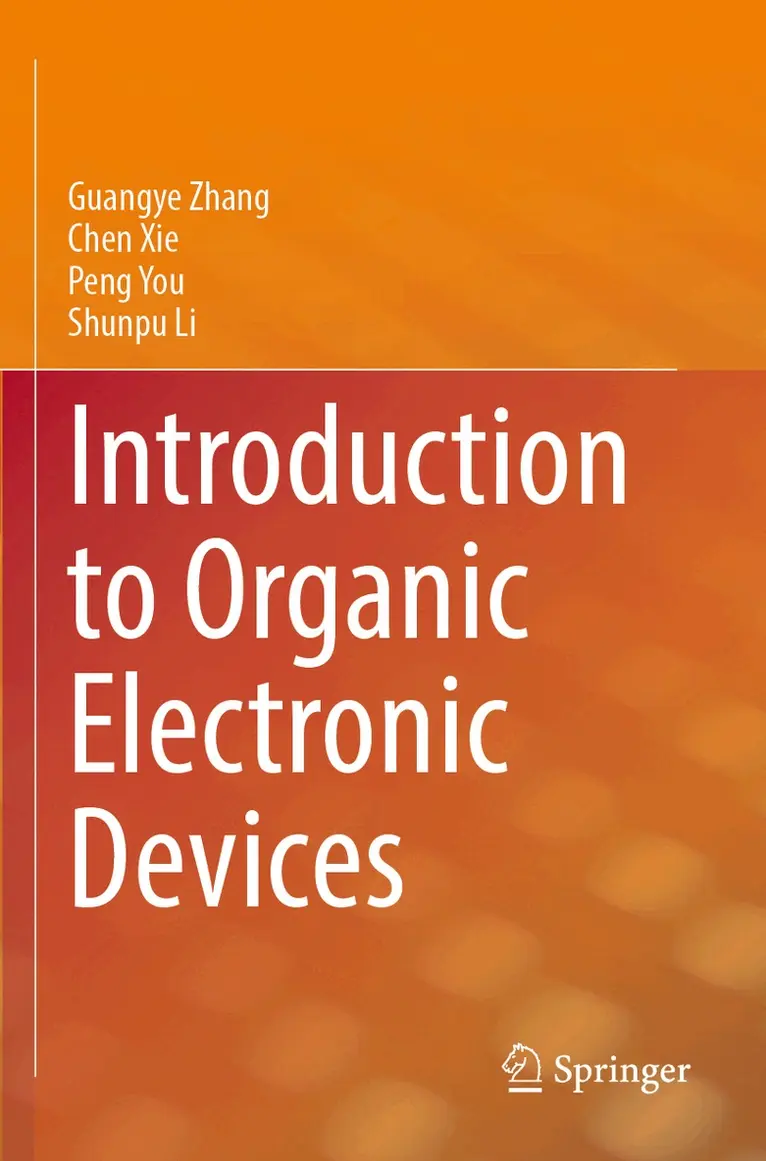
    Introduction to Organic Electronic Devices

    AvGuangye Zhang,Chen Xie

    Häftad, Engelska, 2023

    1 092 kr

    Beställningsvara. Skickas inom 10-15 vardagar. Fri frakt över 249 kr.

    Fler format och utgåvor

    Inbunden

    1 092 kr

    Beskrivning

    This book comprehensively describes organic electronic devices developed in the past decades. It not only covers the mainstream devices including organic light emitting diodes (OLEDs), organic photovoltaics (OPVs), and organic thin-film transistors (OTFTs) but also includes devices of recent interest such as organic immune transistors, organic photocatalysis devices, and themoelectrical devices. The book starts from the introduction of basic theory of organic semiconductor materials and devices, which acquaints the readers with the concepts of each type of device described in the following chapters. It also discusses the working principles, device layout, and fabrication process of these devices. The book is intended for undergraduate and postgraduate students who are interested in organic electronics, researchers/engineers working in the field of organic electronic devices/systems.

    Produktinformation

    • Utgivningsdatum:2023-10-15
    • Mått:155 x 235 x 17 mm
    • Vikt:552 g
    • Format:Häftad
    • Språk:Engelska
    • Antal sidor:307
    • Förlag:Springer Verlag, Singapore
    • ISBN:9789811960932

    Utforska kategorier

    • Elektronik och kommunikationer inom Naturvetenskap och teknik
    • Fysikalisk kemi inom Naturvetenskap och teknik
    • Materietillstånd inom Naturvetenskap och teknik

    Mer om författaren

    Dr. Guangye Zhang graduated from the University of Science and Technology of China (USTC) with a bachelor’s degree in materials physics in 2009 and received his Ph.D. degree in chemistry in 2015 from University of California, Los Angeles (UCLA), for his study in the field of organic photovoltaics under the direction of Professor Benjamin Schwartz. He worked as a postdoctoral fellow and then a research assistant professor in Professor He (Henry) Yan’s group at Hong Kong University of Science and Technology (HKUST). In 2018, he co-founded eFlexPV Limited with Professor Yan, aiming to commercialize organic photovoltaics. In 2020, he joined Shenzhen Technology University (SZTU) as an assistant professor in College of New Materials and New Energies. He has been working on organic photovoltaics since 2008 with a focus on device engineering, device and materials physics and thin-film morphology. Besides photovoltaics, hi^3000 times and an h-index of 36.Dr. ChenXie obtained his bachelor and master degrees from Tianjin University and Nanchang University, respectively. In 2020, he received his Ph.D. degree in Material Science from University of Erlangen-Nuremberg, Germany. Since Sep. 2020, he has become a research scientist in College of New Materials and New Energies, Shenzhen Technology University, China. During his Ph.D., he focused on researches of organic semiconductor nanoparticles and their applications on organic and perovskite solar cells. His recent research interest includes processing technology and morphology engineering in organic solar cells, light emitting diodes, thin-film transistors, and other organic electronics; the application of organic semiconductor nanoparticles in organic electronics and water splitting.Dr. Peng You received his B.S. and M.S. degrees in Physics from Qingdao University, Qingdao, China, in 2010 and 2013, respectively, and the Ph.D. degree in Applied Physics from The Hong Kong Polytechnic University (PolyU) in 2018. Dr. You then worked as a postdoctoral fellow in PolyU for about two years. Since Oct. 2020, Dr. You has been working as a senior research scientist in College of New Materials and New Energies, Shenzhen Technology University. Dr. You focuses on the research of 2D materials and perovskite solar cells. His recent research interests include: semi-transparent perovskite solar cells, laser annealing of organic-inorganic hybrid perovskite materials, applications of novel 2D materials in perovskite solar cells, etc. Since 2013, Dr. You has published 30 SCI papers in many international journals and have been cited for more than 2200 times, and his h-index is 19 (google scholar).Prof. Shunpu Li received his B.S. and M.S. degrees in Physics from Lanzhou University, Lanzhou, China, in 1987 and 1990, respectively, and the Ph.D. degree in Physics of Condensed Mater from The Institute of Physics, Chinese Academy of Sciences in 1993. Subsequently, he worked as postdoc researcher in Cavendish Laboratory and Nanoscience Center in University Cambridge and researcher/senior researcher in Epson Cambridge Research Laboratory and Cambridge Display Technology (CDT). In 2012, he returned back to Cambridge University through Marie-Curie Senior Fellowship. Since Nov. 2018, Dr. Li has been in College of New Materials and New Energies, Shenzhen Technology University as a professor. Dr. Li focuses on the research of organic electronics and magnetic materials and devices. His recent research interests include: organic thin-film transistor, organic photovoltaic, organic biosensors and micro/nanofabrication technology development, etc. Dr. He is named on 29 patent filings and has published 3 book chapters and over 60 papers in peer reviewed journals, such as Nature, Physical Review Letters, Advanced Materials, Nature Communication.

    Innehållsförteckning

    • The electronic process in organic electronics materials.- The fundamentals of organic photochemistry and photophysics.- Organic light emitting diodes.- Organic field effect transistors.- Organic photovoltaic devices.- Organic semiconductor laser.-Organic electrochemical devices and bio-applications.- Organic photocatalytic materials and devices.- Organic thermoelectric devices.- Organic memory and synaptic devices.- Organic-inorganic hybrid devices - Perovskite based devices.