1 834 kr
Läs direkt efter köp
1 834 kr
Läs direkt efter köp
1 105 kr
Skickas inom 10-15 vardagar
999 kr
Skickas inom 10-15 vardagar
1 654 kr
Skickas inom 10-15 vardagar
2 065 kr
Läs direkt efter köp
Inverse Problems is a monograph which contains a self-contained presentation of the theory of several major inverse problems and the closely related results from the theory of ill-posed problems. The book is aimed at a large audience which include graduate students and researchers in mathematical, physical, and engineering sciences and in the area of numerical analysis.
556 kr
Skickas inom 10-15 vardagar
556 kr
Skickas inom 10-15 vardagar
1 898 kr
Skickas inom 5-8 vardagar
684 kr
Skickas inom 5-8 vardagar
1 211 kr
Skickas inom 5-8 vardagar
The second edition of Creating Materials with a Desired Refraction Coefficient includes three new chapters and provides a recipe for creating materials with a desired refraction coefficient and solves the many-body wave scattering problem for many small impedance bodies.
4 300 kr
Skickas inom 10-15 vardagar
1 169 kr
Läs direkt efter köp
1 169 kr
Läs direkt efter köp
1 860 kr
Skickas inom 5-8 vardagar
2 120 kr
Läs direkt efter köp
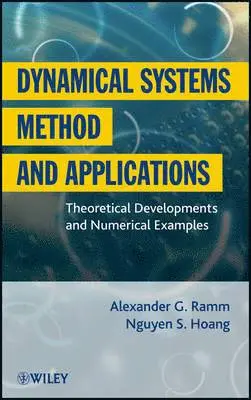
The dynamical systems method (DSM) is a powerful computational method for solving operator equations. With this book as their guide, readers will master the application of DSM to solve a variety of linear and nonlinear problems as well as ill-posed and well-posed problems. The authors offer a clear, step-by-step, systematic development of DSM that enables readers to grasp the method''s underlying logic and its numerous applications.
Dynamical Systems Method and Applications begins with a general introduction and then sets forth the scope of DSM in Part One. Part Two introduces the discrepancy principle, and Part Three offers examples of numerical applications of DSM to solve a broad range of problems in science and engineering. Additional featured topics include:
General nonlinear operator equations
Operators satisfying a spectral assumption
Newton-type methods without inversion of the derivative
Numerical problems arising in applications
Stable numerical differentiation
Stable solution to ill-conditioned linear algebraic systems
Throughout the chapters, the authors employ the use of figures and tables to help readers grasp and apply new concepts. Numerical examples offer original theoretical results based on the solution of practical problems involving ill-conditioned linear algebraic systems, and stable differentiation of noisy data.
Written by internationally recognized authorities on the topic, Dynamical Systems Method and Applications is an excellent book for courses on numerical analysis, dynamical systems, operator theory, and applied mathematics at the graduate level. The book also serves as a valuable resource for professionals in the fields of mathematics, physics, and engineering.
2 098 kr
Läs direkt efter köp
The dynamical systems method (DSM) is a powerful computational method for solving operator equations. With this book as their guide, readers will master the application of DSM to solve a variety of linear and nonlinear problems as well as ill-posed and well-posed problems. The authors offer a clear, step-by-step, systematic development of DSM that enables readers to grasp the method''s underlying logic and its numerous applications.
Dynamical Systems Method and Applications begins with a general introduction and then sets forth the scope of DSM in Part One. Part Two introduces the discrepancy principle, and Part Three offers examples of numerical applications of DSM to solve a broad range of problems in science and engineering. Additional featured topics include:
General nonlinear operator equations
Operators satisfying a spectral assumption
Newton-type methods without inversion of the derivative
Numerical problems arising in applications
Stable numerical differentiation
Stable solution to ill-conditioned linear algebraic systems
Throughout the chapters, the authors employ the use of figures and tables to help readers grasp and apply new concepts. Numerical examples offer original theoretical results based on the solution of practical problems involving ill-conditioned linear algebraic systems, and stable differentiation of noisy data.
Written by internationally recognized authorities on the topic, Dynamical Systems Method and Applications is an excellent book for courses on numerical analysis, dynamical systems, operator theory, and applied mathematics at the graduate level. The book also serves as a valuable resource for professionals in the fields of mathematics, physics, and engineering.
1 413 kr
Läs direkt efter köp
1 653 kr
Skickas inom 10-15 vardagar
710 kr
Läs direkt efter köp
718 kr
Läs direkt efter köp
1 413 kr
Läs direkt efter köp
1 104 kr
Skickas inom 10-15 vardagar
1 104 kr
Skickas inom 10-15 vardagar
1 791 kr
Skickas inom 5-8 vardagar
1 670 kr
Skickas inom 3-6 vardagar
603 kr
Skickas inom 5-8 vardagar
413 kr
Skickas inom 5-8 vardagar
369 kr
Skickas inom 10-15 vardagar
314 kr
Skickas inom 10-15 vardagar
447 kr
Läs direkt efter köp
This book gives a necessary and sufficient condition in terms of the scattering amplitude for a scatterer to be spherically symmetric. By a scatterer we mean a potential or an obstacle. It also gives necessary and sufficient conditions for a domain to be a ball if an overdetermined boundary problem for the Helmholtz equation in this domain is solvable. This includes a proof of Schiffer''s conjecture, the solution to the Pompeiu problem, and other symmetry problems for partial differential equations. It goes on to study some other symmetry problems related to the potential theory. Among these is the problem of "invisible obstacles." In Chapter 5, it provides a solution to the Navier‒Stokes problem in ℝ³. The author proves that this problem has a unique global solution if the data are smooth and decaying sufficiently fast. A new a priori estimate of the solution to the Navier‒Stokes problem is also included. Finally, it delivers a solution to inverse problem of the potential theory without the standard assumptions about star-shapeness of the homogeneous bodies.