Cor Kraaikamp – författare
Visar alla böcker från författaren . Handla med fri frakt och snabb leverans.
4 produkter
4 produkter
Inbunden, Engelska, 2002
544 kr
Skickas inom 5-8 vardagar
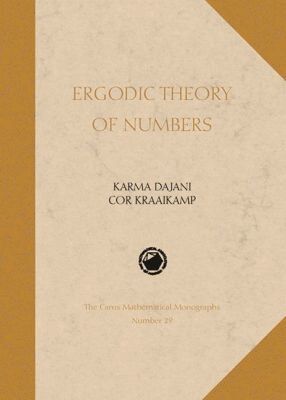
Ergodic Theory of Numbers looks at the interaction between two fields of mathematics: number theory and ergodic theory (as part of dynamical systems). It is an introduction to the ergodic theory behind common number expansions, like decimal expansions, continued fractions, and many others. However, its aim does not stop there. For undergraduate students with sufficient background knowledge in real analysis and graduate students interested in the area, it is also an introduction to a ""dynamical way of thinking"". The questions studied here are dynamical as well as number theoretical in nature, and the answers are obtained with the help of ergodic theory. Attention is focused on concepts like measure-preserving, ergodicity, natural extension, induced transformations, and entropy. These concepts are then applied to familiar expansions to obtain old and new results in an elegant and straightforward manner. What it means to be ergodic and the basic ideas behind ergodic theory will be explained along the way. The subjects covered vary from classical to recent, which makes this book appealing to researchers as well as students.
Inbunden, Engelska, 2002
1 087 kr
Skickas inom 10-15 vardagar
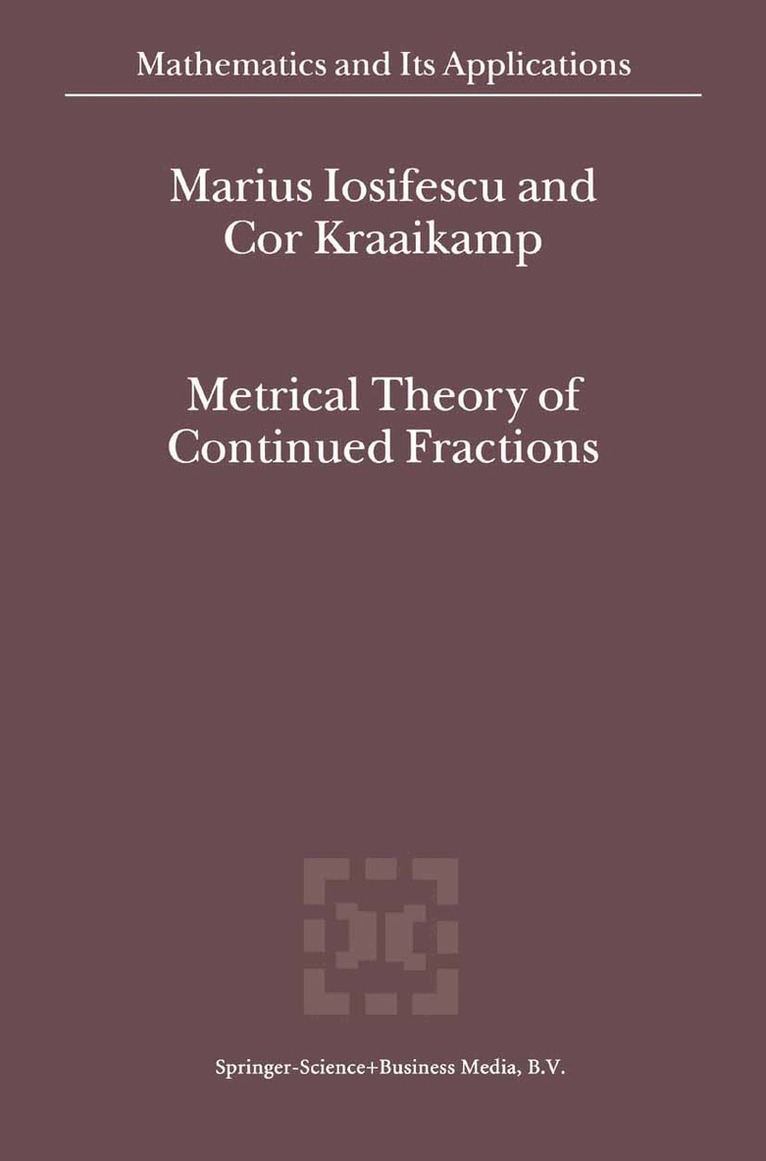
This monograph is intended to be a complete treatment of the metrical the ory of the (regular) continued fraction expansion and related representations of real numbers. We have attempted to give the best possible results known so far, with proofs which are the simplest and most direct. The book has had a long gestation period because we first decided to write it in March 1994. This gave us the possibility of essentially improving the initial versions of many parts of it. Even if the two authors are different in style and approach, every effort has been made to hide the differences. Let 0 denote the set of irrationals in I = [0,1]. Define the (reg ular) continued fraction transformation T by T (w) = fractional part of n 1/w, w E O. Write T for the nth iterate of T, n E N = {O, 1, ... }, n 1 with TO = identity map. The positive integers an(w) = al(T - (W)), n E N+ = {1,2··· }, where al(w) = integer part of 1/w, w E 0, are called the (regular continued fraction) digits of w. Writing . for arbitrary indeterminates Xi, 1 :::; i :::; n, we have w = lim [al(w),··· , an(w)], w E 0, n--->oo thus explaining the name of T. The above equation will be also written as w = lim [al(w), a2(w),···], w E O.
Häftad, Engelska, 2010
1 087 kr
Skickas inom 10-15 vardagar
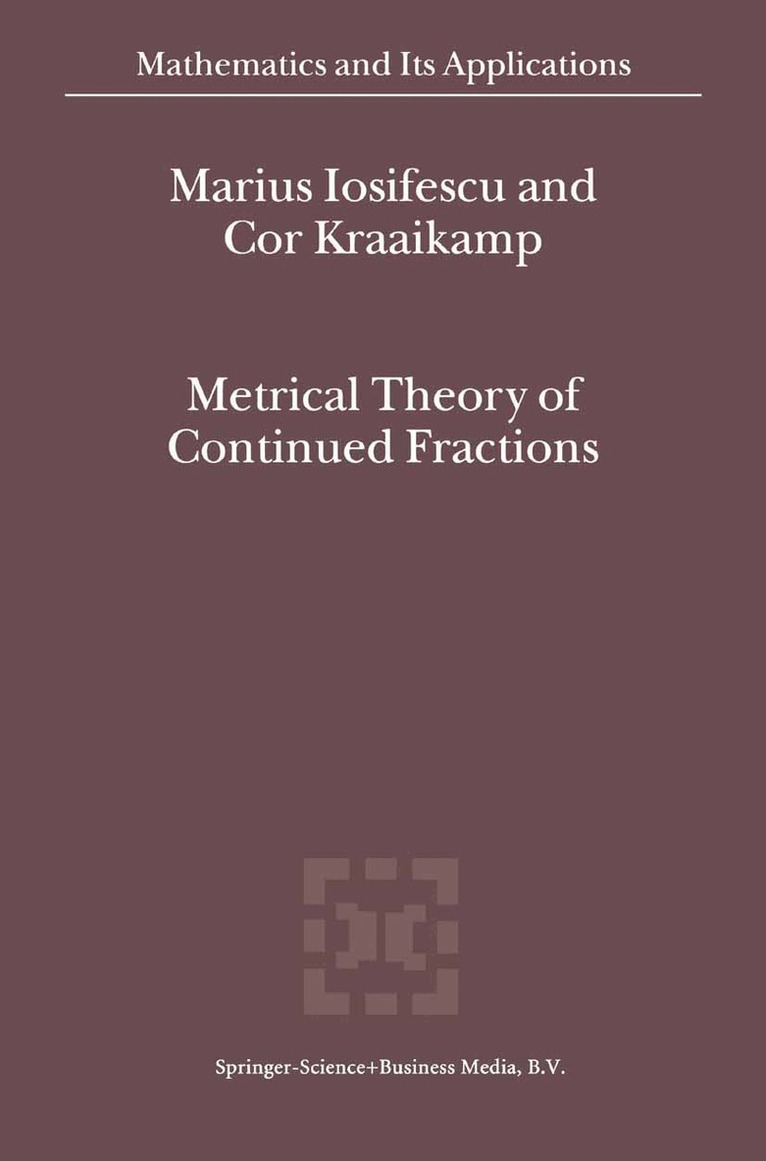
This monograph is intended to be a complete treatment of the metrical the ory of the (regular) continued fraction expansion and related representations of real numbers. We have attempted to give the best possible results known so far, with proofs which are the simplest and most direct. The book has had a long gestation period because we first decided to write it in March 1994. This gave us the possibility of essentially improving the initial versions of many parts of it. Even if the two authors are different in style and approach, every effort has been made to hide the differences. Let 0 denote the set of irrationals in I = [0,1]. Define the (reg ular) continued fraction transformation T by T (w) = fractional part of n 1/w, w E O. Write T for the nth iterate of T, n E N = {O, 1, ... }, n 1 with TO = identity map. The positive integers an(w) = al(T - (W)), n E N+ = {1,2··· }, where al(w) = integer part of 1/w, w E 0, are called the (regular continued fraction) digits of w. Writing . for arbitrary indeterminates Xi, 1 :::; i :::; n, we have w = lim [al(w),··· , an(w)], w E 0, n--->oo thus explaining the name of T. The above equation will be also written as w = lim [al(w), a2(w),···], w E O.
E-bok
PDF, Engelska, 20131 416 kr
Läs direkt efter köp
This monograph is intended to be a complete treatment of the metrical the ory of the (regular) continued fraction expansion and related representations of real numbers. We have attempted to give the best possible results known so far, with proofs which are the simplest and most direct. The book has had a long gestation period because we first decided to write it in March 1994. This gave us the possibility of essentially improving the initial versions of many parts of it. Even if the two authors are different in style and approach, every effort has been made to hide the differences. Let 0 denote the set of irrationals in I = [0,1]. Define the (reg ular) continued fraction transformation T by T (w) = fractional part of n 1/w, w E O. Write T for the nth iterate of T, n E N = {O, 1, ... }, n 1 with TO = identity map. The positive integers an(w) = al(T - (W)), n E N+ = {1,2··· }, where al(w) = integer part of 1/w, w E 0, are called the (regular continued fraction) digits of w. Writing . for arbitrary indeterminates Xi, 1 :::; i :::; n, we have w = lim [al(w),··· , an(w)], w E 0, n--->oo thus explaining the name of T. The above equation will be also written as w = lim [al(w), a2(w),···], w E O.