Deuflhard - Böcker
Visar alla böcker från författaren Deuflhard. Handla med fri frakt och snabb leverans.
2 produkter
2 produkter
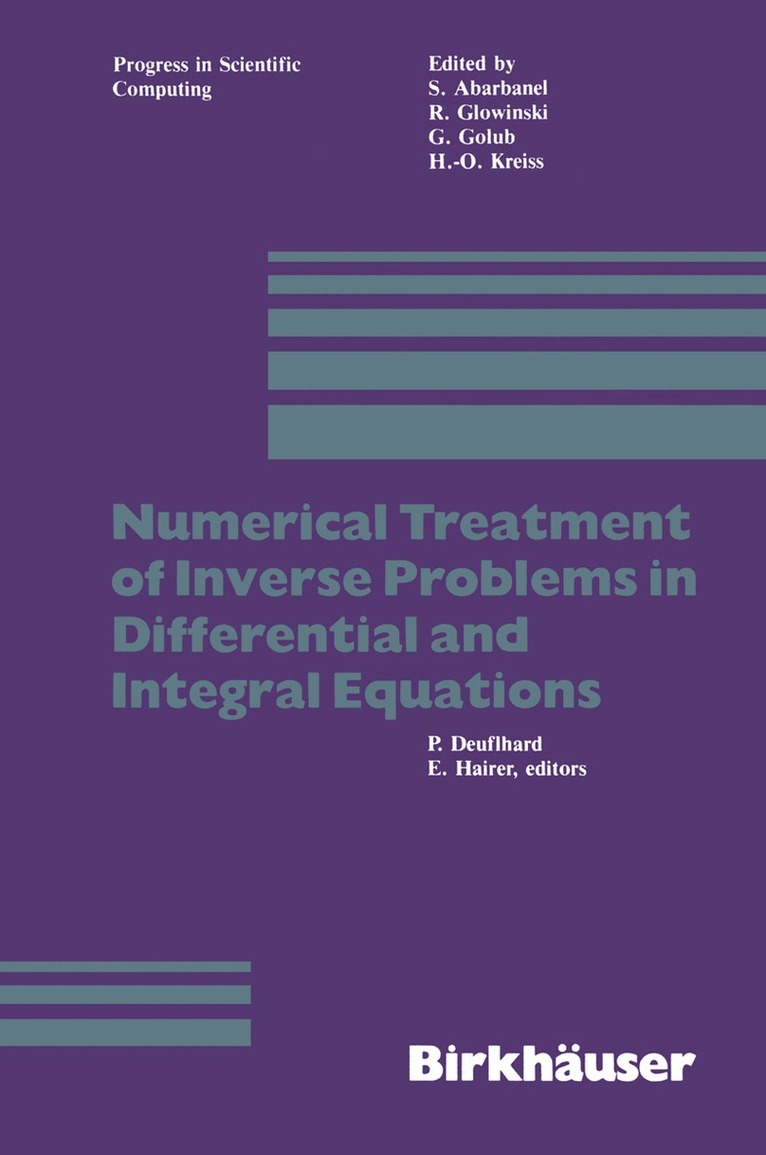
Numerical Treatment of Inverse Problems in Differential and Integral Equations
Proceedings of an International Workshop, Heidelberg, Fed. Rep. of Germany, August 30 — September 3, 1982
Häftad, Engelska, 1983
535 kr
Skickas inom 10-15 vardagar
In many scientific or engineering applications, where ordinary differen tial equation (OOE),partial differential equation (POE), or integral equation (IE) models are involved, numerical simulation is in common use for prediction, monitoring, or control purposes. In many cases, however, successful simulation of a process must be preceded by the solution of the so-called inverse problem, which is usually more complex: given meas ured data and an associated theoretical model, determine unknown para meters in that model (or unknown functions to be parametrized) in such a way that some measure of the "discrepancy" between data and model is minimal. The present volume deals with the numerical treatment of such inverse probelms in fields of application like chemistry (Chap. 2,3,4, 7,9), molecular biology (Chap. 22), physics (Chap. 8,11,20), geophysics (Chap. 10,19), astronomy (Chap. 5), reservoir simulation (Chap. 15,16), elctrocardiology (Chap. 14), computer tomography (Chap. 21), and control system design (Chap. 12,13). In the actual computational solution of inverse problems in these fields, the following typical difficulties arise: (1) The evaluation of the sen sitivity coefficients for the model. may be rather time and storage con suming. Nevertheless these coefficients are needed (a) to ensure (local) uniqueness of the solution, (b) to estimate the accuracy of the obtained approximation of the solution, (c) to speed up the iterative solution of nonlinear problems. (2) Often the inverse problems are ill-posed. To cope with this fact in the presence of noisy or incomplete data or inev itable discretization errors, regularization techniques are necessary.
535 kr
Skickas inom 10-15 vardagar
In this book, the new and rapidly expanding field of scientific computing is understood in a double sense: as computing for scientific and engineering problems and as the science of doing such computations. Thus scientific computing touches at one side mathematical modelling (in the various fields of applications) and at the other side computer science. As soon as the mathematical models de scribe the features of real life processes in sufficient detail, the associated computations tend to be large scale. As a consequence, interest more and more focusses on such numerical methods that can be expected to cope with large scale computational problems. Moreover, given the algorithms which are known to be efficient on a tradi tional computer, the question of implementation on modern supercomputers may get crucial. The present book is the proceedings of a meeting on "Large Scale Scientific Computing" , that was held a t the Oberwolfach Mathematical Institute (July 14-19, 1985) under the auspices of the Sonderforschungsbereich 123 of the University of Heidelberg. Participants included applied scientists with computational interests, numerical analysts, and experts on modern parallel computers. 'l'he purpose of the meeting was to establish a common under standing of recent issues in scientific computing, especially in view of large scale problems. Fields of applications, which have been covered, included semi-conductor design, chemical combustion, flow through porous media, climatology, seismology, fluid dynami. cs, tomography, rheology, hydro power plant optimization, subwil. y control, space technology.